

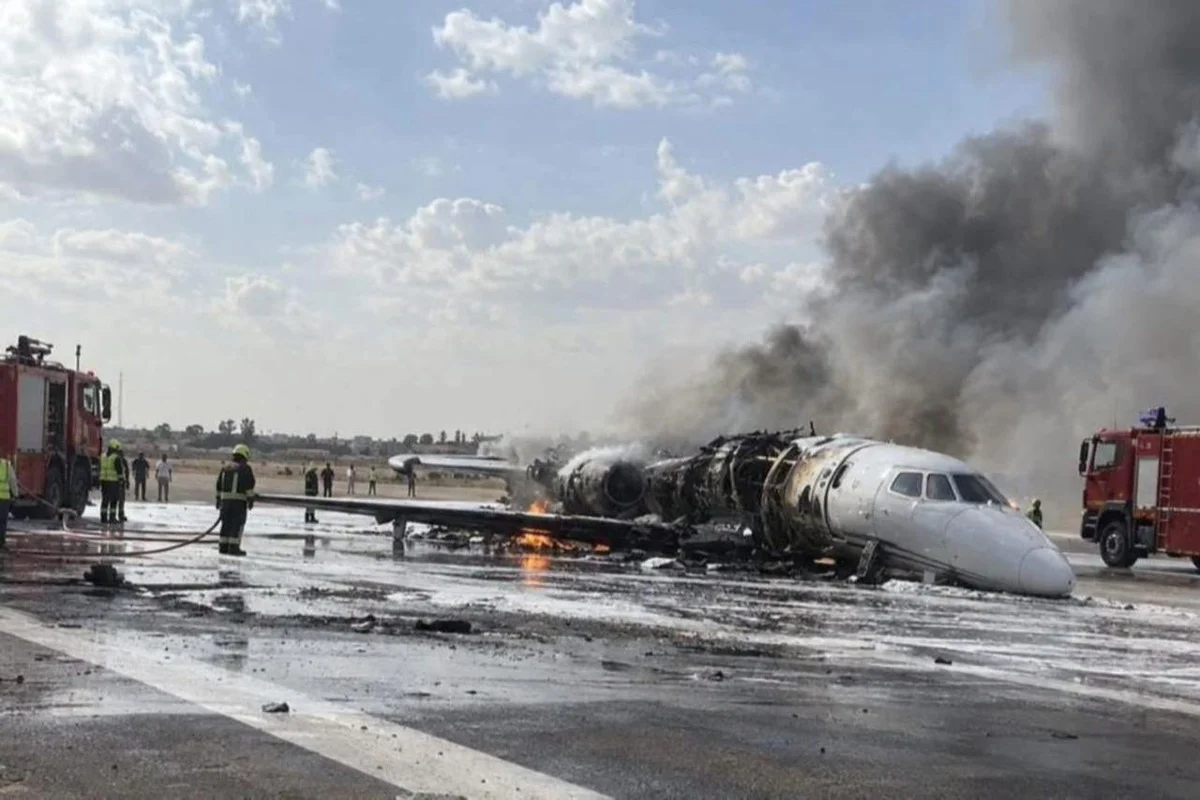
MISRATA, Libya – A routine ferry flight turned into a high-stakes legal and aviation safety confrontation this week, as Libyan prosecutors moved to detain two pilots following the fiery destruction of a Cessna Citation Latitude at Misrata International Airport (MRA). The incident, which occurred on September 14, 2026, has ignited a sharp dispute between local authorities and the aircraft’s Turkish operator, BKNJET, over the physical and mental state of the flight crew at the time of the landing.
While the physical investigation into the wreckage is in its infancy, the legal proceedings have already taken a dramatic turn, with Libyan officials alleging that the cockpit crew was under the influence of alcohol during the approach.
Main Facts: The Incident and Allegations
The aircraft, a Cessna Citation Latitude registered as TC-AKF, arrived at Misrata International Airport from Istanbul on the morning of September 14. The jet was operating as a positioning flight, carrying no passengers, with only two pilots and one flight attendant on board. The mission was intended to be a simple collection of passengers from the Libyan city.
Instead, the flight ended in disaster. Upon touchdown on Runway 15, the aircraft veered sharply off the paved surface, eventually coming to a halt before being consumed by an intense post-crash fire. Miraculously, all three crew members managed to evacuate the aircraft before the flames fully engulfed the fuselage.
Within 48 hours of the accident, the situation escalated from a routine aviation incident to a criminal matter. On September 16, Libya’s state news agency, LANA, released a statement from the Office of the Public Prosecutor, announcing that both pilots had been placed in pretrial detention. The core of the prosecution’s case rests on a grave accusation: that the pilots were intoxicated during the operation of the aircraft. Prosecutors further allege that the crew demonstrated a flagrant disregard for standard aviation safety protocols, thereby endangering not only their own lives and their flight attendant’s life but also the safety of ground personnel and infrastructure at the airport.
Chronology of Events
The timeline of the disaster and its immediate aftermath provides a window into the intensity of the ongoing investigation:
- September 14, 2026 (Morning): The Cessna Citation Latitude (TC-AKF) departs Istanbul, Turkey, bound for Misrata, Libya.
- September 14, 2026 (Landing): The aircraft makes its approach to Runway 15 at MRA. During the landing roll, the jet exits the runway environment, leading to a catastrophic structural failure and subsequent fire. The three crew members survive.
- September 15, 2026: Libyan investigative authorities begin the formal recovery of the flight data recorder (FDR) and cockpit voice recorder (CVR). The wreckage is secured and transferred to a hangar for detailed forensic examination.
- September 16, 2026: The Office of the Public Prosecutor issues a formal announcement via LANA, confirming that the crew was questioned 24 hours post-accident and that the pilots have been detained under allegations of operating an aircraft under the influence of alcohol.
- September 17, 2026: BKNJET, the Turkish operator, issues a public rebuttal, denying the claims of intoxication and stating they have received no official documentation or laboratory results to support the Libyan prosecutor’s assertions.
Supporting Data and Technical Investigation
The technical investigation is currently being spearheaded by the Libyan Civil Aviation Authority (LYCAA), which is operating in coordination with international safety standards. The recovery of the "black boxes"—the flight data recorder and the cockpit voice recorder—is considered the most critical breakthrough in determining the cause of the excursion.
According to a spokesperson for the LYCAA, these recorders are slated for transfer to a high-level specialist facility capable of decoding the encrypted flight parameters and audio logs. This process is expected to reveal whether the runway excursion was the result of mechanical failure, pilot error, or a combination of both.
Furthermore, investigators have conducted a comprehensive review of the environmental and logistical factors present at the time of the accident. This includes:
- Air Traffic Control (ATC) Logs: Transcripts of communications between the tower and the flight deck are being scrutinized for signs of distress or cognitive impairment.
- Weather Analysis: Meteorological data from the time of arrival is being cross-referenced with the flight path to rule out sudden wind shear or adverse weather conditions that might have forced the jet off-course.
- Physical Evidence: The wreckage, now housed in an enclosed hangar, is undergoing a teardown to evaluate the integrity of the landing gear, hydraulic systems, and steering mechanisms at the moment of impact.
- Witness Statements: Technical personnel at the airport, including ground crew and tower controllers, have provided depositions regarding the aircraft’s landing trajectory and the speed at which it exited the runway.
Official Responses: A Diplomatic and Legal Friction
The divergence in narratives between the Libyan government and the Turkish operator has created a point of international friction.
The Libyan Prosecution’s Stance
Libyan authorities have maintained a firm posture, emphasizing that their investigation is following established criminal procedure. By detaining the pilots, the state is signaling that it views the safety of its national aviation infrastructure as a matter of sovereignty and public security. The assertion that the pilots were intoxicated, while not currently supported by publicly released laboratory reports, implies that investigators may have had access to immediate medical testing or preliminary breathalyzer results taken shortly after the crew was rescued from the burning wreckage.
The BKNJET Position
In a statement that highlights the gravity of the legal standoff, BKNJET has characterized the reports of pilot arrests as premature and potentially defamatory. The company’s statement reads: "No verified result or document indicating any such finding regarding alcohol has been received by us."
BKNJET insists that the crew is merely being questioned, rather than being formally charged with a crime. The company’s rebuttal underscores a common concern in international aviation: the need for due process and verified forensic data before accusations of criminal negligence are publicized. If BKNJET maintains its current position, the case could evolve into a broader diplomatic issue between Turkey and Libya regarding the treatment of foreign aviation personnel.
Implications for Aviation Safety and Policy
The Misrata incident raises significant questions regarding the oversight of international private jet operations.
The "Ferry Flight" Risk
Ferry flights—those carrying only crew to collect passengers—are often subjected to less scrutiny than commercial passenger flights. However, this accident serves as a stark reminder that the risks remain constant. The fact that an aircraft was destroyed while simply positioning for a pickup highlights the potential for catastrophe even in the absence of a passenger load.
Pretrial Detention in Aviation Accidents
The decision to hold pilots in pretrial detention is a relatively rare step in many jurisdictions, where aviation accidents are typically treated as civil or administrative matters unless gross criminal intent (such as terrorism or sabotage) is proven. By treating this as a criminal matter involving alcohol, Libyan authorities are setting a precedent that could complicate future investigations. If pilots are threatened with immediate detention, it may influence the willingness of crew members to be transparent with investigators during the critical early stages of an inquiry.
Future Scrutiny of International Operators
The aviation community will be watching closely as the CVR and FDR data are released. If the investigation confirms the presence of alcohol, it will likely trigger a massive review of BKNJET’s safety management systems (SMS) and potentially lead to the permanent grounding of the company’s operations within Libyan airspace. Conversely, if the alcohol allegations are proven false, the Libyan authorities may face significant legal pushback for the detention of the flight crew, potentially leading to a diplomatic request for the immediate release and repatriation of the pilots.
As the wreckage remains under lock and key in the Misrata hangar, the aviation world awaits the decoding of the flight data. For now, the case of TC-AKF serves as a cautionary tale of how quickly a flight path can shift from a standard commute to a complex international legal battle.
 Layla Zulfa
  Azzam Bilal Chamdy