

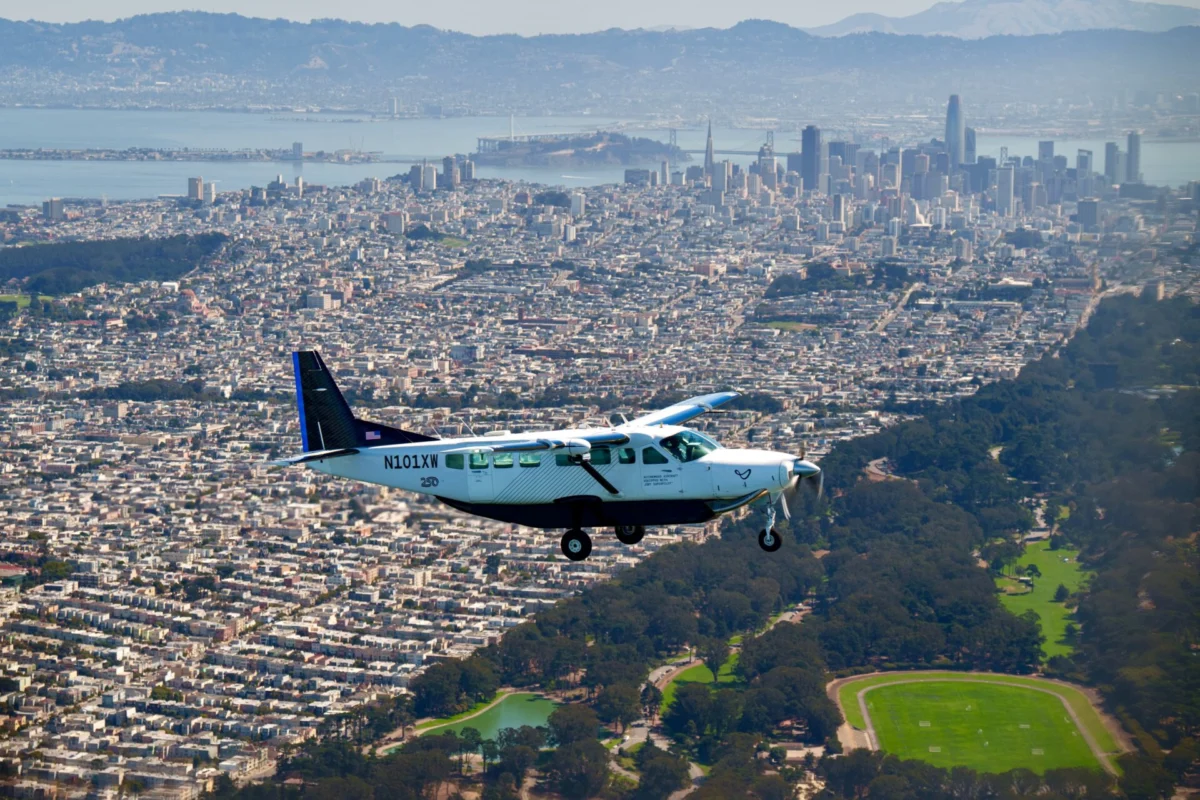
In the grand tapestry of aviation history, certain names are etched in gold: the Wright brothers, whose fragile craft first defied gravity at Kitty Hawk; Charles Lindbergh, who bridged the Atlantic solo; and Amelia Earhart, who shattered barriers of endurance and gender. As of September 2026, a new chapter has been written into this storied chronicle. Joby Aviation, the California-based leader in electric vertical take-off and landing (eVTOL) technology, has completed the first fully autonomous coast-to-coast flight across the United States.
The mission, involving a modified Cessna 208B Caravan known as the "J208," covered 3,199 miles of American airspace. While the aircraft carried an onboard safety pilot, the most striking detail of the journey was the absence of human interference: from the moment the engine roared to life in California to the final touchdown on the East Coast, the pilot made zero control inputs. This landmark achievement serves as a watershed moment, transitioning the concept of autonomous flight from the realm of science fiction to a verifiable, scalable reality.
The Chronology of an Autonomous Crossing
The journey began on September 8, 2026, in Concord, California. The J208, a workhorse of regional aviation retrofitted with Joby’s proprietary autonomy software, embarked on a multi-stage trek across the continent.
The route was meticulously planned to traverse diverse landscapes and complex air traffic environments. Following its departure from the West Coast, the aircraft made scheduled stops in Phoenix, Arizona; Fort Worth, Texas; and Shaw Air Force Base in South Carolina. Each leg of the journey was a test of the system’s resilience, navigating varying weather conditions and the intricate regulatory demands of the U.S. National Airspace System.
The odyssey culminated on the historic sands of North Carolina. After completing an autonomous landing at the Dare County Regional Airport, the J208 performed a symbolic low pass near the Wright brothers’ First Flight Monument in Kitty Hawk. It was a poignant nod to the pioneers of 1903, contrasting the mechanical ingenuity of the past with the algorithmic precision of the future.
While the aircraft was physically piloted by software, it remained under the watchful eye of a human "pilot in command" located on the ground. This supervisor, stationed as far as 2,300 miles away from the aircraft, managed flight-plan updates and handled critical communication with Air Traffic Control (ATC). The safety pilot onboard acted solely as a redundant fail-safe, a passenger to their own flight, confirming that the autonomous systems performed with 100% reliability.
The Genesis of the J208: Technology and Integration
The success of this mission was not a spontaneous stroke of luck but the result of years of rigorous development. A critical turning point occurred in June 2024, when Joby Aviation acquired the autonomous flight division of Xwing, a pioneer in self-flying technology. By integrating Xwing’s software suite—which had already logged over 400 flights and 800 hours in both controlled and uncontrolled airspace—into their robust operational framework, Joby accelerated its timeline for commercial autonomy.
The J208 represents a sophisticated synthesis of legacy hardware and futuristic intelligence. The Cessna Caravan, a platform renowned for its ruggedness and reliability, serves as the perfect testbed. By installing advanced sensors, LiDAR, and computer vision systems, Joby has enabled the aircraft to "perceive" its environment, manage taxiing, execute take-offs, and navigate landings with a level of consistency that mimics, and in some areas exceeds, human performance.
Proven Utility in Military Applications
The J208 is not merely a prototype for demonstration; it has already been put to work. During the U.S. Air Force’s Agile Flag exercises, the autonomous Caravan was tasked with the rapid transport of critical aircraft components. According to Joby’s performance reports, the autonomous delivery system enabled the return of grounded aircraft to service approximately 24 hours faster than traditional logistics chains allowed. This proof-of-concept demonstrates that autonomous flight is not just about passenger convenience—it is a vital tool for defense, emergency medical services, and urgent supply-chain logistics.
Official Responses and Strategic Vision
JoeBen Bevirt, the founder and CEO of Joby Aviation, has framed the flight as a testament to the company’s "mission-first" culture. In a statement released on September 18, 2026, the company emphasized that the goal of the tour was to demonstrate the feasibility of "autonomous logistics."
"This is not about replacing the human element entirely," a company spokesperson clarified, "but about expanding the utility of aviation. By removing the need for a pilot to be physically inside the cockpit for every mission, we unlock the ability to deliver medical supplies to remote areas or transport freight into hazardous environments without putting crew at risk."
Industry analysts have praised the transparency of the flight. By providing detailed logs of the flight-plan management and the remote pilot’s interaction with ATC, Joby has provided the Federal Aviation Administration (FAA) and other global regulators with a blueprint for future certification of autonomous cargo operations.
Implications for the Future of Flight
The successful transit of the J208 has profound implications for the aerospace industry, touching upon economics, safety, and the future of urban air mobility (UAM).
1. Revolutionizing Regional Logistics
The most immediate application of this technology lies in the "middle mile" of logistics. Small, autonomous aircraft can move freight between regional hubs with far greater frequency and lower costs than traditional trucking. This could effectively decentralize distribution centers, allowing for faster deliveries to rural communities that have historically been underserved by major logistics providers.
2. The Path to Electric Air Taxis
While the J208 is a turboprop, it is a precursor to Joby’s primary objective: the electric vertical take-off and landing (eVTOL) air taxi. Joby is currently developing a platform capable of carrying a pilot and four passengers. While the company has confirmed that initial passenger services will maintain a human pilot for safety and passenger comfort, the Xwing-derived software will be progressively integrated to support increasing levels of automation. This evolution is expected to reduce pilot workload, enhance safety in high-density urban corridors, and eventually lead to fully pilotless air taxi operations.
3. Regulatory and Societal Acceptance
The "coast-to-coast" tour serves a secondary, perhaps more important, purpose: public normalization. For the general public, the idea of an empty cockpit is inherently unsettling. By conducting a long-distance, multi-stop tour, Joby is demystifying the technology. Seeing an aircraft taxi, take off, and land without a pilot at the controls in major metropolitan airports helps to build the necessary social license to operate.
Conclusion: A New Horizon
As the J208 continues its demonstration tour, making stops in cities like Louisville, Wichita, Oklahoma City, Salt Lake City, and Portland, it carries with it the weight of a transformed industry. The flight from California to North Carolina was more than just a logistical feat; it was a demonstration of a future where distance is no longer an obstacle to reliable, efficient, and automated transportation.
While we are not yet at a point where the average traveler will board an autonomous airliner for a transcontinental vacation, the gap between the present and that future has narrowed significantly. Joby Aviation’s accomplishment proves that the technology is ready. The remaining challenges—regulatory certification, infrastructure development, and public policy—are significant, but they are no longer theoretical.
The spirit of the Wright brothers lives on in the code written by the engineers at Joby. Just as the pioneers of 1903 looked at the sky and saw a path forward, the architects of today’s autonomous systems look at the horizon and see a world that is more connected, more responsive, and increasingly pilotless. The J208 has crossed the continent, but in the history of aviation, it has only just begun to take flight.
 Layla Zulfa
  Azzam Bilal Chamdy