

Drones have fundamentally transformed the landscape of travel photography and videography. What was once the exclusive domain of high-budget film crews with heavy equipment and helicopter pilots has been democratized, allowing solo travelers to capture sweeping, cinematic vistas from the palm of their hand. However, despite the boom in drone popularity, the industry has remained tethered to a traditional limitation: the gimbal-mounted, forward-facing camera.
Enter the Antigravity A1, a revolutionary piece of hardware released in late 2025 that challenges the very paradigm of aerial capture. By pivoting to a 360-degree dual-lens system, the A1 renders the traditional gimbal obsolete for a significant segment of the creative community. It transforms the act of piloting from a stressful, focus-dependent chore into a fluid, "fly now, frame later" experience that feels less like flying a machine and more like directing a virtual camera in a living, breathing environment.
The Core Innovation: Capturing the Impossible
At the heart of the Antigravity A1’s appeal is its unique optical architecture. While the standard drone market has focused on incremental sensor upgrades for forward-facing cameras, Antigravity has opted for total immersion.
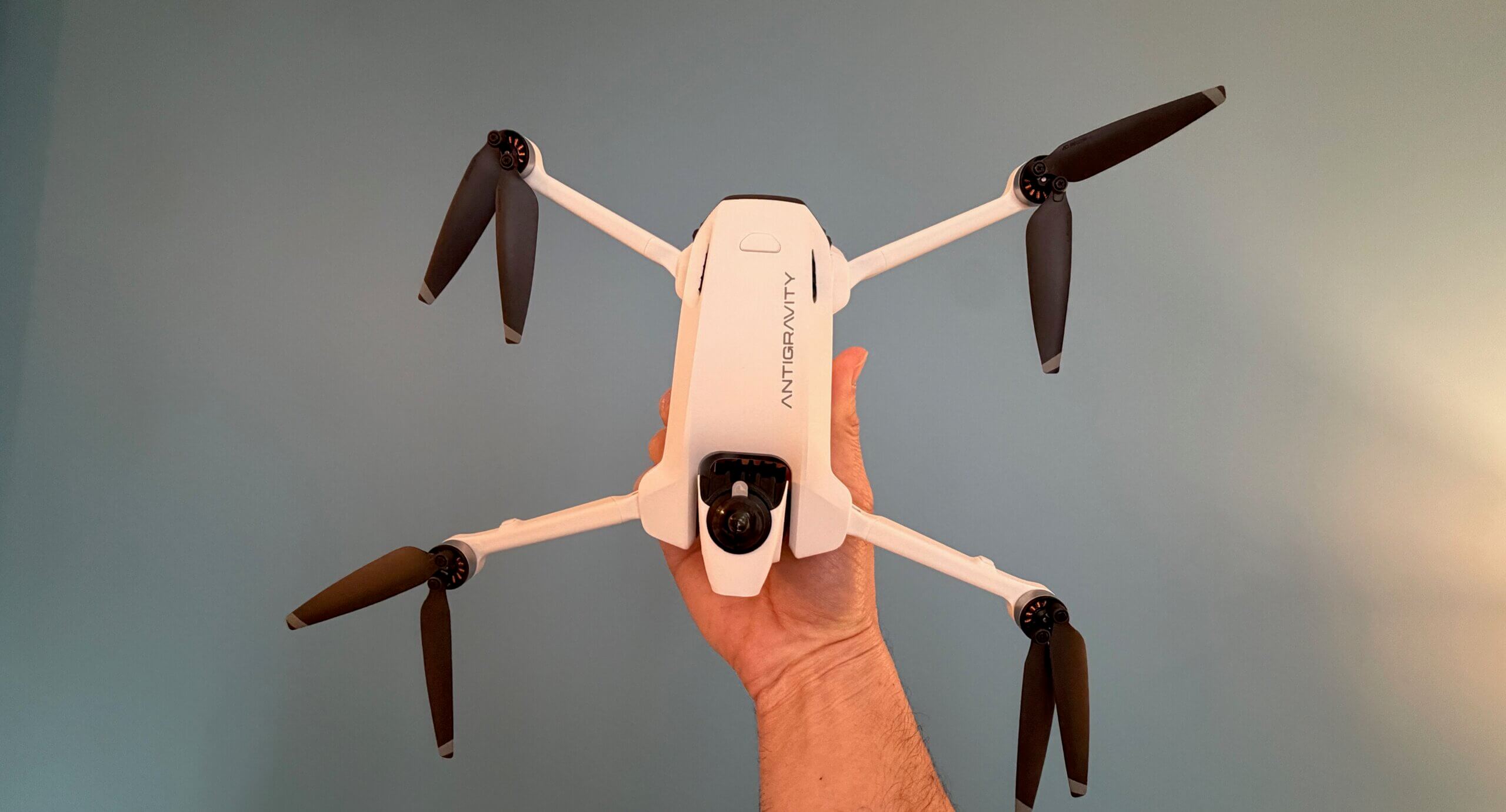
The A1 utilizes two ultra-wide-angle lenses, positioned precisely on the top and bottom of the central fuselage. Each lens captures a 200-degree field of view. When these two images are stitched together in real-time, they create a seamless, 360-degree sphere of data. Because of this, the drone itself is digitally "erased" from the final exported footage, leaving viewers with the surreal, clean aesthetic of a camera floating untethered in mid-air.
Technical Specifications and Sensor Performance
The sensors powering the A1 are 1/1.28-inch CMOS units. While purists might point out that these are smaller than the 1-inch sensors found on certain "Pro" level photography drones, they represent a massive leap forward compared to standard 360-degree action cameras.
This sensor size allows for a significant boost in low-light performance and, more importantly, a superior dynamic range. The A1 handles the harsh contrast of midday sun with remarkable grace, preserving details in both the deepest shadows and the brightest highlights—a frequent point of failure for lesser hardware.
Regulatory Intelligence: The 249-Gram Threshold
Perhaps the most tactical decision made by the Antigravity engineering team was their adherence to international aviation regulations. In most jurisdictions, drones weighing 250 grams or more are subject to mandatory registration and strict operational restrictions.
Antigravity engineered the A1 to weigh exactly 249 grams with its standard battery. By staying just under that critical threshold, the A1 avoids the bureaucratic friction of commercial registration in many countries. This makes it an ideal companion for the nomadic traveler who wants to bypass administrative headaches without sacrificing high-end performance.
The Flight Experience: A New Sensory Language
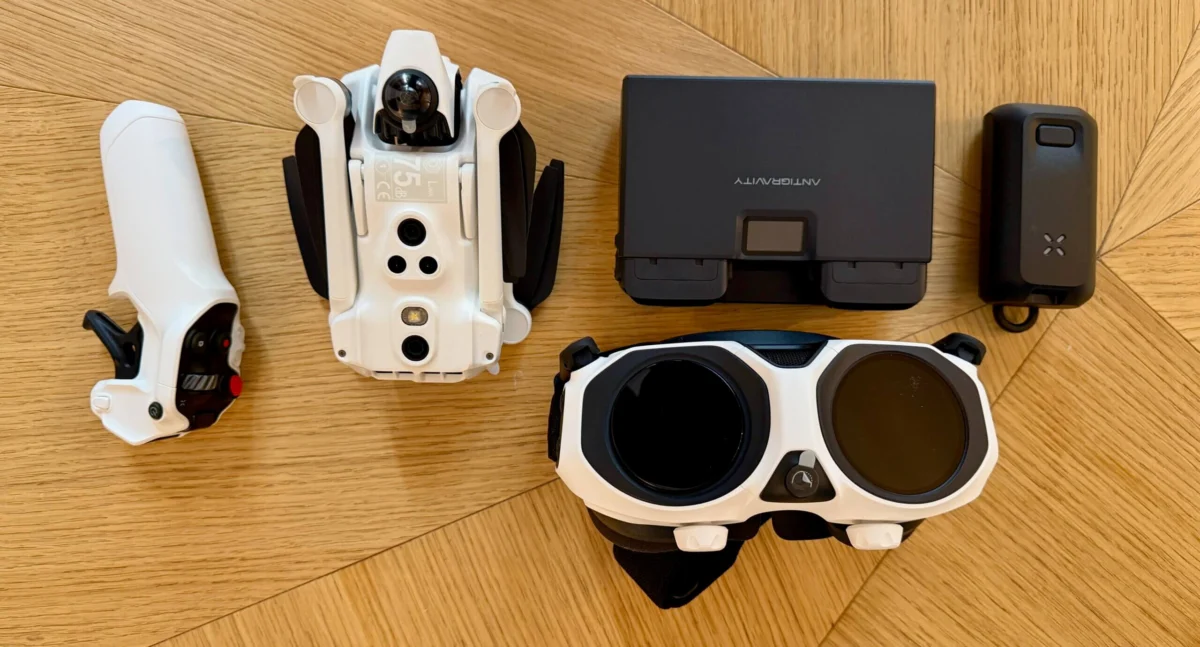
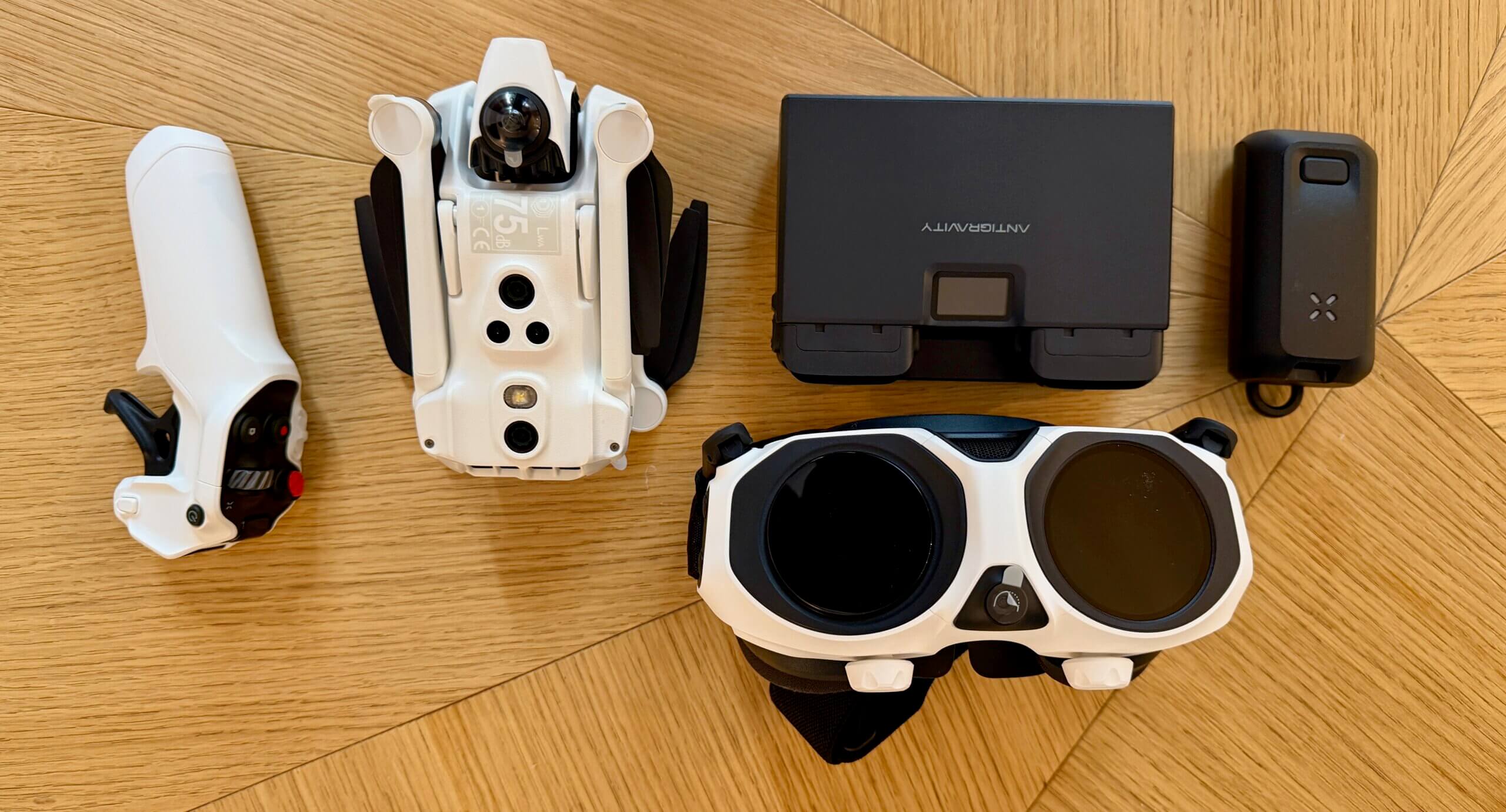
The A1 experience is defined by two primary interfaces: the Vision Goggles and the motion-sensing controller.
The Vision Goggles
The goggles are a masterclass in ergonomics and display technology. Equipped with dual 4K micro-OLED displays and a 120Hz refresh rate, they provide a nearly zero-latency view. However, the standout feature is the integrated head-tracking. Because the drone is capturing everything in 360 degrees, the pilot is not restricted to the camera’s orientation. If you turn your head, the feed pans; if you look down, you see the world beneath you. This spatial awareness provides a sense of presence that fixed-camera drones simply cannot replicate.
Intuitive Motion Control
Antigravity has largely moved away from the complex stick-and-throttle arrangements of the past. The A1 features a single-handed motion controller. To accelerate, you pull a trigger; to bank or climb, you tilt your wrist. It is a system designed for accessibility, allowing novices to master complex maneuvers in minutes. For the purists, a traditional "Mode 2" stick controller remains an option, though the motion-based system is so fluid that most users report never feeling the need to return to sticks.
Chronology of the A1’s Development
The development of the A1 did not happen in a vacuum. It was the result of a multi-year effort to solve the "framing anxiety" that plagues most drone pilots.
- Q1 2024: Antigravity begins prototyping the dual-lens fuselage, aiming to minimize the "blind spot" where the lenses meet.
- Q3 2024: Successful implementation of the "FlowState" stabilization algorithm, which allows the drone to ignore high-velocity wind turbulence.
- Q2 2025: Beta testing begins with a select group of travel creators to refine the "Antigravity Studio" app.
- Late 2025: Official launch of the A1.
- Q1 2026: Rollout of "Turtle Mode" firmware updates, allowing the drone to self-right after a crash.
Supporting Data: The Power of Reframing
The shift from 8K resolution to a 360-degree sphere requires a change in perspective. In a standard 8K camera, pixels are packed into a 16:9 rectangle. In the A1, those pixels are distributed across the sphere. When the user "reframes" the footage in the Antigravity Studio app, they are effectively choosing a "crop" of the total image.
The app utilizes a 80MB/s wireless transfer speed, allowing users to pull footage to their smartphones and use the phone’s gyroscope to re-film the scene. The "Auto-Frame" AI tool is the true game-changer here; it identifies subjects—be it a mountain climber, a cyclist, or a moving vehicle—and automatically creates cuts that keep the action perfectly centered. For the solo creator, this is the equivalent of having a dedicated cameraman.
Battery Life and Physical Durability
Battery life remains the primary challenge for the A1. The standard Intelligent Flight Battery offers a theoretical 24 minutes, though real-world conditions usually net the pilot about 19 to 20 minutes.
However, the "work per minute" ratio is vastly superior to traditional drones. Because the pilot captures everything at once, they don’t need to perform multiple passes over a subject to get different angles. One 20-minute flight with an A1 is often more productive than three flights with a standard drone. For those who require more endurance, the "Pro Battery" extends flight time to 39 minutes, albeit at the cost of crossing the 250-gram regulatory threshold and slightly reducing flight agility.
Constructed from high-grade carbon-fiber-reinforced polymer, the drone is built to handle the rigors of travel. When folded, it is comparable in size to a large smartphone, making it easy to slip into a carry-on or backpack.
Official Responses and Industry Implications
The drone industry has taken note of Antigravity’s success. While larger, cinema-grade drones still dominate the professional film industry, the A1 has effectively captured the "prosumer" market. Competitors have begun to scramble to integrate similar 360-degree, gimbal-less technology into their own lineups.
Antigravity representatives have stated that their goal was never to replace the high-end cinema drone, but to "bridge the gap between traditional cinematography and the immersive potential of virtual reality." The response from the creative community has been overwhelmingly positive, with creators praising the drone for allowing them to focus on storytelling rather than technical flight parameters.
Implications for Future Travelers
The Antigravity A1 is more than just a camera; it is a shift in how we document our world. By removing the technical barriers to entry, the A1 allows travelers to focus on the narrative of their journey.
If you are a creator tired of the repetitive, forward-facing "drone shot," the A1 offers a path to genuine creative liberation. It is an essential tool for those who want to push the boundaries of aerial storytelling, providing a unique vantage point that bridges the gap between reality and the immersive digital experiences of tomorrow. As battery technology continues to evolve and the software ecosystem matures, the A1 will likely be remembered as the moment the industry moved away from the gimbal and into the era of total, omnidirectional capture.
 Lina Hope
  Jia Lissa
  Ali Ikhwan