

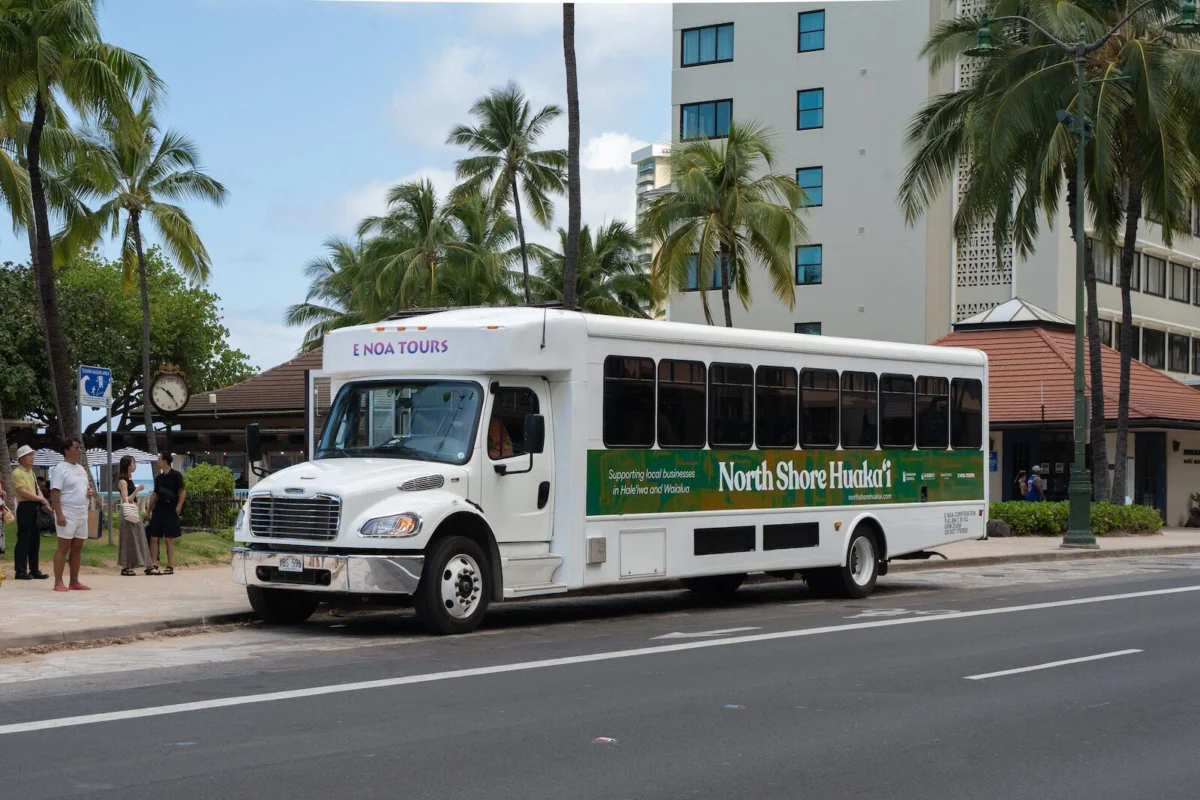
Following a series of devastating storms that crippled the economy of Oʻahu’s northern coastline, a coalition of cultural, tourism, and community organizations has launched an innovative transit initiative designed to funnel tourism dollars directly into recovering communities.
The North Shore Huakaʻi, a daily shuttle service launched on June 29, 2026, represents a targeted effort to bridge the geographic and economic gap between Oʻahu’s primary resort areas—Waikīkī and Ko Olina—and the historic, flood-damaged commercial districts of Waialua and Haleʻiwa. Operating as a 90-day pilot program scheduled to run through September 26, 2026, the project is a collaborative venture between the Council for Native Hawaiian Advancement (the Hawaiian Council), the Hawaiʻi Visitors and Convention Bureau (HVCB), E Noa Tours, and the Hawaiʻi Tourism Authority (HTA).
Conceived as a direct intervention to the compounding economic losses suffered by local merchants in the wake of severe spring flooding, the program seeks to redefine the relationship between visitor transportation and community-based economic recovery.
Main Facts: The Structure and Mechanics of the North Shore Huakaʻi
The North Shore Huakaʻi operates as a curated, full-day experience spanning approximately six to seven hours. Rather than functioning as a standard point-to-point transit system, the shuttle is designed to slow down the visitor journey, encouraging extended stays and deliberate spending within two distinct North Shore hubs.
[Waikīkī Route (40 Seats)] ---
                               +---> [Stop 1: Waialua (1 Hour)] ---> [Stop 2: Haleʻiwa (2-2.5 Hours)]
[Ko Olina Route (26 Seats)] ---/          (Historic Sugar Mill)             (Local Shops & Dining)
Route Operations and Logistics
The program utilizes two distinct routes to capture visitors staying in Oʻahu’s primary tourism centers:
- The Waikīkī Route: Utilizing a 40-seat coach, this route begins morning pickups at 8:30 AM at the Prince Waikiki hotel, continuing along Kalākaua Avenue to select resort properties. The shuttle departs the Waikīkī area at approximately 9:15 AM, traveling north toward the historic town of Waialua.
- The Ko Olina Route: Catering to the West Oʻahu resort corridor, a secondary 26-seat shuttle services major properties in Ko Olina, located approximately 30 minutes west of Waikīkī. This route accommodates guests staying at family-centric and luxury resorts, including Disney’s Aulani Resort & Spa, the Four Seasons Resort Oʻahu at Ko Olina, Marriott’s Ko Olina Beach Club, and the Beach Villas at Ko Olina.
The Curated Itinerary
Both shuttles follow a coordinated itinerary designed to distribute foot traffic across two historically significant commercial zones:
- First Stop: Waialua (Approx. 1 Hour): Passengers are dropped off in Waialua’s historic sugar mill district. Once the industrial heart of the North Shore, the repurposed mill now houses local artisans, specialty food producers, and craft shops.
- Second Stop: Haleʻiwa (Approx. 2 to 2.5 Hours): The shuttle then moves to Haleʻiwa town, the North Shore’s primary commercial center. Visitors are given ample time to dine, shop, and explore local galleries before boarding the return shuttle for a mid-afternoon arrival back at their respective resorts.
Onboard Cultural Integration
To align the service with Hawaiʻi’s broader shift toward regenerative tourism, each shuttle features onboard "cultural practitioners" who act as guides, storytellers, and educators. Rather than offering standard sightseeing commentary, these practitioners share the history, genealogy, and ecological significance of the moku (districts) through which the shuttle travels.
The educational curriculum and onboard experience are curated by two prominent cultural leaders:
- Kumu Hula Mehanaokalā Hind: Senior adviser to the CEO of the Hawaiian Council and a highly respected cultural authority.
- Kamaka Pili: A well-known local storyteller, television host, and cultural practitioner.
According to program organizers, these guides were selected specifically for their deep ties to the community and their ability to foster a sense of kuleana (responsibility) and respect among visitors before they step off the bus.
The "North Shore Passport" Incentivization Scheme
To ensure that the physical presence of tourists translates into direct economic support, the program incorporates a novel "North Shore Passport." Upon boarding, each rider receives a physical passport listing participating small businesses, restaurants, galleries, and boutique shops in Waialua and Haleʻiwa.
+-------------------------------------------------------------+
|                     NORTH SHORE PASSPORT                    |
|  [ Stamp 1 ]    [ Stamp 2 ]    [ Stamp 3 ]    [ Stamp 4 ]   |
|                                                             |
|  * Spend locally to collect stamps.                         |
|  * 5 stamps = Free commemorative local gift.                |
|  * Proof of purchase requested upon boarding return shuttle.|
+-------------------------------------------------------------+
Visitors receive a stamp in their passport for every purchase made at these designated locations. Collecting five stamps qualifies the rider for a complimentary, locally sourced gift. To reinforce the economic mission of the initiative, passengers are requested to present proof of purchase from a local merchant prior to boarding the return shuttle to Waikīkī or Ko Olina.
Participating Merchants
The passport network features a diverse cross-section of the North Shore’s culinary and retail landscape, including:
- Food and Beverage: Giovanni’s Shrimp Truck (a pioneer of the North Shore food truck industry), Haleʻiwa Bowls (specializing in fresh açai bowls), Poke for the People, and the Farm to Barn Cafe and Juicery.
- Specialty Retail and Crafts: The Ukulele Site (a premier dealer of Hawaiʻi-made string instruments), North Shore Goodies (famous for locally made coconut peanut butter and pantry staples), Maui Divers Jewelry, Splash Hawaii, and the historic Aloha General Store.
Chronology of Events: From Meteorological Disaster to Economic Intervention
The launch of the North Shore Huakaʻi is the culmination of a rapid, multi-agency response to an environmental and economic crisis that unfolded in the spring of 2026.
[March 2026] Double "Kona Low" Storms hit Oʻahu; severe flooding renders 264 homes uninhabitable.
     │
[April 2026] Federal and State Disaster Declarations issued; business losses estimated at $100M.
     │
[May-June 2026] Hawaiian Council, HTA, HVCB, and E Noa Tours draft and fund the shuttle initiative.
     │
[June 28, 2026] Public announcement of the North Shore Huakaʻi pilot program.
     │
[June 29, 2026] Official launch of the daily shuttle service.
     │
[Sept 26, 2026] Scheduled conclusion of the 90-day pilot; impact assessment and evaluation.
March 2026: The Double "Kona Low" Storms
The origin of the crisis trace back to March 2026, when Oʻahu was struck by consecutive "Kona low" storm systems within a single week. Unlike the state’s typical trade wind weather patterns, Kona storms pull warm, highly saturated tropical moisture from the south and west, often resulting in prolonged, torrential rainfall.
Because the first storm completely saturated the island’s water tables and soils, the second system triggered catastrophic runoff. On the morning of March 20, 2026, streams and drainage networks across the North Shore overflowed, causing widespread flash flooding. The deluge forced immediate evacuations, closed major transit corridors, and inundated residential neighborhoods and commercial farmlands in Waialua and Haleʻiwa.
April 2026: Disaster Declarations and Damage Assessment
By early April, the scale of the destruction prompted a major disaster declaration. Damage assessments revealed that 23 homes were completely destroyed, and at least 264 homes were classified as "uninhabitable."
Because the storms struck during the peak spring break travel season, the economic fallout extended far beyond property damage. Flight delays, cruise ship cancellations, and the closure of major outdoor attractions resulted in widespread losses for the state’s tourism sector.
Late Spring 2026: Developing the Recovery Model
As the physical cleanup progressed, local business associations warned of a secondary crisis: a sharp decline in foot traffic and consumer spending on the North Shore. Many visitors, under the impression that the entire region was closed or inaccessible, bypassed the area entirely.
In response, the Council for Native Hawaiian Advancement began collaborating with state tourism officials and private transportation operators. Recognizing that individual businesses lacked the marketing reach to draw visitors back independently, the partners designed a subsidized transit program that would lower the barrier to entry for tourists while guaranteeing that participants supported the local economy.
June 28–29, 2026: Announcement and Launch
On June 28, 2026, the Hawaiian Council and its partners officially announced the creation of the North Shore Huakaʻi. The following morning, June 29, the first shuttles departed Waikīkī and Ko Olina, marking the formal beginning of the 90-day pilot program.
Supporting Data: The Economic and Physical Toll of the Flooding
To understand the necessity of the North Shore Huakaʻi, it is essential to examine the underlying economic and structural damage data compiled by state agencies and business organizations following the March storms.
Physical Damage Metrics
Data compiled by city and county emergency management services highlighted the concentration of damage on Oʻahu’s northern coast:
| Damage Category | Residential Impact Count |
|---|---|
| Homes Rendered Completely Uninhabitable | 264 |
| Homes Totally Destroyed | 23 |
| Affected Farms/Agricultural Acres | Over 400 acres |
The destruction of residential properties directly impacted the local workforce, as many retail and service workers in Haleʻiwa and Waialua were displaced or forced to focus on personal recovery rather than returning to work.
Macroeconomic Impact on Tourism
According to reports published by the Hawaiʻi Department of Business, Economic Development and Tourism (DBEDT), the timing of the Kona low storms caused severe disruptions to the state’s primary economic engine:
- Statewide Tourism Revenue Loss: Estimated at $300 million for the month of March 2026 alone, driven by canceled flights, harbor closures, and localized hotel cancellations.
- Direct North Shore Economic Loss: The Chamber of Commerce Hawaii and local merchant associations estimated the direct economic loss to businesses in Waialua and Haleʻiwa at close to $100 million. This figure accounts for structural damage, ruined inventory, utility interruptions, and lost revenue during the peak spring travel window.
Shuttle Capacity and Projected Influx
Over its 90-day pilot run, the North Shore Huakaʻi has the capacity to transport a significant volume of high-intent spenders directly to these struggling commercial centers:
$$textDaily Capacity = 40 text seats (Waikīkī) + 26 text seats (Ko Olina) = 66 text passengers per day$$
$$textTotal Pilot Capacity (90 Days) = 66 text passengers/day times 90 text days = 5,940 text potential visitors$$
If each passenger spends an average of $100 to $150 on dining, retail, and activities during their trip, the program could inject between $594,000 and $891,000 in direct consumer spending into Waialua and Haleʻiwa over the course of the summer, excluding the multiplier effect within the local supply chain.
Official Responses and Community Voices
The launch of the shuttle has drawn praise from community leaders, cultural advocates, and tourism executives, many of whom view the program as a blueprint for future disaster recovery and tourism management.
The Council for Native Hawaiian Advancement
Kūhiō Lewis, President and CEO of the Hawaiian Council, emphasized that the project was born directly from grassroots recovery efforts:
"The North Shore Huakaʻi grew out of the Hawaiian Council’s recovery work alongside families, businesses and community leaders following the storms, and the community’s need for help bringing customers back in a thoughtful way. We’ll evaluate its impact on local businesses, rider and community feedback, and available funding support at the end of the 90-day pilot."
Lewis noted that the program’s success will not be measured solely by rider volume, but by the tangible economic relief felt by the shopkeepers and restaurant workers who form the backbone of the North Shore community.
Cultural Leadership
For cultural practitioners like Kamaka Pili and Kumu Hula Mehanaokalā Hind, the program represents an opportunity to shift the mindset of the average vacationer. By educating riders about the historical and spiritual significance of the land before they arrive, organizers hope to cultivate a more respectful, mindful visitor demographic.
"They were selected for their knowledge and their ability to help participants develop a meaningful connection to the communities they visit," Lewis told Matador Network, highlighting the intentionality behind the guide selection process.
The Merchant Perspective
Local business owners, particularly those operating outside the primary tourist strips, have expressed cautious optimism. In Waialua, where businesses located in the old sugar mill often struggle to compete with the high-visibility storefronts of Haleʻiwa, the dedicated one-hour stop provides a guaranteed, consistent stream of foot traffic that did not exist prior to the storm.
Implications: A Model for Regenerative Tourism and Disaster Resilience
The North Shore Huakaʻi pilot program has broader implications for the future of tourism management in Hawaiʻi and other destination economies vulnerable to natural disasters.
Addressing Overtourism and Traffic Congestion
For decades, residents of Oʻahu’s North Shore have voiced concerns over traffic congestion along the two-lane Kamehameha Highway, which often becomes bottlenecked by rental cars traveling to popular surf spots and beaches. By consolidating up to 66 rental car trips per day into two high-capacity shuttles, the Huakaʻi program addresses a major point of friction between locals and visitors.
[Traditional Tourism Model]
Individual Rental Cars ──> High Traffic Congestion ──> Fragmented Local Spending

[Huakaʻi Regenerative Model]
Consolidated Shuttles   ──> Reduced Road Congestion ──> Targeted, High-Impact Local Spending
The Transition to Regenerative Tourism
The state of Hawaiʻi has increasingly sought to transition from a volume-based tourism model to a value-based, regenerative model under the "Mālama Hawaiʻi" banner. The North Shore Huakaʻi is a concrete operationalization of this philosophy.
Rather than merely asking visitors to behave responsibly, the program structures the entire excursion around economic contribution and cultural education. The requirement—or strong expectation—to show local receipts before boarding the return shuttle creates a clear, transactional understanding: in exchange for convenient, curated access to a world-famous region, visitors are expected to directly support the community’s recovery.
Future Outlook and Scalability
As the September 26, 2026 conclusion of the pilot program approaches, the partners will analyze spending data from the passport program, feedback from North Shore merchants, and overall rider satisfaction. If the data reveals a measurable boost in local business revenues and a reduction in community strain, the model could be extended or replicated.
Similar programs could eventually be deployed to assist other disaster-affected or economically isolated areas across the Hawaiian Islands, proving that tourism, when managed with intentionality and community oversight, can serve as a powerful tool for economic resilience and recovery.
 Ammar Sabilarrohman
  Raul Delapena Setiawan
  Nila Kartika Wati