

Executive Summary: A Unified Voice for Sustainable Travel
In an era defined by climate consciousness and a burgeoning desire for authentic travel experiences, The International Ecotourism Society (TIES) recently concluded a comprehensive global survey to gauge the pulse of the ecotourism industry. The initiative, launched via the organization’s newsletter, sought to understand the current operational landscape, identify prevailing trends, and highlight the primary challenges facing stakeholders worldwide.
The results, drawn from 971 viable responses spanning 91 countries, offer a profound snapshot of an industry in transition. With representation from every continent—ranging from the United States to Sudan, Bhutan, and Bosnia and Herzegovina—the survey underscores the universality of the ecotourism movement. The findings confirm a near-unanimous consensus: ecotourism is not merely a niche interest but a rapidly expanding global economic force.
The Chronology of Inquiry: Gathering Global Intelligence
The survey was conceptualized by TIES leadership to bridge the communication gap between the organization and its diverse global membership. The process was structured in three distinct phases:
- Outreach and Data Collection: Following the initial call to action in the society’s newsletter, the data collection phase saw a steady influx of contributions from industry professionals, academics, and conservationists.
- Aggregation and Categorization: Over several months, TIES analyzed responses, noting that while 90% of participants could easily categorize their work within the provided industry segments, many expressed a need for more nuanced options, such as multi-disciplinary classification.
- Synthesis and Strategy Alignment: The final phase involved correlating the survey feedback with TIES’s internal strategic goals, specifically regarding multilingual outreach and thematic prioritization.
The diverse geographic spread of respondents was a point of particular pride for the organization. While the USA provided the largest volume of feedback, the inclusion of voices from nations as varied as Iran, Nepal, Montenegro, and Cote d’Ivoire provided a multidimensional view of how ecotourism is perceived in both developed and emerging markets.
Supporting Data: Mapping the Ecotourism Landscape
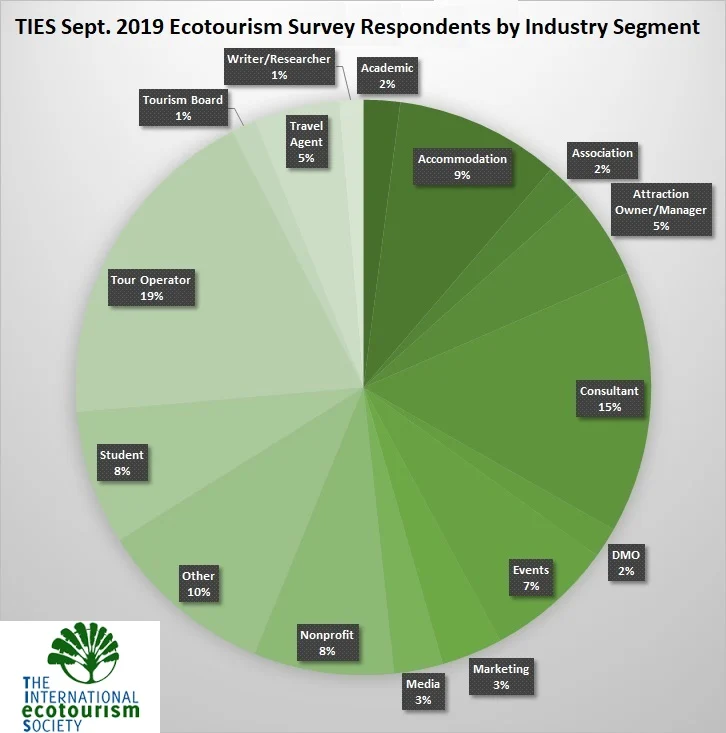
To better understand the makeup of the modern ecotourism professional, TIES requested that respondents self-classify their industry roles. The resulting data revealed a broad spectrum of stakeholders, including tour operators, sustainability consultants, hoteliers, and government officials.
Participation Discrepancies
One notable anomaly identified by the TIES research team was the lower-than-expected response rate from the academic sector. Given that scholars and researchers constitute a significant portion of the TIES membership base, their relative under-representation in the survey suggests a potential misalignment in engagement strategy or a shift in the academic community’s focus regarding industry-wide surveys.

The Growth Trajectory
Perhaps the most striking data point concerns the industry’s outlook. When asked about the current trajectory of ecotourism, the response was overwhelming: 99.5% of participants (967 out of 971) reported that they see the sector growing, with a vast majority describing that growth as "rapid." Only four respondents suggested that the industry was slowing down. This finding serves as a powerful indicator that the sustainable tourism movement is gaining significant momentum, a conclusion that mirrors broader market research from major platforms like Booking.com.
Official Responses and Strategic Pivot
The survey results have acted as a catalyst for immediate strategic shifts within TIES. Recognizing the global nature of their audience, the organization is currently addressing two primary feedback pillars: language accessibility and thematic focus.
The Push for Multilingualism
A significant portion of the survey feedback emphasized the need for linguistic diversity. Respondents, particularly those from Latin America, strongly advocated for Spanish-language content. The reasoning is clear: Spanish-speaking countries represent some of the most ecologically significant regions on the planet, and their local stakeholders are pivotal to the success of global ecotourism initiatives.
TIES has acknowledged this request as a priority. The leadership is currently in the process of rolling out Spanish-language support across their official digital platforms and article archives. Furthermore, the survey highlighted interest in French and Mandarin support. While responses from China were limited, the proactive demand for Mandarin resources highlights a forward-looking perspective on the emerging Chinese ecotourism market.
Realigning Institutional Priorities
When asked where TIES should direct its resources, the respondents provided a clear mandate. The priorities were ranked as follows:
- Education (41%): The largest segment of respondents believes that knowledge sharing, professional training, and capacity building should be the primary mission of the society.
- Conservation and Climate Change (18%): A recognition of the existential threat to the very environments that sustain the industry.
- Ecodestinations (14%): A desire for structured, country-by-country guides that highlight authentic ecotourism offerings.
- Publications and Social Media (20%): A request for more robust content dissemination.
Interestingly, very few respondents prioritized internal administrative goals like "increasing membership" or "UN partnerships." This suggests that the membership views TIES primarily as a resource and education hub rather than a traditional lobbying organization. In response, TIES has already begun reaching out to key players in the education sector to develop new training modules and professional certifications.
Implications: The Challenges Ahead
Despite the overwhelming optimism, the survey provided a sobering list of obstacles. Industry professionals are not blind to the risks associated with the rapid growth of the sector.
The Specter of Overtourism
The most cited concern was "overtourism"—the phenomenon where the popularity of a destination leads to the degradation of the natural environment and the displacement of local communities. This, coupled with the systemic issue of "greed" and "overdevelopment," presents a paradox for the industry: how to promote growth without sacrificing the integrity of the destination.
Operational Barriers
Beyond environmental concerns, respondents highlighted significant practical challenges:
- Permitting and Financing: Many operators struggle with the bureaucratic hurdles of obtaining eco-permits and securing sustainable financing.
- The "Booking Gap": A critical insight from the survey was the lack of infrastructure that allows travelers to book "truly" sustainable experiences. There is a perceived disconnect between the consumer’s desire to travel ethically and their ability to find and verify the legitimacy of those options.
- Climate Change and Awareness: Respondents expressed frustration with the lack of general awareness among the traveling public, suggesting that the industry must work harder to educate consumers on the nuances of ecotourism versus "greenwashing."
Conclusion: A Future-Forward Outlook
The 2019 TIES industry survey has provided more than just raw data; it has provided a roadmap for the future of the organization and the wider ecotourism community. While the challenges—ranging from bureaucratic red tape to the global climate crisis—are substantial, the consensus remains one of cautious optimism.
The industry is clearly in a phase of rapid expansion, and as it matures, the focus is shifting toward education, accessibility, and tangible, on-the-ground impact. By responding to the demand for multilingual content and prioritizing educational resources, TIES aims to empower its members to navigate these complexities. Ultimately, the survey reaffirms that ecotourism continues to be a vital, evolving framework—one that offers a better, more sustainable way to experience the diversity of our world. As the industry moves forward, the insights gathered from these 971 voices will serve as the foundation for a more resilient and inclusive global network.
 Laily UPN
  Basiran