

CAIRO & LONDON — Long before the minimalist architecture, the celebrity-studded red carpets, and the multi-billion-dollar valuation, the global phenomenon known as Nobu Hospitality had the humblest of beginnings: a hungry Hollywood icon, a Los Angeles boulevard, and a very cooperative elevator.
“I was just happy getting my food brought to my apartment each day,” recalls Robert De Niro, a trademark smile creeping up to the corners of his eyes as he recounts the brand’s genesis. “This was in the late 1980s, when I lived on La Cienega Boulevard, right across from Matsuhisa, and one of the waiters would bring it across the street, put it in my elevator, and it’d bring it up to the 10th floor where I lived.”
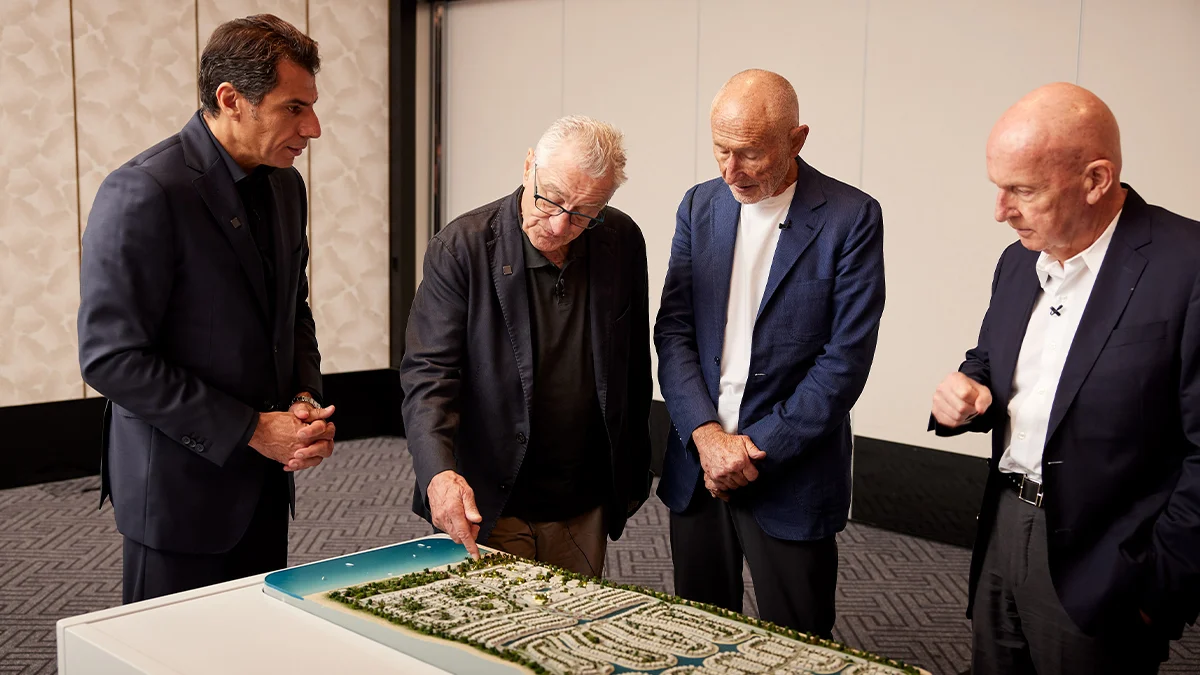
Today, those vertical food deliveries have metastasized into one of the most recognizable luxury lifestyle brands on the planet. Seated in a top-floor suite at the Nobu Hotel London Portman Square, De Niro is flanked by fellow co-founder Meir Teper, CEO Trevor Horwell, and Ayman Amer, general manager of leading real estate developer SODIC. (Chef Nobu Matsuhisa, the final pillar of the founding trio, is absent.) Together, the quartet is pulling back the curtain on the brand’s most ambitious play yet: a massive, three-pronged expansion into Egypt spanning restaurants, luxury hotels, and branded residences from the sun-drenched Mediterranean coast to the historic doorstep of Cairo.
1. Main Facts: The Egyptian Triad
The partnership between Nobu Hospitality and SODIC (Sixth of October Development & Investment Company)—a premier Egyptian developer backed significantly by Abu Dhabi’s Aldar Properties—marks a watershed moment for both brands. Rather than a singular hotel drop, the collaboration deploys a multi-destination strategy designed to capture Egypt’s surging luxury tourism and real estate markets.
The ambitious rollout features three distinct developments:
- Eastown District, New Cairo: Anchored by a newly opened Nobu restaurant that debuted this past summer, serving as a culinary trailer for a full-scale Nobu Hotel slated to open next year.
- OGAMI, North Coast (Ras El Hekma Bay): A sprawling 440-acre coastal mega-development featuring a seasonal Nobu restaurant (operational since summer 2025), which will expand to house a permanent Nobu Hotel, branded residences, and ultra-luxury beachfront villas.
- New Zayed: Located west of Cairo, positioning guests roughly 20 minutes from the Great Pyramids, the Sphinx, and the monumental Grand Egyptian Museum. This location will feature a third integrated hotel and residential community.
2. Chronology: From La Cienega to a Global Footprint
To understand how a sushi counter in Los Angeles transformed into a multinational hospitality juggernaut, one must trace a timeline defined by serendipity, persistence, and strategic evolution.
The Late 1980s: The Elevator Delivery
While residing on La Cienega Boulevard in Los Angeles, Robert De Niro became a devoted regular at Matsuhisa, the intimate namesake restaurant of classically trained Japanese chef Nobu Matsuhisa. Chef Nobu had developed his revolutionary culinary style—fusing traditional Japanese techniques with Peruvian ingredients—during his formative years living and working in Lima. De Niro, entranced by the flavors, frequently had meals delivered across the street via elevator to his 10th-floor apartment.

The Early 1990s: The Pitch
Through mutual acquaintances, notably British film director Roland Joffé, De Niro secured an introduction to Chef Nobu.
“As soon as I’d spent half an hour with him, I said, ‘If you ever want to open a restaurant in New York, let me know,’” De Niro recalls. “I saw how special it was, and I’d never seen a Japanese restaurant like that on the East Coast. It had a sexiness to it, a pizazz. So I said, ‘This is great. This will work in New York or London.’”
It took several years of patient persuasion before Chef Nobu agreed to partner with the Hollywood legend. But when their first collaborative restaurant opened in New York in 1994, the gamble paid off instantly.
1994–Present: The Snowball Effect
Over the next three decades, the culinary concept snowballed. The brand grew to encompass nearly 60 restaurants worldwide. Eventually, the founders made a pivotal realization: developers were leveraging the Nobu name to sell real estate and add immediate "cachet" to their properties. Rather than simply lending their name for a fee, De Niro and Teper pivoted the business model.
“Why are we not participating more in projects we’re being invited into just to give them extra cachet?” De Niro asked. The mandate shifted: no more standalone restaurants without hotels; soon, branded residences followed.
The Present Day: Entering Egypt
The partnership with SODIC represents the latest evolutionary leap. Following groundwork laid in the Middle East—including a major luxury project on Saadiyat Island in Abu Dhabi with Aldar Properties—Nobu has officially planted its flag in North Africa, capitalizing on a nation undergoing a massive infrastructural and economic renaissance.
3. Supporting Data & Market Dynamics
The timing of Nobu’s Egyptian expansion is far from accidental. It is underpinned by sweeping macroeconomic shifts, massive foreign direct investment (FDI), and an aggressive reimagining of Egypt’s tourism corridors.
- Foreign Direct Investment: The Egyptian luxury market has experienced a massive influx of capital from Emirati, Qatari, and international institutional investors over the past half-decade.
- Infrastructure Upgrades: Billions of dollars pumped into roads, high-speed rail, and new airports have radically transformed accessibility. The North Coast is now serviced by modernized air hubs, enabling direct chartered flights from Europe and GCC nations.
- Pricing Power: According to Ayman Amer, general manager of SODIC, room rates in prime Egyptian luxury corridors have experienced an exponential climb, jumping from historical averages of $200–$300 a night to upwards of $1,000 a night over the past two years.
- Extending the Season: Traditionally, Egypt’s Mediterranean coast (Sahel) has operated as a strictly seasonal destination, populated for roughly six months of the year before going dormant. Nobu’s residential and hotel components are explicitly engineered to convert the North Coast into a vibrant, year-round community.
4. Official Responses: Inside the Executive Suite
The collaboration between Nobu and SODIC is built on a shared vision of mutual respect for local culture and a belief in the transformation of untapped landscapes.

Meir Teper emphasizes that the empire’s expansion was never the result of a rigid corporate blueprint, but rather a series of organic evolutions.
“Sometimes it just happens without planning,” Teper explains. “Bob’s vision becomes: ‘Why don’t we do our own hotels rather than go to other brands’ hotels?’ Then we do a hotel in Toronto, and the developers say, ‘Can you do also a residence, because we’re building a tower, and call it Nobu?’ When things happen and are successful, it makes more things happen.”
Trevor Horwell, CEO of Nobu Hospitality, explains how the partnership with SODIC came to fruition through their existing ties with Abu Dhabi’s Aldar Properties.
“Aldar said, ‘Look, you have to meet with SODIC, because we believe in that company and they’re doing spectacular things in Egypt,’” Horwell recalls. “So we flew to Egypt and went to the north coast and saw everything that was going on. I’d lived there many years ago, and could see how profound the change was… We don’t believe there’s any better partner than SODIC.”
Crucially, Horwell stresses that luxury expansion requires cultural humility.
“You’ve got to embrace the local culture and blend into that. You have to adapt to local customs,” he says. Speaking of the North Coast development, he adds: “The location is very untouched, and we’re going to be the first. I expect many others will come after us.”
Ayman Amer of SODIC points to the architectural synthesis underpinning the projects. Nobu has retained a trusted New York-based architecture firm—one that has previously designed several international Nobu properties—to collaborate with local designers.
“They’ve used a lot of local materials while incorporating into designs our Nobu, Japanese look and feel,” Teper notes. “It’s going to be a beautiful product.”
5. Implications: Redefining Global Hospitality
The Egyptian tri-site expansion signals a profound maturation of the modern lifestyle hospitality brand. Nobu is no longer merely a high-end restaurant group managing hotels; it is actively dictating urban planning, coastal real estate development, and regional tourism habits.
By transforming seasonal summer playgrounds like the North Coast into year-round residential hubs, and by anchoring developments near monumental cultural landmarks like the Grand Egyptian Museum, Nobu and SODIC are creating self-sustaining micro-ecosystems of ultra-luxury living.
For an enterprise that began with a modest plate of black cod sliding quietly out of a Los Angeles elevator, the journey to the pyramids and the Mediterranean shores proves that some Hollywood scripts write themselves—provided you have the vision to see where the elevator is going.
 Iffa Jayyana