

By Global Hospitality Desk
Published exclusively by Robb Report
Main Facts: The Egyptian Ascent
In a move that marks one of the most ambitious chapters in its storied three-decade history, Nobu Hospitality is planting its flag firmly in North Africa. The luxury lifestyle juggernaut—co-founded by Hollywood legend Robert De Niro, celebrity chef Nobu Matsuhisa, and producer Meir Teper—has announced a landmark three-site development in Egypt.
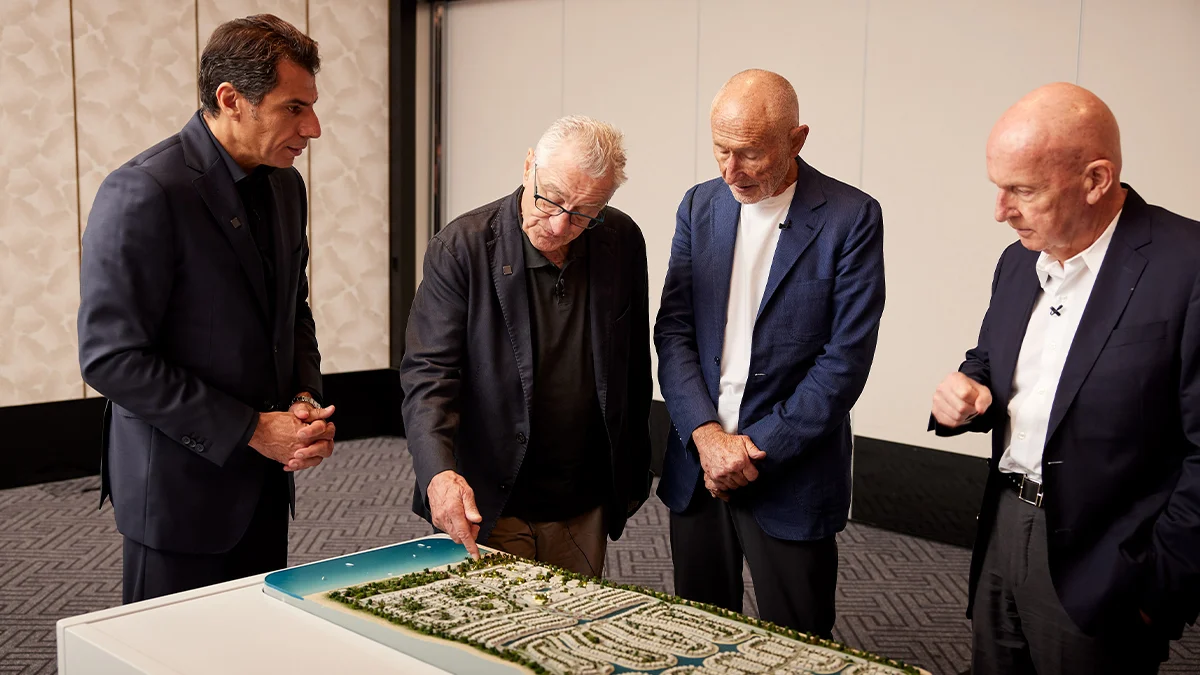
Executed in strategic partnership with leading real estate developer SODIC, the multi-faceted expansion will span across Cairo and the pristine Mediterranean coastline. It encompasses high-end restaurants, luxury hotels, and exclusive branded residences.
The initiative is highlighted by three major developments:
- Eastown District, New Cairo: A newly opened Nobu restaurant acting as a prelude to a forthcoming hotel slated to open next year.
- OGAMI (Ras El Hekma Bay): A sweeping 440-acre coastal development on the Mediterranean hosting a Nobu Hotel, branded residences, and beachfront villas, anchored by a seasonal restaurant that launched last summer.
- New Zayed: A third integrated hotel and residential destination situated west of Cairo, strategically positioned just 20 minutes from the Giza Pyramids, the Great Sphinx, and the newly anticipated Grand Egyptian Museum.
Chronology: From La Cienega Boulevard to a Global Empire
To understand the magnitude of Nobu’s Egyptian rollout, one must look back to the late 1980s. At the time, Robert De Niro was living on La Cienega Boulevard in Los Angeles, directly across the street from a small, unassuming Japanese restaurant run by a classically trained chef named Nobu Matsuhisa.
"I was just happy getting my food brought to my apartment each day," De Niro recalls with a trademark smile. "One of the waiters would bring it across the street, put it in my elevator, and it’d bring it up to the 10th floor where I lived."
The casual delivery routine soon blossomed into a profound professional relationship. Introduced by British film director Roland Joffé, De Niro spent just half an hour with Matsuhisa before making a prophetic pitch: "If you ever want to open a restaurant in New York, let me know."
De Niro recognized something entirely unique in Matsuhisa’s cuisine—which expertly fused traditional Japanese techniques with vibrant Peruvian ingredients discovered during the chef’s time living in Lima. "It had a sexiness to it, a pizazz," De Niro notes. "I’d never seen a Japanese restaurant like that on the East Coast."
It took several years of persistent persuasion, but in 1994, the first collaborative Nobu restaurant officially opened in New York City. What began as a single downtown eatery quickly snowballed into an international cultural phenomenon. Today, the brand encompasses nearly 60 restaurants worldwide, alongside an expanding portfolio of luxury hotels and high-end residential developments.

The evolution from a standalone dining concept into a multi-billion-dollar hospitality empire was largely organic. As De Niro explains, the shift toward hotels and residences was born from a simple realization about the brand’s immense cultural capital.
"When we were repeatedly being asked to be in places, hotels, buildings, shopping centers, I’d always ask myself: Why are we being asked to be in all these places? And the answer is, because it adds a kudos, a certain credibility," De Niro says. Drawing a parallel to his acting career, he realized that if the Nobu name was bankable, the founders had earned the right to equity and active participation in these developments. The foundational rule shifted: "We’ll do a restaurant, but we want to do a hotel, too, or later a residence."
Meir Teper echoes this sentiment, emphasizing that the brand’s trajectory was never mapped out by a rigid corporate master-plan. "Sometimes it just happens without planning," Teper says. "Bob’s vision becomes: Why don’t we do our own hotels rather than go to other brands’ hotels? Then we do a hotel in Toronto, and the developers say, Can you do also a residence? When things happen and are successful, it makes more things happen."
Supporting Data: The Transformation of Egypt’s Luxury Market
The partnership with SODIC—a developer with more than 27 years of experience crafting master-planned communities across Cairo and Egypt’s North Coast—did not happen in a vacuum. It is part of a broader, macroeconomic shift sweeping through the country.
According to Trevor Horwell, CEO of Nobu Hospitality, the catalyst for the Egyptian expansion came through an introduction by Abu Dhabi-based Aldar Properties, a major shareholder in SODIC.
"We’d already been working on a major luxury development with Aldar on Saadiyat Island in Abu Dhabi, when the guys at Aldar said, Look, you have to meet with SODIC… they’re doing spectacular things in Egypt," Horwell explains. "So we flew to Egypt and went to the North Coast and saw everything that was going on. I’d lived there many years ago, and could see how profound the change was."
Ayman Amer, general manager at SODIC, points to a massive influx of direct foreign investment as the primary driver behind this renaissance. "There’s a lot of direct foreign investment getting into this market: Emiratis, Qataris, and others," Amer notes.
Crucially, this financial influx has been paired with heavy infrastructure development over the past decade. The opening of new airports, improved national connectivity, and a surge in chartered flights from Europe and the Gulf Cooperation Council (GCC) nations have fundamentally altered the country’s tourism landscape.
The financial indicators in the hospitality sector are stark. According to industry data shared by Amer, average luxury room rates along the North Coast have skyrocketed from historical baselines of $200 or $300 to upwards of $1,000 per night over the past two years alone.

Official Responses: Respecting Local Culture and Expanding Horizons
For the leadership team behind Nobu, success in a new market hinges on a delicate balance between maintaining the brand’s distinct global identity and deeply respecting indigenous traditions.
"You’ve got to embrace the local culture and blend into that," says Horwell. "You have to adapt to the local customs and lots of other things. Nobu is doing that everywhere… but in Egypt, we think that, especially on the North Coast, it’s very, very special. The location is very untouched, and we’re going to be the first. I expect many others will come after us."
The architectural vision for the Egyptian projects reflects this cross-cultural synthesis. Teper notes that the group enlisted a trusted New York-based architecture firm—one that has previously designed several international Nobu properties—to collaborate with SODIC.
"They liked what they saw, and they’ve used a lot of local materials while incorporating into designs our Nobu, Japanese look and feel," Teper says. "It’s going to be a beautiful product."
Furthermore, the team is looking to challenge historical travel patterns within the region. Traditionally, Egypt’s Mediterranean coastline (known locally as Sahel) has functioned strictly as a seasonal summer retreat, populated for roughly six months of the year before going dormant for the winter. Nobu and SODIC aim to shatter this paradigm.
"We’re also doing a residential development at Sahel… which is currently considered by everyone to be a place to visit for only six months of the year," Teper explains. "We want to change it to an all-year-round destination for people to buy a house or villa in. Including in the wintertime."
Implications: A New Benchmark for Mixed-Use Luxury
The entry of Nobu into Egypt signifies much more than the rollout of three new luxury destinations; it highlights a profound maturation of the global hospitality model.
By evolving from a purveyor of high-end dining into an anchor for master-planned, multi-use communities encompassing hotels, branded residences, and entire neighborhood ecosystems, Nobu has redefined its market position. The brand no longer just rents its name for cachet; it drives real estate value, stimulates regional economies, and opens up frontier markets to international luxury travelers.
From an elevator shaft on La Cienega Boulevard to the sweeping vistas of the Mediterranean Sea and the timeless horizon of the Giza pyramids, the journey of Nobu is a testament to the power of intuition, creative synergy, and bold international expansion. As Egypt positions itself as the new epicenter of Mediterranean luxury, Nobu and SODIC are ensuring they are right at the forefront of its history.
 Basiran
  Sagoh
Sagoh  Dwi Wanna