

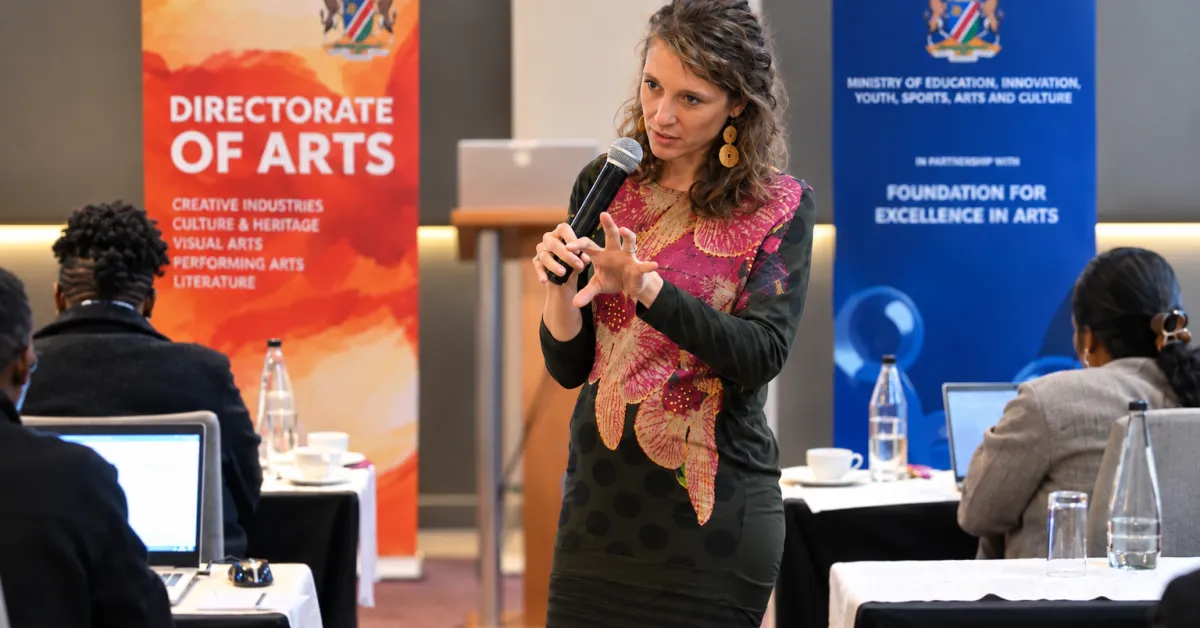
WINDHOEK, Namibia — In a decisive step toward cementing the foundational role of heritage, creativity, and identity in national progress, key governmental and international stakeholders convened at the Avani Hotel in Namibia’s capital for a high-level two-day gathering.
The Ministry of Education, Innovation, Youth, Sports, Arts and Culture (MEIYSAC), operating in close coordination with the National Arts Council of Namibia and the City of Windhoek, partnered with the United Nations Educational, Scientific and Cultural Organization (UNESCO) to host the final restitution workshop on the UNESCO Culture|2030 Indicators. Held from August 4 to 5, 2026, the event marked the culmination of an exhaustive data collection and analytical journey designed to measure, quantify, and elevate the economic and social impact of culture across the Southern African nation.
Drawing together 32 distinguished delegates—representing a cross-section of national and local government bodies, prestigious academic institutions, bustling cultural enterprises, civil society organizations, and international development partners—the workshop served as a vital forum. Attendees did not merely review statistical metrics; they engaged in profound discussions regarding how traditional values and contemporary creative industries can actively drive Namibia’s broader sustainable development agenda.
Main Facts
The core objective of the August 2026 workshop in Windhoek was twofold: to present the definitive implementation results of the UNESCO Culture|2030 Indicators framework within Namibia, and to tangibly demonstrate how cultural assets directly contribute to sustainable growth, social cohesion, and environmental resilience.
- Convening Partners: The Ministry of Education, Innovation, Youth, Sports, Arts and Culture (MEIYSAC), the National Arts Council of Namibia, and the City of Windhoek, in strategic alliance with UNESCO.
- Dates: August 4–5, 2026.
- Location: Avani Hotel, Windhoek, Namibia.
- Participants: 32 specialized delegates spanning government ministries, local authorities, academic researchers, creative sector practitioners, civil society representatives, and multilateral development partners.
- Primary Instrument: The UNESCO Culture|2030 Indicators—a pioneering framework of thematic and operational indicators that measures the contribution of culture to the national and local implementation of the 2030 Agenda for Sustainable Development.
- Key Outcomes: Presentation of empirical implementation results, promotion of widespread results dissemination, formulation of targeted policy actions, and the establishment of robust frameworks for future data collection and continuous monitoring.
Chronology of the Initiative
The path leading to the August 2026 restitution workshop in Windhoek was built upon a deliberate, multi-year strategic roadmap designed to embed cultural metrics into national policy planning.
Phase 1: Institutional Alignment and Framework Adoption (2024–2025)
Recognizing that culture has historically been undervalued in macro-economic planning, MEIYSAC—alongside the National Arts Council of Namibia and municipal leaders in Windhoek—engaged UNESCO to explore the deployment of the Culture|2030 Indicators. Unlike traditional economic metrics that focus strictly on industrial output or agricultural yields, this framework offers a multi-dimensional approach. Preparatory committees were established, bringing together statisticians from the Namibia Statistics Agency (NSA) and cultural experts to map out existing data gaps.
Phase 2: Data Collection, Synthesis, and Pilot Studies (Mid-2025 to Early 2026)
Over several months, national stakeholders executed a comprehensive data-gathering campaign. This phase evaluated four main dimensions of the framework:
- Environment and Resilience: How heritage and traditional practices interact with environmental protection and urban sustainability.
- Prosperity and Livelihoods: The economic weight of cultural and creative industries (CCIs), employment rates, and contribution to the Gross Domestic Product (GDP).
- Knowledge and Skills: Educational integration, cultural literacy, and the transmission of indigenous knowledge systems.
- Inclusion and Participation: Access to cultural heritage, gender equality within the arts, and the role of culture in fostering social inclusion.
Phase 3: The Restitution Workshop (August 4–5, 2026)
The process culminated in the two-day gathering at the Avani Hotel. Day one focused on revealing the empirical findings of the data collection exercise to the 32 invited stakeholders. Participants analyzed how Namibian cities, particularly Windhoek, measure up against international benchmarks. Day two pivoted toward actionable strategy: translating statistical findings into concrete policy recommendations, improving institutional data-sharing mechanisms, and drafting a sustainable monitoring roadmap for the post-2026 era.
Supporting Data and Thematic Insights
The implementation of the UNESCO Culture|2030 Indicators in Namibia provides an invaluable empirical foundation for policymakers. While cultural richness has always been a point of national pride, quantifying its socio-economic value has historically presented challenges. The workshop highlighted several critical data points and thematic areas:
The Economic Footprint of Creative Industries
Historically, the contribution of arts, crafts, music, literature, and heritage tourism to Namibia’s economy was largely anecdotal. The Culture|2030 implementation sheds light on the economic viability of the Cultural and Creative Industries (CCIs). Preliminary findings presented at the workshop indicate that CCIs serve as a major employer of youth and women, offering vital avenues for self-employment and entrepreneurial growth outside the traditional mining and agricultural sectors.
Urban Sustainability and the Role of Local Government
As the nation’s administrative and economic hub, the City of Windhoek plays a pivotal role in shaping cultural infrastructure. The indicators assessed how urban planning integrates cultural spaces, public art, and heritage preservation. Data demonstrated that cities incorporating cultural considerations into their zoning and development plans experience higher levels of civic engagement, enhanced social cohesion, and improved tourist attraction metrics.
Education and Intergenerational Knowledge Transfer
A significant portion of the data analyzed during the project focused on the "Knowledge and Skills" dimension. Namibia boasts a rich tapestry of indigenous knowledge systems, oral traditions, and traditional craftsmanship. The workshop data underscored the urgent need to bridge formal educational curricula with traditional heritage safeguarding, ensuring that younger generations not only appreciate their heritage but can monetize and protect intellectual property rights effectively.
Official Responses and Stakeholder Perspectives
The significance of the restitution workshop resonated deeply across all participating institutions, highlighting a unified national resolve to elevate culture as a fourth pillar of sustainable development—alongside economic growth, social inclusion, and environmental protection.
Speaking on behalf of the government, senior representatives from MEIYSAC emphasized that the empirical data generated through the UNESCO framework provides the missing link between cultural advocacy and state budgeting. “For too long, culture has been viewed merely as a source of national identity or entertainment,” noted a ministry spokesperson during the opening sessions. “The findings presented at this workshop prove beyond a doubt that culture is an economic driver, an educational tool, and a catalyst for social healing. We now possess the hard data required to advocate for increased budgetary allocations and more robust legal protections for our artists and heritage sites.”
The National Arts Council of Namibia echoed these sentiments, pointing out that creative practitioners stand to benefit immensely from evidence-based policymaking. When cultural output can be accurately measured in terms of job creation and GDP contribution, negotiating public-private partnerships and securing venture capital becomes considerably more streamlined.
Meanwhile, representatives from the City of Windhoek highlighted the municipality’s dedication to urban cultural planning. “As local leaders, we see daily how public spaces, community theaters, and heritage sites anchor our communities,” a municipal delegate stated. “The insights gained from the Culture|2030 Indicators allow us to design smarter, more inclusive urban environments where economic development walks hand-in-hand with cultural preservation.”
UNESCO representatives commended Namibia for its proactive stance. By successfully implementing the indicators, Namibia joins a vanguard of global nations willing to scrutinize and elevate their cultural sectors using standardized, internationally recognized benchmarks. International development partners at the workshop further pledged continued technical and financial assistance to ensure that the momentum generated in Windhoek translates into long-term institutional capacity building.
Broader Implications for Namibia’s Future
The successful conclusion of the UNESCO Culture|2030 Indicators restitution workshop carries profound implications for Namibia’s socio-economic trajectory over the coming decade.
1. Policy Reform and Legislative Strengthening
The most immediate implication is the potential for targeted policy overhaul. Armed with empirical data, MEIYSAC and its partners are uniquely positioned to lobby for updated cultural policies, intellectual property rights frameworks, and tax incentives tailored specifically to creative entrepreneurs. Moving away from vague cultural promotions toward data-backed legislative mandates will ensure long-term stability for artists and heritage workers.
2. Enhanced Data Collection and Statistical Integration
A major hurdle identified during the workshop was the historical fragmentation of cultural data across different government departments. The framework has laid the groundwork for a centralized, cross-sectoral data collection mechanism. Moving forward, integrating cultural metrics into the national census and periodic labor force surveys conducted by the Namibia Statistics Agency will become standard practice, ensuring continuous monitoring of the sector’s health.
3. Boosting Economic Diversification and Tourism
Namibia is globally renowned for its breathtaking landscapes and wildlife tourism. However, the cultural dimension—spanning diverse indigenous communities, rich musical traditions, unique culinary arts, and contemporary visual arts—represents an under-leveraged frontier. By demonstrating the value of culture through the UNESCO indicators, Namibia can diversify its tourism product, attracting high-spending cultural tourists and positioning itself as a premier creative hub in Southern Africa.
4. Fostering Social Cohesion and Youth Empowerment
With a median age under 25, Namibia faces the critical challenge of youth unemployment. The cultural and creative industries are uniquely positioned to absorb young talent, ranging from digital media creators and fashion designers to traditional artisans and performing artists. By validating the economic viability of these sectors, the workshop outcomes support national efforts to foster youth empowerment, reduce poverty, and strengthen national unity in a multicultural society.
Conclusion
The final restitution workshop on the UNESCO Culture|2030 Indicators held at the Avani Hotel in Windhoek on August 4–5, 2026, will be remembered as a watershed moment for Namibia. By merging rigorous international methodology with local cultural richness, MEIYSAC, the National Arts Council, the City of Windhoek, and UNESCO have charted a clear, measurable course toward a sustainable future—proving that a nation’s cultural heritage is not merely a reflection of its past, but the ultimate compass for its future development.
 Pevita Pearce
 Reynand Wu
