

Introduction: The Forgotten Foundation of the American West
To the average traveler crossing the vast, arid expanse of the American West, the landscape often blurs into a monotonous tapestry of dust and scrub brush. Between the dramatic sandstone monoliths of Moab and the alpine majesty of the San Juan Mountains lies a formation that is frequently overlooked, dismissed as mere "badlands" or dreary gray hills. This is the Mancos Shale—a geologic behemoth that stretches across New Mexico, Arizona, Colorado, Wyoming, and Utah. While it lacks the photogenic verticality of the Navajo Sandstone, it is perhaps the most defining, and misunderstood, geologic actor on the Colorado Plateau.
Ninety million years ago, during the Late Cretaceous, this region was not a desert. It was the floor of the Western Interior Seaway, a massive inland ocean that bisected North America. The sediment that settled at the bottom of this ancient sea—microscopic clay particles and organic detritus—eventually lithified into the Mancos Shale. Today, that seafloor has been pushed, folded, and eroded to form the friable, gray-blue-brown mudstone that defines the horizon for thousands of miles.
Chronology of a Cretaceous Basin
The story of the Mancos Shale begins in the middle of the Late Cretaceous, a period of global sea-level rise.
- 95 Million Years Ago: The Western Interior Seaway reaches its peak, inundating the continental interior. As the sea deepens, vast quantities of silt and mud accumulate, trapping organic material from marine life.
- 70 Million Years Ago: The Laramide Orogeny begins. The tectonic upheaval that created the Rocky Mountains starts to uplift the seafloor. The Mancos Shale is raised from its submarine resting place, though it remains soft and susceptible to the elements.
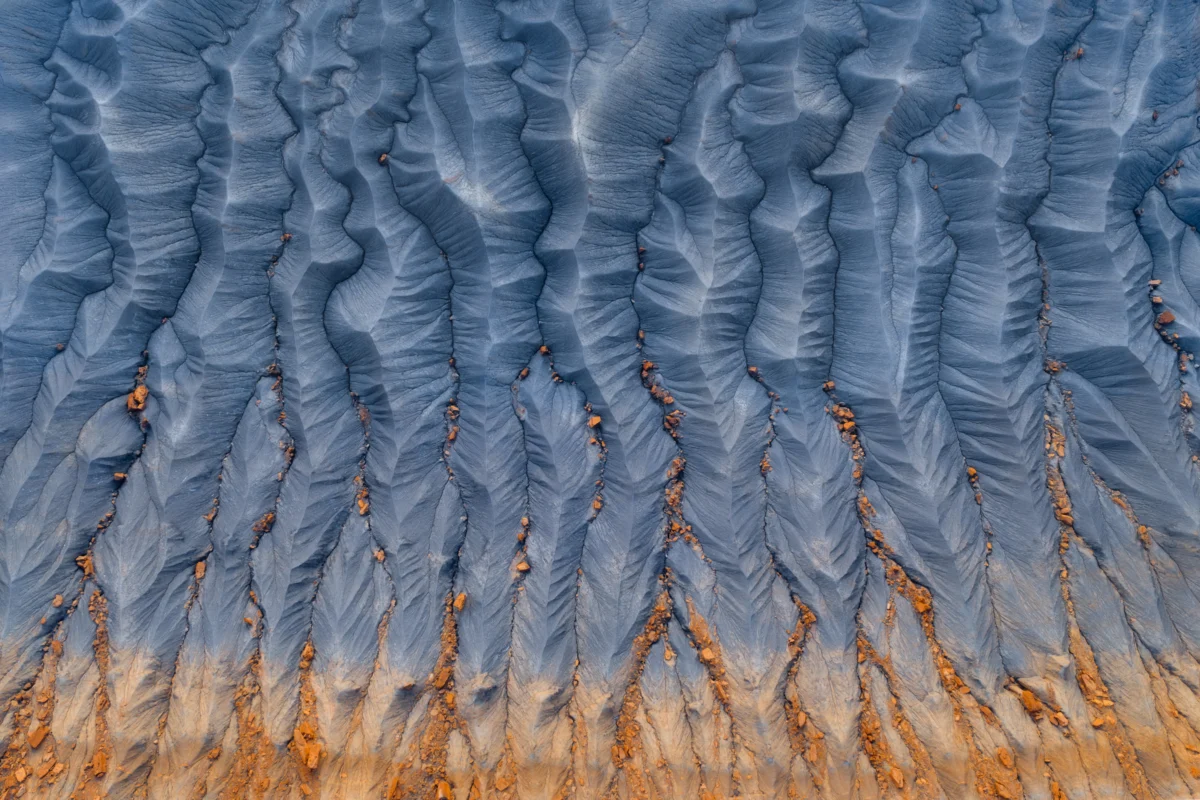
- Post-Glacial Epochs to Present: Cycles of glaciation and aridity carve the formation into its current, complex topography. Because the shale is "fissile"—it breaks into thin, fragile sheets—it creates a unique "fractal" pattern of erosion, where the smallest rill mimics the shape of a massive canyon.
The Geologic Science: Why "Friable" Matters
The defining characteristic of the Mancos Shale is its fragility. Geologists classify it as a clastic sedimentary rock. Because it is composed of very fine-grained clay minerals, it does not hold a "cliff" profile like the harder, more resistant sandstones that sit above it in the stratigraphic column.
When rain hits the Mancos, it doesn’t just wash away; it swells, turns into a slick, impassable "gumbo" mud, and then dries into a powdery, gray crust. This process, known as "shrink-swell," is a nightmare for civil engineers but a masterpiece of natural art. The erosion patterns are often dendritic, branching out like the veins of a leaf or the circuitry of a computer chip. It is a land of fractals, where every inch of ground is a miniature version of the entire landscape.
Supporting Data: An Economic and Ecological Pivot Point
The Mancos Shale is not merely an aesthetic curiosity; it is a critical resource and a point of immense controversy.
- Hydrocarbon Potential: The same organic matter that settled in the Cretaceous sea eventually matured into significant oil and gas deposits. The Mancos Shale plays are currently among the most productive in the San Juan Basin.
- Water Quality Impacts: Because the shale is rich in salts and minerals—a byproduct of its marine origin—runoff from Mancos landscapes is notoriously high in dissolved solids. This contributes significantly to the salinity of the Colorado River, affecting downstream agricultural irrigation in California and Arizona.
- Flora and Fauna: The soil derived from the Mancos is often alkaline and toxic to many plants, leading to unique, specialized ecosystems. Species like the Mancos milkvetch are endemic to these specific soils, having evolved to thrive where others fail.
Official Perspectives and Industry Challenges
The Bureau of Land Management (BLM) and various geological surveys view the Mancos Shale as a "high-maintenance" landscape. For land managers, the primary concern is erosion control and the stabilization of infrastructure.
"The Mancos is a landscape in constant motion," notes one regional geologist. "You cannot build a road across it without it eventually reclaiming the path. It is perhaps the most ‘alive’ rock formation we have, in terms of its daily transformation."
From an industrial standpoint, the Mancos presents a paradox. While it contains vast energy reserves, the shale’s tendency to swell makes well-bore stability difficult. Engineers must use specialized drilling muds and casing techniques to prevent the formation from collapsing into the wellbore—a constant battle between human ambition and the geologic nature of the rock.
Implications for the Future
As we look toward the future of the American West, the Mancos Shale serves as a reminder of our tenuous relationship with the land.
1. The Challenge of Infrastructure
Climate change, characterized by more intense, sporadic precipitation events, is accelerating the erosion of the Mancos. For those living and working on these lands, the maintenance of roads, pipelines, and fences is becoming increasingly difficult as the ground itself continues to shift and dissolve.
2. Conservation and Stewardship
Because the Mancos supports unique, salt-tolerant plant communities, it has become a focus for restoration ecologists. The challenge lies in identifying which areas of the shale are prone to irreversible erosion and which can be managed for biodiversity. It is not a landscape that can be "fixed" in the traditional sense; it is a landscape that must be understood and accommodated.
3. The Aesthetic Shift
Perhaps the most significant implication is a cultural one. We are learning to value the "lesser" landscapes. The grand canyons and snow-capped peaks will always draw the tourists, but the subtle, gray-blue beauty of the Mancos Shale is beginning to attract its own audience of photographers, writers, and naturalists. It is a landscape that requires a slower pace—a "dusty exploration" that rewards the observer with a deep, quiet appreciation for the persistence of time.
Conclusion: A Lesson in Humility
Driving through the heart of the Mancos, one cannot help but feel a sense of humility. The radio static, the vastness of the horizon, and the infinite fractal patterns in the dirt remind us that we are merely visitors on a surface that has been shifting for nearly a hundred million years.
The Mancos Shale does not shout like the Grand Canyon. It whispers. It whispers of ancient seas, of tectonic forces that built the mountains, and of a future where the land continues to reform itself in the wake of our own short-lived endeavors. To appreciate the Mancos is to appreciate the true, raw, and often messy process of earth-making. It is the forgotten foundation, the dusty backdrop, and the quiet, persistent architect of the American West. Next time you find yourself crossing these gray, unassuming hills, don’t look past them. Look down. The history of the world is written in the mud.
 Nana Muazin
  Azzam Bilal Chamdy
  Siti Muinah