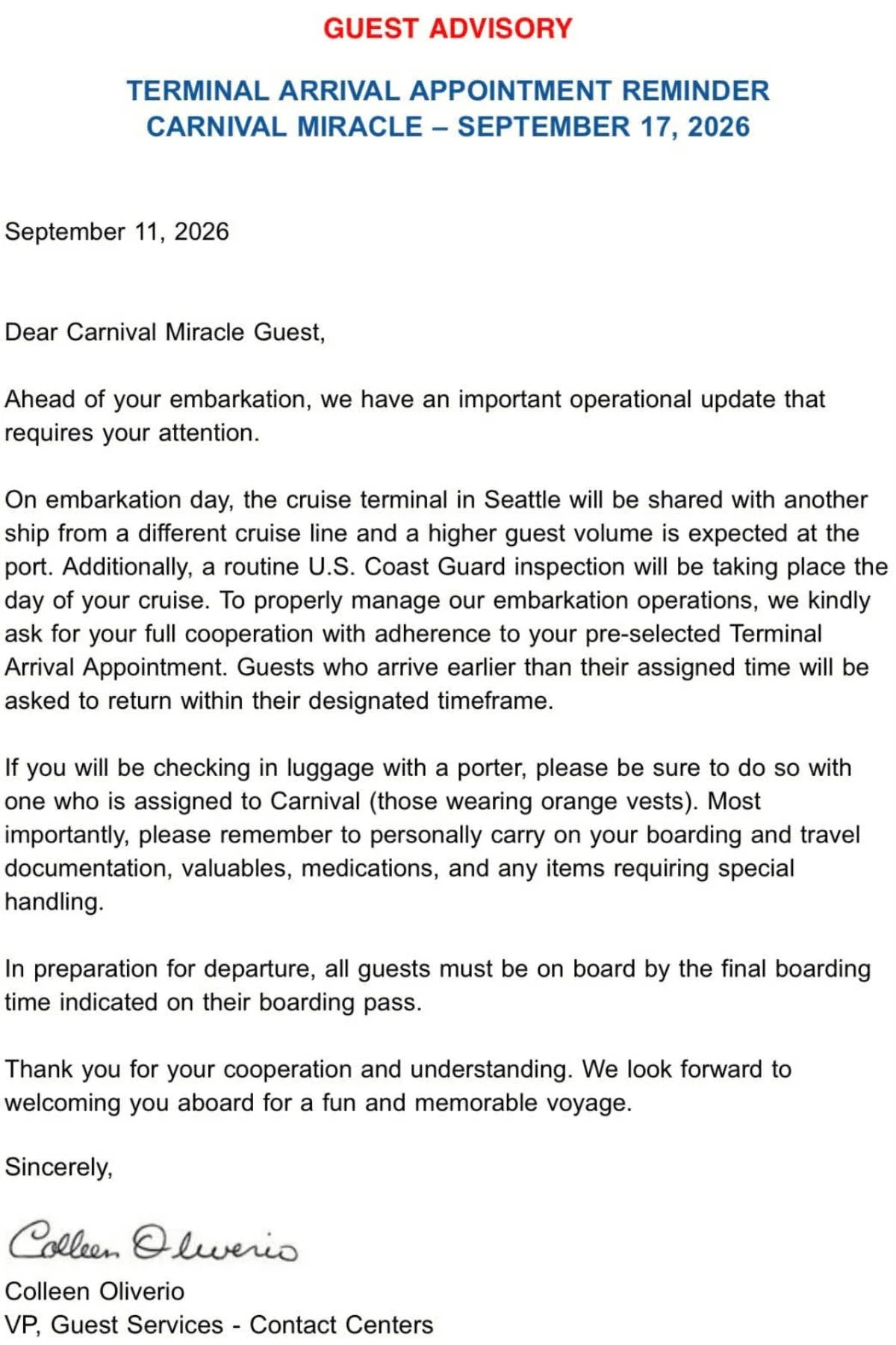
SEATTLE, Washington — Passengers booked on the upcoming September 17, 2026, voyage of the Carnival Miracle out of Seattle are facing strict directives from cruise line executives. In an official communication distributed to travelers on September 11, Carnival Cruise Line explicitly instructed guests not to arrive at the Smith Cove Cruise Terminal at Pier 91 ahead of their pre-assigned terminal arrival appointments.
The warning underscores a growing operational challenge for major cruise operators navigating heavily congested North American homeports. With simultaneous ship turnarounds, routine regulatory inspections, and peak-season passenger volumes converging on a single waterfront facility, cruise lines are adopting a zero-tolerance policy toward early arrivals to maintain terminal fluidity and prevent chaotic highway and curbside backups.
Main Facts
The operational advisory centers on a specific confluence of events at the Port of Seattle on Wednesday, September 17, 2026:
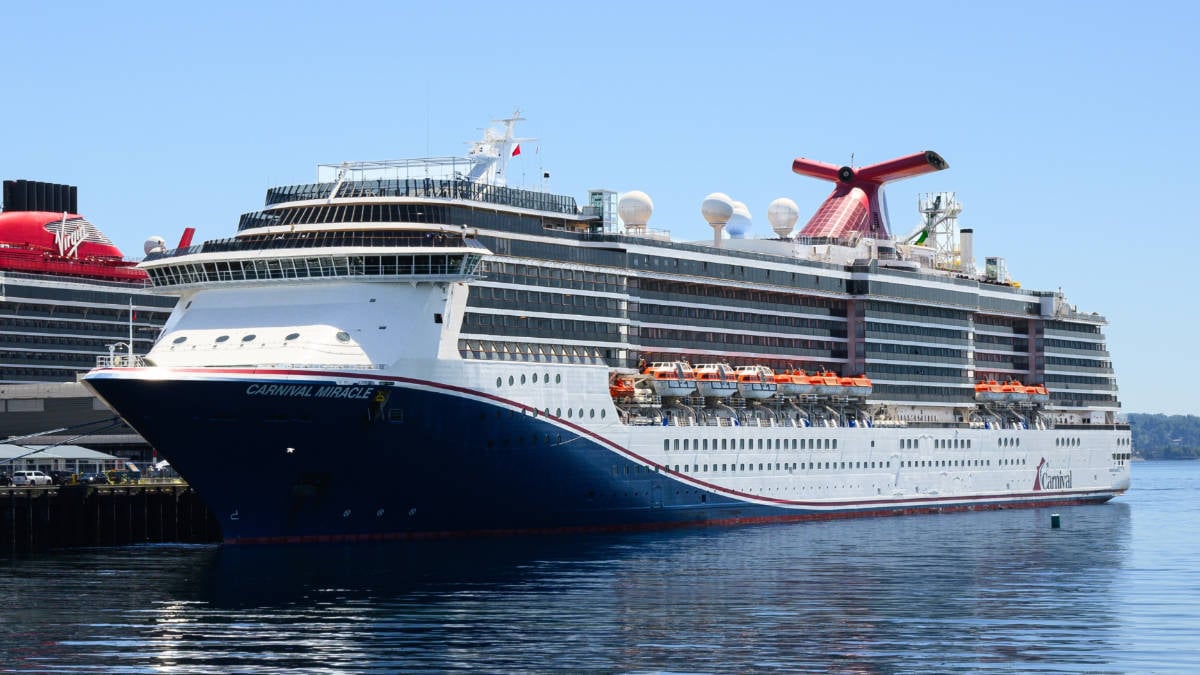
The Vessel: The Carnival Miracle, an 88,500-gross-ton Spirit-class ship with a double-occupancy capacity of 2,124 passengers, is preparing for its final Alaska voyage of the 2026 season.
The Location: Smith Cove Cruise Terminal at Pier 91 in Seattle, Washington.
The Core Directive: Guests arriving prior to their designated, pre-selected terminal arrival time will be turned away and told to return during their proper window.
Contributing Factors: Pier 91 will handle dual-ship operations with Cunard’s Queen Elizabeth, alongside a routine, scheduled United States Coast Guard safety and compliance inspection.
Itinerary Adjustments: The 9-night Alaska itinerary will feature calls in Ketchikan, Sitka, Skagway, Juneau, and Victoria, alongside scenic cruising through Endicott Arm, though it excludes Tracy Arm due to ongoing geological instability following regional natural disasters.
Chronology of Events
To understand how this port congestion materialized, it is necessary to examine the timeline leading up to the September 17 departure:
August 2025: A significant landslide and subsequent tsunami occur in the Tracy Arm fjord region of Alaska. The geological instability prompts widespread safety evaluations across regional cruise corridors.
Early 2026: Carnival Cruise Line officially removes Tracy Arm from all 2026 Alaska itineraries, substituting alternative scenic cruising routes such as Endicott Arm to ensure passenger and vessel safety.
October 2025 – February 2026: The Port of Seattle finalizes and publishes its preliminary 2026 cruise calendar, locking in overlapping port calls at Pier 91 between Carnival Cruise Line and Cunard Line for mid-September.
September 11, 2026: Recognizing the logistical hurdles of the upcoming turnaround day, Carnival dispatches an urgent email advisory to all booked guests of the Carnival Miracle, warning them of high traffic volumes and mandating strict adherence to arrival windows.
September 17, 2026 (Embarkation Day): The high-stakes turnaround takes place at Smith Cove Cruise Terminal, marked by dual-ship processing, Coast Guard inspections, and active enforcement of arrival times.
September 26, 2026: Following its return to Seattle, the Carnival Miracle is scheduled to embark on a 16-night Panama Canal repositioning cruise, officially concluding its Pacific Northwest season and setting a course for Galveston, Texas.
Supporting Data and Port Logistics
The logistical strain at Pier 91 on September 17 is driven by specific operational data points involving passenger volumes, port scheduling, and regulatory oversight.
Dual-Ship Terminal Sharing
While Carnival’s initial September 11 notice broadly referenced sharing Pier 91 with a ship from another line, cross-referencing the Port of Seattle’s official maritime schedule identifies the vessel as Cunard’s Queen Elizabeth.
Cunard’s Queen Elizabeth: Accommodating approximately 2,081 guests, this luxury liner is scheduled to depart Pier 91 at 5:00 p.m. on September 17—just one hour after the Carnival Miracle, which targets a 4:00 p.m. departure. The Queen Elizabeth is set to embark on a 7-night Alaska voyage calling at Ketchikan, Juneau, and Victoria, featuring scenic cruising in Endicott Arm before returning to Seattle on September 24.
Combined Volume: Together, the two vessels will inject more than 4,200 embarking passengers into the terminal area within a compressed afternoon window, compounded by thousands of disembarking guests wrapping up their previous sailings.
U.S. Coast Guard Oversight
Adding to the terminal’s operational complexity, a routine U.S. Coast Guard inspection is slated for the same day. While standard operating procedure for cruise vessels, these inspections require dedicated coordination between federal maritime officers, port security, and shipboard leadership, consuming valuable terminal personnel resources and limiting spatial flexibility.
Itinerary Overview: The Carnival Miracle’s Final 2026 Alaska Run
The September 17 sailing is a 9-night roundtrip voyage from Seattle. The route includes:
Ketchikan, Alaska
Sitka, Alaska
Skagway, Alaska
Juneau, Alaska
Victoria, British Columbia
Scenic cruising through Endicott Arm
Notably, this itinerary reflects post-2025 adjustments. The voyage was originally slated to include Tracy Arm Fjord. However, following the major August 2025 landslide and tsunami, geological surveys deemed the fjord too unstable for regular cruise traffic. Carnival proactively modified its 2026 Alaska deployments to avoid the area, prioritizing the safety of the 88,500-gross-ton ship and its passengers.
Official Responses and Directives
Carnival Cruise Line has adopted an uncompromising stance regarding terminal arrivals, mirroring similar warnings issued recently at other high-density homeports, such as the Carnival Venezia operations in New York.
In the September 11 communication sent to passengers, cruise line representatives emphasized that arrival appointments are binding operational windows rather than loose guidelines:
“To properly manage our embarkation operations, we kindly ask for your full cooperation with adherence to your pre-selected Terminal Arrival Appointment,” the notice stated.
The line explicitly outlined the consequences for travelers attempting to bypass their designated times:
“Guests who arrive earlier than their assigned time will be asked to return within their designated timeframe.”
Cruise management elaborated on curbside protocols, instructing passengers utilizing baggage porters to look exclusively for authorized personnel wearing distinct orange vests. Furthermore, travelers were reminded to retain custody of essential carry-on items—such as passports, government-issued identification, medications, electronic devices, and travel documents—rather than checking them with baggage handlers.
Despite the anticipated bottlenecks, Carnival confirmed that the ship’s departure schedule remains unaffected. The Carnival Miracle is expected to cast off precisely on time, requiring all passengers to be fully checked in and onboard by the final boarding window specified on their cruise documents.
Implications for Travelers and the Industry
The enforcement measures at Pier 91 highlight broader structural shifts within the modern cruise industry. As cruise ships grow larger and homeports face space constraints, managing the flow of passengers from land to sea has become a complex logistical science.
The Problem of "Early Bird" Arrivals
Historically, cruise passengers frequently arrived at terminals hours before their scheduled boarding times in hopes of getting an early start on their vacations. However, in major urban ports like Seattle, New York, Miami, and Port Everglades, early arrivals create severe traffic backlogs on municipal roadways, overwhelm terminal security queues, and disrupt the seamless disembarkation of passengers finishing the previous cruise.
By threatening to turn away early arrivals, lines like Carnival are forcing compliance to protect local traffic agreements with port authorities and municipal governments, which heavily penalize cruise operations that cause gridlock.
The Evolution of Alaska Itineraries
The operational adjustments surrounding the Carnival Miracle also highlight the growing impact of environmental and geological changes on cruise tourism. The permanent removal of Tracy Arm from Carnival’s 2026 schedules demonstrates how cruise lines must remain flexible in the face of climate and geographical instability. Destinations once considered cruise staples are increasingly subject to sudden re-evaluations, requiring lines to pivot toward alternatives like Endicott Arm without diminishing the overall value of the passenger experience.
Future Deployment and Repositioning
For the Carnival Miracle, the September 17 sailing carries dual significance: it closes the book on a successful Pacific Northwest season and initiates a major logistical repositioning.
Immediately following its return to Seattle on September 26, the ship will embark on a 16-night Panama Canal cruise. This epic repositioning voyage will feature scenic transit through the Panama Canal alongside international port calls in Cabo San Lucas, Puntarenas, and Cartagena, culminating in the vessel’s arrival in Galveston, Texas, on October 12, 2026.
From its new Texas homeport, the Carnival Miracle will operate a robust schedule of Western and Eastern Caribbean itineraries through early May 2027. Following its Caribbean deployment, the ship is scheduled to cross the Atlantic on a transatlantic voyage on May 6, 2027, positioning itself for European summer operations.
Key Takeaways for Cruisers
For travelers preparing to board the Carnival Miracle on September 17, the message is unequivocal: respect the appointment times. By logging into their Carnival accounts, securing precise arrival slots, and planning local transportation to align precisely with those windows, passengers can protect themselves from curbside rejection and ensure a smooth start to their Alaskan journey.


 Asro
Asro  Suro Senen
  Basiran