

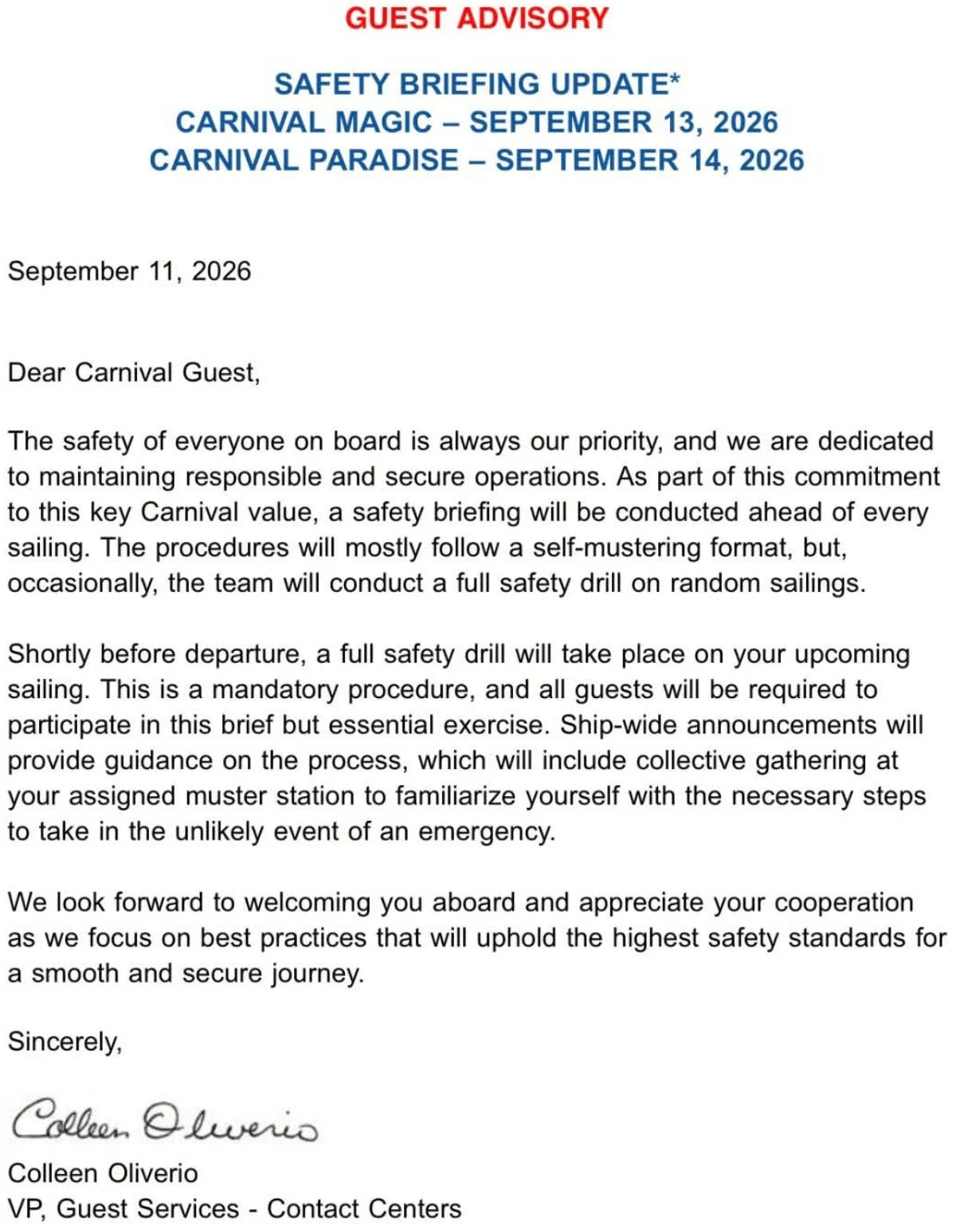
MIAMI & TAMPA — In a notable departure from the ubiquitous “e-muster” format that has defined the modern cruising experience since the global industry restart, Carnival Cruise Line has announced that passengers embarking on two of its vessels this mid-September will participate in a traditional, full-scale, in-person safety drill.
The requirement marks a temporary yet strict pivot away from the self-guided check-ins travelers have grown accustomed to over the past several years. Carnival has proactively reached out to all booked guests via email to apprise them of the operational change, detailing what they can expect during the mandatory proceedings.
The affected departures include the Carnival Magic, setting sail from the Port of Miami on Sunday, September 13, 2026, and the Carnival Paradise, departing from the Port of Tampa on Monday, September 14, 2026. Both ships will execute the comprehensive, ship-wide assembly drill prior to pulling away from their respective piers.
Main Facts: The Return of the Traditional Muster Drill
For millions of cruisers who have taken to the seas since 2021, the safety briefing has consisted of the "e-muster"—a streamlined, digital process where guests watch a safety video on their smartphones or stateroom televisions and then casually stroll up to their assigned muster station at their leisure before departure. A crew member scans their Sail & Sign card, verifies they know where to go, and the requirement is fulfilled in a matter of minutes.
The upcoming sailings for Carnival Magic and Carnival Paradise will scrap this convenience entirely.
“A full safety drill will take place on your upcoming sailing. This is a mandatory procedure, and all guests will be required to participate in this brief but essential exercise,” Carnival Cruise Line stated in its advisory email to passengers.
Unlike the self-paced e-muster, the traditional drill requires all passengers to stop what they are doing, report simultaneously to their designated assembly stations, and stand together while crew members review emergency protocols, demonstrate the proper donning of life jackets, and test the ship’s emergency horn signals.
Chronology of the Change: From Pre-2020 Tradition to Modern E-Muster and Semi-Annual Mandates
To understand why some passengers may find themselves surprised by this announcement, it helps to examine the evolution of cruise ship safety procedures over the last decade:
- Pre-2020: The traditional, mandatory in-person assembly drill was an immutable rite of passage for every cruise passenger. Thousands of travelers would crowd onto open decks or into interior lounges wearing heavy life jackets, waiting for the drill to conclude before the ship could legally cast off.
- 2021–2025 (The E-Muster Era): As the cruise industry resumed operations following pandemic-related suspensions, regulatory bodies and cruise lines widely adopted virtual mustering. The format was universally praised by passengers for eliminating congestion, reducing embarkation-day stress, and allowing travelers to begin enjoying their vacation immediately upon boarding.
- Late 2025–Present: Rumors and occasional passenger advisories regarding the return of full drills began to circulate widely. Industry insiders and cruise line representatives clarified that these were not permanent rollbacks of the e-muster system, but rather routine, mandatory compliance events required on a periodic basis.
- September 2026: Carnival Magic and Carnival Paradise issue alerts to upcoming travelers, confirming that their mid-September itineraries will feature the mandatory semi-annual in-person drills.
Supporting Data: Fleet Capacities and Time Commitments
Executing a full safety drill on a modern cruise ship is a massive logistical undertaking involving thousands of vacationers and hundreds of crew members. The scale of the operation is underscored by the passenger capacities of the two affected vessels:
- Carnival Magic (Dream-class): This massive vessel can comfortably accommodate 3,690 guests at double occupancy, but when every berth is filled to capacity, the passenger count surges to a maximum of 4,724 people.
- Carnival Paradise (Fantasy-class): As a smaller, more intimate ship, Carnival Paradise welcomes 2,190 guests at double occupancy, scaling up to a maximum capacity of 2,606 travelers.
While a self-directed e-muster check-in takes mere seconds and can be completed at any point between boarding and sail-away, a full in-person drill requires significantly more time. Depending on how efficiently passengers locate and travel to their assigned assembly stations—and the time required to complete the full curriculum of safety announcements and demonstrations—the entire process typically takes anywhere from 20 to 45 minutes.

Furthermore, during the exercise, safety procedures are broadcast over the ship’s public address (PA) system, and the vessel’s horn sounds the mandatory emergency signal: seven short blasts followed by one long blast.
Official Responses and Regulatory Context: Why Full Drills Still Happen
Understandably, receiving a notification about a mandatory, time-consuming assembly drill can cause mild anxiety or frustration for travelers accustomed to the swift e-muster process. However, cruise executives and brand representatives have repeatedly emphasized that these events are non-negotiable legal requirements.
Addressing similar rumors and scheduling rollouts in late 2025, Carnival Cruise Line Brand Ambassador John Heald took to social media to demystify the process for concerned guests.
“This is something that every single ship needs to do twice a year as per US Coast Guard, Australian Coast Guard, and other government agencies, and SOLAS, Safety of Life at Sea,” Heald explained.
The International Convention for the Safety of Life at Sea (SOLAS)—alongside stringent domestic maritime authorities—mandates that cruise ships conduct periodic physical safety drills to ensure that both crew members and passengers remain fully rehearsed in emergency evacuation procedures.
Carnival is not alone in implementing these periodic physical drills. Similar compliance exercises have previously affected other vessels within the fleet, including the Carnival Sunshine, Carnival Liberty, Carnival Valor, and Carnival Conquest. Under current operational standards, every ship in the Carnival fleet undergoes these full-scale physical drills twice annually.
To mitigate confusion and minimize guest friction, Carnival’s protocol dictates that passengers are notified several days prior to embarkation, allowing them to adjust their embarkation-day schedules accordingly.
Implications for Travelers: What Passengers Need to Know
For those boarding the Carnival Magic in Miami on September 13 or the Carnival Paradise in Tampa on September 14, the return of the traditional drill carries several practical implications:
- Adjusted Boarding Plans: Guests should avoid planning immediate spa appointments, specialty dining reservations, or shore excursion bookings during the late afternoon hours on embarkation day, as public spaces and elevators will be heavily utilized for the drill.
- Elevated Congestion: Muster stations can become tightly packed as thousands of guests attempt to gather in designated lounges, dining rooms, and open decks simultaneously. Travelers with mobility concerns or those traveling with small children are encouraged to speak with crew members upon boarding for specialized assistance.
- Patience is Key: Crew members will be stationed throughout the ship to guide guests to their correct zones. Following crew instructions promptly ensures that the mandatory exercise concludes as quickly and safely as possible, allowing the ships to depart on schedule.
Ultimately, while the return of the full in-person drill may temporarily disrupt the relaxed, frictionless rhythm of modern embarkation day, it stands as a vital reminder of the maritime industry’s unwavering commitment to safety on the high seas.
 Asro
Asro  Suro Senen
  Basiran