

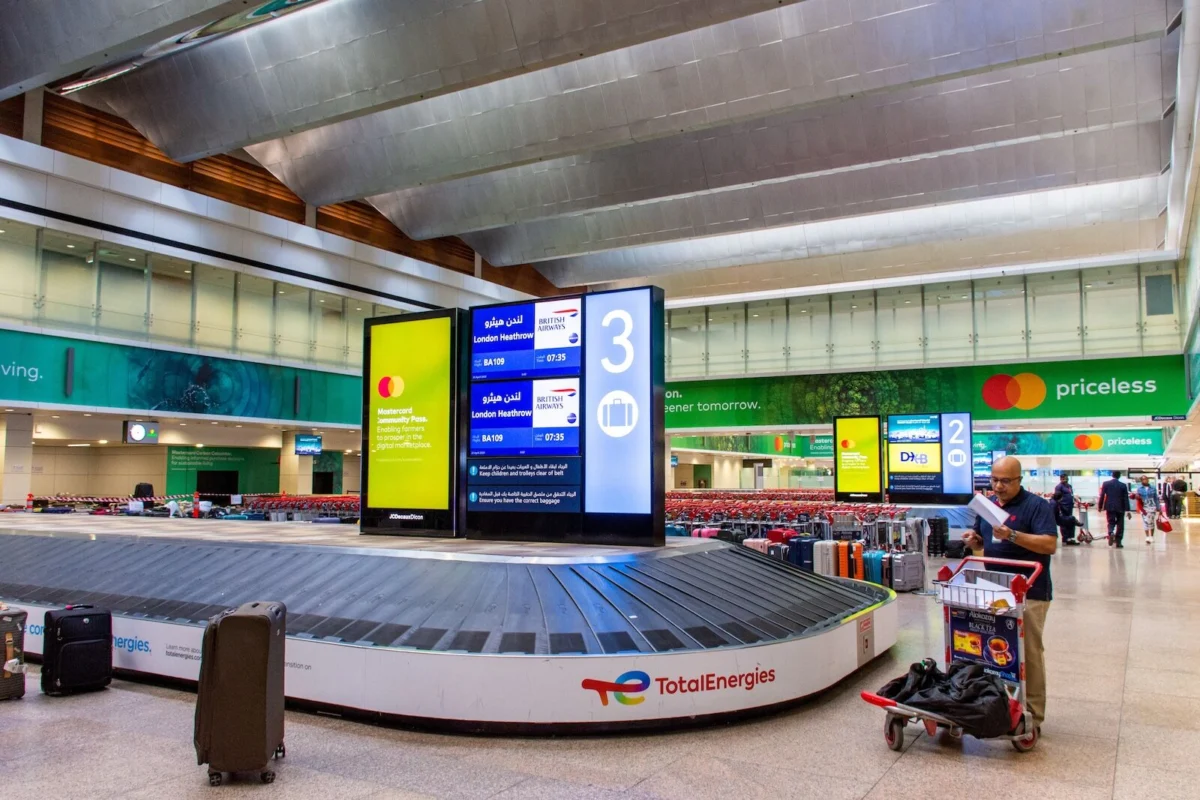
For millions of travelers, the experience of landing at a major airport follows a predictable, often frustrating rhythm: the wheels touch down, the cabin door opens, and the long, weary trek through the terminal begins. You walk past gates, navigate moving walkways, and weave through corridors until you finally reach the baggage claim area. By the time you arrive, your luggage is usually already circling the carousel.
While many travelers view this distance as a minor inconvenience—or a design flaw—the prevailing theory in the travel industry is that this walk is no accident. It is a masterclass in "queuing psychology," a deliberate strategy designed to mitigate passenger frustration by transforming idle waiting time into productive movement.
The Origin of the "Long Walk" Theory
The legend, which has gained significant traction on platforms like TikTok via creators such as @designsecretsss, centers on a specific anecdote regarding Houston’s George Bush Intercontinental Airport (IAH). According to the story, airport executives were besieged by passenger complaints regarding the agonizingly slow speed of baggage delivery.
Even after the airport invested in additional staffing and streamlined ground operations to reduce the physical wait time to a respectable eight minutes, the complaints persisted. The passengers, it seemed, were not just concerned with the speed of the bags; they were concerned with the agony of the wait.
The airport’s alleged solution was not to speed up the baggage handlers, but to change the passenger experience. By moving the baggage claim terminals to the far side of the airport, the travel time from the gate to the carousel was increased. By the time passengers had navigated the long trek through the terminal, the eight minutes of "actual" wait time had already elapsed. The result? The bags were waiting for the passengers, not the other way around. Complaints reportedly dropped to zero.
A Chronology of a Traveling Myth
While the TikTok version of this story feels modern, the narrative is an established fixture of travel lore. Its origins date back at least to 2012, when a New York Times opinion piece titled "Why Waiting in Line Is Torture" brought the concept into the mainstream. In that article, the author explored the psychological intricacies of queues, highlighting the Houston baggage story as a primary example of how human perception dictates the quality of an experience.
Since that publication, the anecdote has traveled through various mediums:
- The 2010s: The story surfaced in various psychology blogs and academic discussions regarding service management, often cited as a classic case of "managing expectations."
- The 2020s: With the rise of short-form video, the story found a new audience. Creators began retelling the tale, often adding hyperbolic details—some versions claim the walk takes six minutes, others claim a 12-minute detour—to emphasize the ingenuity of the design.
- The Present Day: The story remains a staple of airport trivia, circulating as a "life hack" that reveals the hidden architecture of our travel environments.
The Science of Queuing: Perceived vs. Actual Time
At the heart of this legend lies a fundamental truth of behavioral science: perceived wait time is far more important than actual wait time. Researchers, including those within the operations research community at institutions like MIT, have spent decades analyzing the physics of lines.
The consensus is clear: the experience of waiting is defined by the "unoccupied" nature of that wait. When a passenger stands idle at a carousel, their brain is focused entirely on the lack of progress. They are in a state of high-alert, watching the empty belt, checking their watch, and becoming increasingly irritated by every passing second. This is known as "unoccupied time," and it is psychologically perceived as being significantly longer than it actually is.
Conversely, when a passenger is walking—navigating through the terminal, finding their way to the baggage claim, or even just moving toward their destination—that time is "occupied." Because the individual is moving toward a goal, the brain processes the time as productive. Even if the total elapsed time from "plane doors open" to "baggage in hand" remains the same, the person who walked for eight minutes feels far less frustrated than the person who waited for eight minutes while standing still.
This principle is applied across industries. Disney, for example, is famous for its winding, themed queues that keep guests entertained and moving, ensuring that the wait for a ride feels like a part of the experience rather than a barrier to it.
The Search for Verification: An Elusive Fact
Despite the widespread repetition of the Houston baggage story, it remains an unverified piece of design lore. There is no official record or archived press release from Houston’s George Bush Intercontinental Airport confirming that a deliberate, strategic relocation of baggage claims was ever undertaken to solve a complaint crisis.
Matador Network and other investigative outlets have reached out to major carriers, including United and American Airlines, as well as airport authorities, to seek confirmation. As of the time of this writing, no official entity has stepped forward to validate the story.
Experts suggest that the "zero complaints" detail is likely a narrative flourish—a piece of storytelling hyperbole that makes the point more compelling. While it is entirely plausible that an airport might have moved a baggage claim for operational reasons or terminal expansion, the idea that it was done solely as a psychological trick to quiet grumpy travelers remains a "well-traveled myth." Whether or not it happened exactly as described, the story serves as a perfect illustration of how airports manage the complex, often irrational psychology of modern travel.
Industry Standards: How Baggage Actually Works
To understand the reality of baggage handling, one must look at the lack of federal standards. In the United States, there is no government-mandated regulation requiring airlines to deliver bags within a specific timeframe. However, the industry operates on an informal, self-imposed benchmark: 20 minutes from the moment the aircraft parks at the gate.
This benchmark is rarely a formal guarantee, though some airlines have leveraged it for marketing. Alaska Airlines, for instance, has long maintained a "20-minute guarantee" for its elite-status flyers, offering points or discount codes if the bags are delayed beyond that window.
The reality of baggage delivery is dictated by logistical complexity:
- Narrow-body vs. Wide-body: Smaller regional aircraft are easier to unload, often hitting the 10-to-15-minute mark. Massive international wide-body jets carry hundreds of bags, requiring a more complex ground crew operation that can easily push wait times to 40 minutes or more.
- Infrastructure: The distance from the tarmac to the carousel is a physical limitation. At massive hubs, the sheer distance the ground tugs must travel adds an inherent delay that is difficult to compress.
- Peak Windows: During high-traffic hours, the congestion on the ramp can delay ground crews, creating a bottleneck that has nothing to do with the design of the terminal and everything to do with the volume of traffic.
Implications for Future Terminal Design
The "long walk" strategy, if indeed intentional, represents a shift in airport design toward "experience-based" architecture. Modern terminals are increasingly being designed not just to move people, but to manage their emotional state.
This includes:
- Visual Transparency: Many airports are now installing glass walls that allow passengers to see the baggage handling process, providing "visible progress" that reduces the anxiety of the unknown.
- Dynamic Signage: Digital boards that provide real-time updates on bag status reduce the uncertainty that fuels frustration.
- Ambience and Flow: By integrating retail, dining, and art installations into the path from the gate to the exit, airports can turn a walk that once felt like an annoyance into a pleasant transition, effectively "hiding" the time spent waiting for luggage.
Conclusion: The Art of the Wait
Whether the Houston airport legend is historical fact or clever folklore, it speaks to a profound reality of the human condition: we are not built to stand still. In an era of instant gratification, the transition between transit and destination is a psychological minefield for those who manage public spaces.
The next time you find yourself walking through a seemingly endless terminal, only to arrive at the carousel just as your bag appears, take a moment to consider the design. You may be the beneficiary of a psychological strategy designed to keep your frustration low and your journey smooth. The walk may feel like a chore, but in the grand design of airport operations, it is a necessary part of the arrival—a way to ensure that by the time you reach your bags, your patience hasn’t reached its limit.
The lesson is clear: when you cannot change the wait, change the experience of the waiter. It is a philosophy that has shaped the modern airport, turning the frustration of travel into a more seamless—and calculated—process for millions of passengers every day.
 Raul Delapena Setiawan
  Nila Kartika Wati
  Iffa Jayyana