

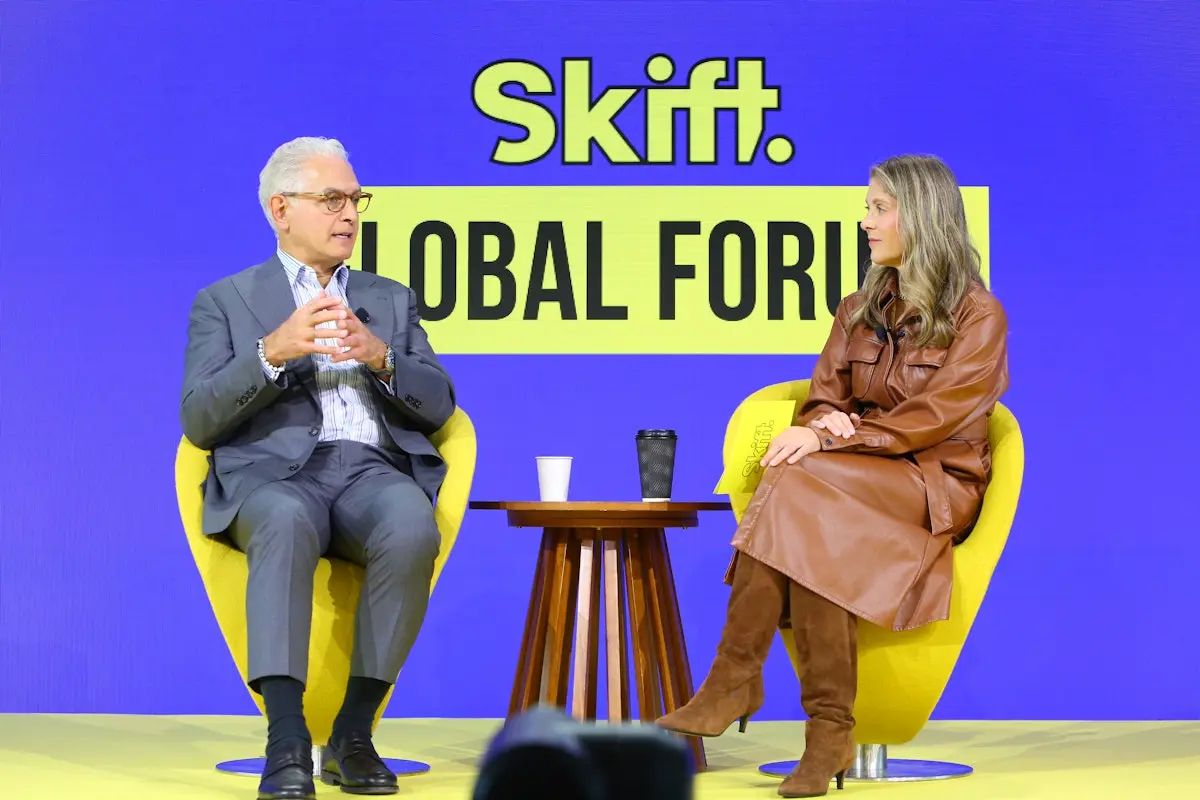
In the high-stakes, competitive landscape of global hospitality, the relationship between a hotel brand and its property owners is often fraught with tension. Operators push for brand standards and technological upgrades, while owners—who carry the weight of capital expenditures—often view these mandates as intrusions on their bottom line. However, Mark Hoplamazian, the Chairman, President, and CEO of Hyatt Hotels Corporation, argues that Hyatt’s unique corporate DNA offers a solution to this perennial friction.
Speaking at the Skift Global Forum, in a conversation moderated by Skift Editor-in-Chief Sarah Kopit, Hoplamazian underscored a fundamental truth about Hyatt’s trajectory: for 67 of its 70 years in existence, the company functioned primarily as an owner-operator. This historical reality, he posits, creates a "fundamentally different set of decisions" than those made by asset-light competitors.
The Decision Brief: An Owner-First Mindset
The core of Hyatt’s current strategy is a deep-seated empathy for the property owner. In an industry that has largely pivoted toward an "asset-light" model—where brands manage properties owned by third-party real estate investors—Hyatt maintains a perspective that is heavily influenced by its origins as a hotel owner.
"Most hotel companies talk about owner value," Hoplamazian noted during the session. "But because of our history, we understand what it feels like to be on the other side of the table."
This understanding was put to the ultimate test during a massive, multi-year technological overhaul. Hyatt made the strategic decision to replace all four of its core hotel operating systems simultaneously. In the hospitality industry, such an undertaking is notoriously disruptive, expensive, and prone to technical failures. Yet, Hyatt managed the transition with a focus on efficiency that resulted in a 40% cost saving for the property management system.
Perhaps most significantly, Hyatt chose to absorb the entirety of the financial burden for this technological upgrade. "We did that without sending a bill for even one penny to any of our owners," Hoplamazian emphasized. This move represents a radical departure from the industry norm, where digital transformation costs are frequently passed down to franchisees, often creating significant friction between corporate headquarters and property investors.
Chronology: From Family Ownership to Global Powerhouse
To understand the significance of Hyatt’s current operational philosophy, one must examine the timeline of the company’s evolution.
- 1957: The first Hyatt hotel is purchased by Jay Pritzker at the Los Angeles International Airport. From this moment, the brand is inextricably linked to the Pritzker family’s interests in real estate and hotel ownership.
- The Ownership Era (1957–Early 2000s): For decades, Hyatt grew primarily by owning the physical assets it managed. This fostered an "owner-operator" culture where corporate decision-makers were also the ones dealing with day-to-day property maintenance, payroll, and asset appreciation.
- The Strategic Shift (2009–Present): Hyatt began a calculated transition toward a more asset-light model, selling off significant portions of its real estate to recycle capital into brand growth, loyalty programs, and high-margin management contracts.
- The Tech Transformation (The Last 5 Years): Hyatt embarked on a massive, company-wide digital transformation aimed at centralizing property management systems and improving data interoperability. Unlike its competitors, who often leveraged these upgrades to extract additional fees from owners, Hyatt chose to treat these investments as a core corporate responsibility.
Supporting Data: Why the "Hyatt Way" Matters
The hotel industry is notoriously fragmented, with a wide variety of stakeholders ranging from private equity firms to family-owned boutique operators. The primary metric for these owners is GOPPAR (Gross Operating Profit Per Available Room).
By absorbing the costs of system-wide technology upgrades, Hyatt effectively boosted the GOPPAR for its property owners compared to a scenario where those costs were passed on. This decision serves as a powerful retention tool. In an industry where owners frequently switch flags or brands, Hyatt’s willingness to eat the cost of innovation acts as a "loyalty incentive."
Furthermore, the 40% reduction in costs associated with the new property management system is not merely a headline figure; it represents a tangible improvement in the margin profile of a Hyatt-branded hotel. When an owner sees that the brand is not just taking fees but is actively working to reduce the operational burden, the alignment of interest becomes near-absolute.

Official Responses and Strategic Implications
During the forum, the discourse between Hoplamazian and Kopit highlighted the implications of this strategy for the broader market. When asked about the challenges of modernizing a legacy portfolio, Hoplamazian pointed to the "cultural hurdle" of internal alignment.
"If you don’t understand the owner’s risk profile, you will always build the wrong product," he explained.
The implication here is clear: Hyatt is betting that in a future defined by high interest rates and increased operational costs, owners will gravitate toward brands that act as partners rather than landlords. The "owner-first" narrative is Hyatt’s key differentiator in a crowded market that includes giants like Marriott, Hilton, and IHG.
The Implications for Loyalty
A frequently overlooked aspect of the owner-operator relationship is how it affects the guest experience. When a property owner is financially healthy and feels that the brand is protecting their investment, they are more likely to invest in property renovations, high-quality staff training, and exceptional service standards.
Conversely, when an owner feels squeezed by the brand, they are more likely to defer maintenance or cut staffing—actions that immediately degrade the guest experience. By insulating owners from the cost of corporate-mandated digital transformations, Hyatt is essentially protecting the consistency and quality of its brand promise.
What to Watch: The Future of Hotel Management
As the hospitality industry moves toward 2026 and beyond, several key themes have emerged from the Hyatt strategy that industry observers should monitor:
- The End of "Fee-Heavy" Expansion: As owners become more sophisticated, brands that rely solely on extracting fees without offering operational value will find it harder to secure new properties. Hyatt’s model suggests that value-add technology is the new standard for brand retention.
- Technological Integration: The success of Hyatt’s system-wide replacement proves that large-scale digital transformation is possible, provided the cost structure is managed equitably. Other chains will likely face pressure from their owners to adopt similar, owner-friendly cost-sharing models.
- The Consolidation of Loyalty: As Hyatt continues to integrate its various brands (such as the recent acquisitions within the luxury and lifestyle segments), the ability to maintain a unified, efficient operating system will be the primary test of its scalability.
Conclusion: A Philosophy of Partnership
The decision by Mark Hoplamazian and his team to absorb the costs of a massive technological pivot was more than just a financial gesture; it was a strategic reinforcement of the company’s identity. In an era where "customer experience" is often synonymous with digital interface, Hyatt has demonstrated that the experience begins long before the guest enters the lobby—it begins with the relationship between the brand and the investor.
By prioritizing the health of its owners, Hyatt is securing its position as a preferred partner in an increasingly volatile global real estate market. While other hotel chains may continue to view owners as a source of revenue, Hyatt’s 70-year legacy suggests that the most successful way to grow is to ensure that the people who own the buildings are as invested in the brand as the people who manage them.
As the industry looks ahead, the "Hyatt Way"—a blend of institutional memory, fiscal responsibility toward partners, and a relentless focus on operational efficiency—will serve as a blueprint for how global hospitality leaders must operate in the coming decade. The verdict from the Skift Global Forum is clear: the future of the hotel business is not just in the rooms, but in the integrity of the partnership that keeps them open.
 Jia Lissa
  Azzam Bilal Chamdy
  Nila Kartika Wati