

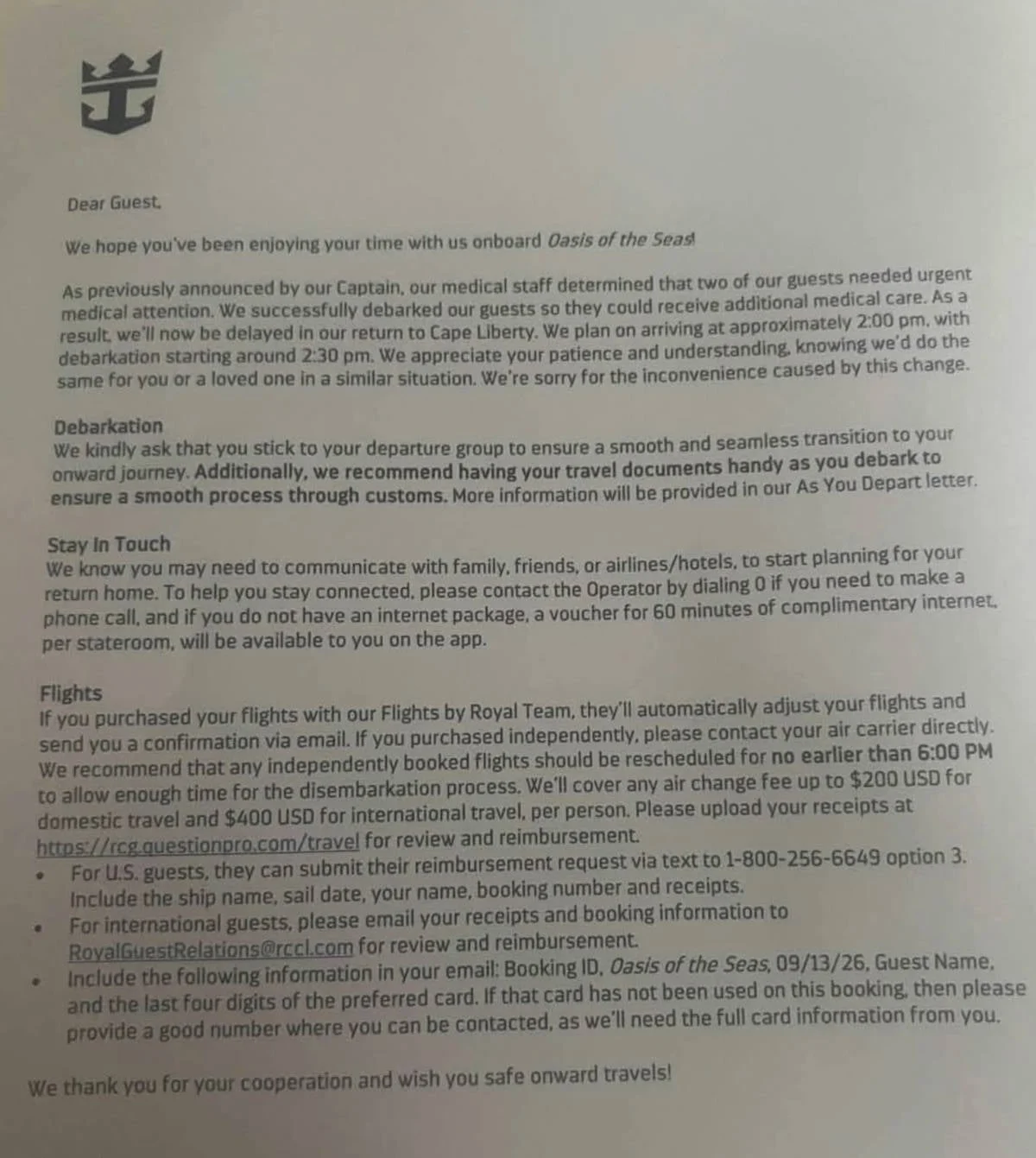
CAPE LIBERTY, New Jersey — Royal Caribbean International’s mega-ship Oasis of the Seas is facing a significant schedule disruption following a harrowing series of medical emergencies at sea. The unexpected detour has forced the vessel to push back its return to its homeport in Cape Liberty, New Jersey, triggering a cascading effect that alters not only the end of the current voyage but also severely impacts the upcoming itinerary.
While the cruise line has emphasized that passenger safety remains its absolute priority, the dual medical evacuations highlight the unpredictable nature of maritime operations, leaving hundreds of travelers scrambling to adjust flights, accommodations, and vacation plans.
Main Facts: The Incidents and Disruptions
The disruption centers on two separate, urgent medical situations that occurred toward the conclusion of the ship’s current voyage. Oasis of the Seas was originally scheduled to smoothly glide back into her New Jersey homeport at approximately 6:00 a.m. on Sunday, September 20, 2026. However, letters distributed to guests onboard confirmed that the vessel will now be delayed by roughly eight hours.
The revised timeline anticipates the ship docking at Cape Liberty at approximately 2:00 p.m. on Sunday, with passenger debarkation slated to commence at around 2:30 p.m.
The unexpected delay stems from a critical need to divert the ship back toward Nassau, Bahamas, to offload two critically ill individuals. The first emergency involved a critically ill 7-year-old child, prompting the vessel to reverse course. While en route to Nassau for this initial evacuation, shipboard medical staff identified a second passenger requiring immediate, advanced medical intervention.
To accommodate these crises, the ship was forced to steam back toward port, resulting in a substantial consumption of time and fuel that could not be made up entirely, even while traveling at maximum engine capacity.
Chronology of Events: From Paradise to Emergency Response
Understanding the logistical nightmare faced by the ship’s crew requires examining the timeline of events as they unfolded on the high seas. AIS (Automatic Identification System) tracking data confirms that Oasis of the Seas was cruising smoothly on her standard itinerary path when the emergencies struck.
At the time of the first diversion, the ship was positioned significantly northeast of Nassau, roughly 120 miles away, just east of Treasure Cay. Captain and crew immediately executed a course reversal to secure the fastest possible access to a fully equipped hospital facility, which Nassau uniquely provided within the immediate cruising zone.
According to public address announcements made by the ship’s master, the vessel successfully navigated back to Nassau, where both patients were safely debarked to local medical professionals. Following the second evacuation, Oasis of the Seas finally cast off lines and departed Nassau just before 1:00 p.m. on Friday, September 18.
From that moment onward, the vessel entered "full steam ahead" mode. The captain informed passengers over the public address system that all available engines were brought to a full load, pushing the massive ship to a brisk speed of 20 to 20.5 knots (approximately 23.5 miles per hour). Despite running at these elevated speeds, the sheer nautical distance between the Bahamas and New York Harbor rendered an on-time arrival impossible.
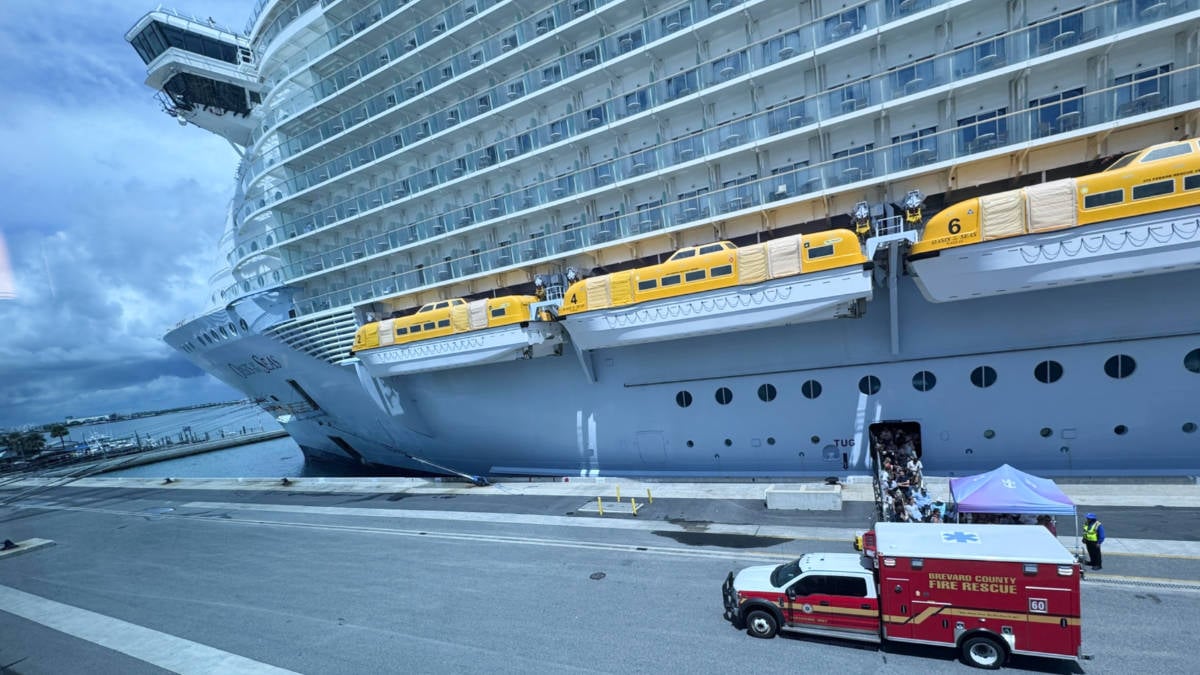
Supporting Data: Distances, Speeds, and Logistics
The mathematics behind maritime transit make it clear why cruise lines must announce delays nearly two days in advance. Naval architects and marine operations teams calculate transit times based on hull resistance, weather patterns, narrow channel navigation, and docking protocols.
When Oasis of the Seas resumed her journey northward from Nassau on Friday afternoon, marine calculations dictated a grueling sprint across the Atlantic seaboard. Operating at her maximum continuous output of 20 to 20.5 knots, marine transit models show that covering the distance from the Bahamas to New York Harbor requires more than 46 hours of uninterrupted, high-speed sailing. This estimate precisely aligns with the newly projected arrival time of 2:00 p.m. on Sunday afternoon at Cape Liberty.
Furthermore, the logistical footprint of running a ship of this scale at maximum load involves careful management of fuel reserves, auxiliary power systems, and port slot coordination. Cape Liberty Cruise Port, constrained by heavy weekend traffic and specific tidal windows for turning basins, had to reshuffle its berthing schedule to accommodate the delayed giant.
Official Responses and Passenger Assistance
In the wake of the announcement, Royal Caribbean implemented a comprehensive relief and reimbursement framework to mitigate the stress placed on travelers facing missed connections and altered vacation timelines. Because the delay affects both disembarking guests and those preparing to board, the response has been multi-layered.
Support for Disembarking Guests (Current Voyage)
For passengers wrapping up their cruise on Sunday, September 20, the eight-hour delay poses immediate challenges regarding air travel and hotel check-outs:
- Internet Access: Every stateroom has been issued a voucher for 60 minutes of complimentary internet access via the Royal Caribbean app. This allows travelers to immediately contact airlines, hotels, and loved ones to rearrange logistics.
- Cruise-Booked Airfare: Guests who utilized the "Flights by Royal" program will have their flight itineraries automatically adjusted by the cruise line’s dedicated team, with confirmation details sent directly via email.
- Independent Airfare: Passengers who booked their flights independently must handle their own rebooking with airlines. To cushion the financial blow, Royal Caribbean has committed to reimbursing airline change fees up to $200 per person for domestic flights and up to $400 per person for international flights, subject to receipt and documentation submission.
Support for Embarking Guests (Next Voyage)
The ripple effects of the medical diversion are equally punishing for guests scheduled to embark on the September 20, 2026 departure—a 7-night Bahamas itinerary. Royal Caribbean issued widespread notifications outlining sweeping changes to their vacation experience:
- Delayed Boarding Windows: Check-in times at the Cape Liberty terminal have been pushed back by 7 to 8 hours. All embarking passengers must complete check-in and be onboard no later than 9:30 p.m. on Sunday evening.
- Omission of Port Canaveral: To claw back time and keep the remainder of the itinerary intact, the scheduled Tuesday, September 22 stop at Port Canaveral, Florida (originally planned for 12:30 p.m. to 8:30 p.m.) has been completely cancelled. The ship will spend that day at sea instead.
- Adjusted CocoCay Arrival: Perfect Day at CocoCay, the line’s private island destination in the Bahamas, will now be visited slightly earlier. The ship is scheduled to dock at 7:45 a.m. on Wednesday, September 23—45 minutes ahead of the original 8:30 a.m. arrival time—while maintaining the standard 5:00 p.m. departure.
- Shore Excursion Refunds: Any pre-paid shore excursions booked through Royal Caribbean for Port Canaveral have been automatically cancelled. These funds will be issued as onboard credit, with any unused balance refunded to the guest’s card on file after the cruise concludes.
- Goodwill Onboard Credit: To compensate for the loss of a port day and the chaotic embarkation, Royal Caribbean is providing a non-refundable onboard credit. Interior and oceanview staterooms will receive $100, balconies and neighborhood staterooms will receive $150, and suites will receive $200. Third and fourth guests sharing a stateroom will receive an additional $50 each.
Implications: Privacy, Maritime Law, and Passenger Resilience
As is standard operating procedure under international maritime law and privacy regulations, Royal Caribbean has not disclosed further details regarding the specific medical conditions of the two patients. This protective stance ensures the privacy and dignity of the affected individuals—including the critically ill 7-year-old child—as well as their traveling families and companions.
Whether the two medical crises were related or entirely coincidental remains undisclosed, though cruise industry experts note that concurrent medical evacuations on a single sailing are an exceedingly rare statistical anomaly.
The incident underscores the immense responsibility cruise operators shoulder regarding healthcare at sea. Modern cruise ships like Oasis of the Seas function as floating cities, equipped with advanced medical centers, ICU-level equipment, and dedicated doctors and nurses capable of stabilizing critical patients until they can be transferred to land-based medical infrastructure.
Ultimately, the situation has drawn widespread praise from the cruising community for the empathy demonstrated by fellow passengers. While frustrated by missed ports and disrupted travel schedules, the overwhelming sentiment reflected in passenger forums and onboard responses acknowledges a fundamental cruising tenet: human life takes precedence over itineraries, and every traveler hopes for the same swift, compassionate intervention should they or a loved one ever face a medical emergency on the open ocean.
 Asep Darmawan
  Laily UPN
  Nila Kartika Wati