

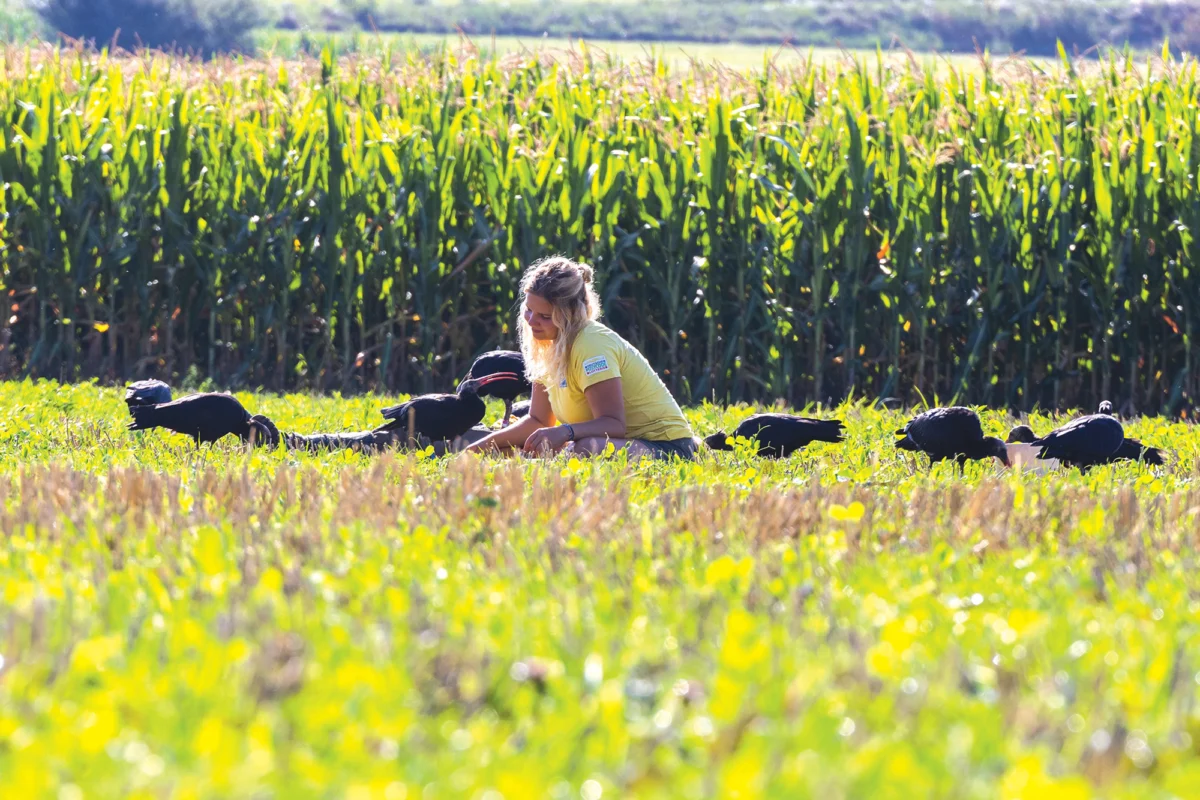
In the rugged, verdant valleys of southern Austria, a peculiar scene unfolds each spring that defies the traditional boundaries of wildlife conservation. It is a world of maternal devotion, where the "mothers" wear flight suits instead of aprons and the "nursery" smells not of powder, but of shredded beef hearts and field mice. Here, biologists Barbara Steininger and Helena Wehner are engaged in a high-stakes experiment to reverse the fortunes of one of the planet’s most endangered avian species: the northern bald ibis (Geronticus eremita).
Once common across Europe, the Middle East, and North Africa, the northern bald ibis has been extinct in the wild in Europe for nearly four centuries. Today, thanks to the maverick efforts of researchers like Johannes Fritz and his dedicated team of foster parents, the species is being taught how to survive in a modern world that has long since forgotten them.
The Plight of the Bald Ibis: A Species on the Brink
The northern bald ibis is, by conventional standards, an unconventional beauty. With its distinct red, wrinkled face, long down-curved bill, and a wild crest of feathers at the back of its head, it looks like a creature from a prehistoric epoch. Historically, these birds were revered in Ancient Egypt, but by the 17th century, they had vanished from the European landscape due to overhunting and habitat destruction.
For decades, the species survived only in tiny, isolated pockets in Morocco and a minuscule, critically endangered population in Syria. In Europe, the species existed only in zoos. The mission, led by the Waldrappteam—an international conservation project—is not merely to breed these birds in captivity, but to reintroduce a self-sustaining migratory population into the European wild.
The primary hurdle? Migration is a learned behavior. Without adult birds to guide them, hand-reared ibises have no roadmap to their ancestral wintering grounds in Tuscany, Italy. If they are simply released, they remain stationary, susceptible to predators and the harsh realities of a changing climate.
The Human-Bird Bond: A Chronology of Care
The process of "imprinting" is the cornerstone of the Waldrappteam’s methodology. For the ibises to view these human biologists as their guides, the relationship must begin the moment they break their shells.
April: The Nursery Phase
The lifecycle of each cohort begins in the crisp, cool air of April. In the aviary at the Wildlife Park Rosegg, Steininger and Wehner assume the role of surrogate parents. This is not a passive observation role; it is an all-consuming commitment. The chicks require feeding eight times daily. Because these birds are imprinted on their human caretakers, they follow them everywhere, responding to specific vocal cues and the comforting presence of their "moms."
May to July: The School of Flight
As the chicks grow, the focus shifts from nutrition to aviation. The birds must be taught to fly, but more importantly, they must be taught to follow. The "moms" use ultralight aircraft, specially modified to emit specific sounds that the ibises have been conditioned to associate with safety and guidance. This phase involves grueling hours of practice flights, where the biologists must maintain precise speeds and altitudes to keep the flock together.
August: The Great Migration
This is the crescendo of the project. The migration is a multi-stage journey covering hundreds of kilometers across the formidable Alps. The human "mothers" lead the way in their ultralight planes, with the ibises trailing in a V-formation, mimicking the behavior they would have learned from their biological parents. It is a delicate, dangerous dance; the team must navigate thermals, wind shear, and shifting weather patterns to guide the birds to their Italian wintering grounds.
Supporting Data: Why This Works
The success of the Waldrappteam is rooted in rigorous scientific observation. Since the project’s inception in 2002, the team has successfully reintroduced hundreds of birds.
- Survival Rates: Captive-bred birds that undergo the human-led migration training show a significantly higher survival rate than those released without such guidance.
- Genetic Diversity: The project maintains a careful pedigree database to ensure that the reintroduced population remains genetically healthy, avoiding the pitfalls of inbreeding that often plague small, isolated populations.
- Technological Integration: Each bird is fitted with a GPS transmitter. This allows the team to track their movements, understand their foraging habits, and intervene if a bird strays too far from the path or encounters trouble during the migration.
Official Responses and Ethical Considerations
The project has garnered international acclaim, not just for its scientific ambition, but for the ethical questions it raises. Critics have occasionally questioned the degree of human intervention—is it truly "wild" if it requires an ultralight plane and human foster parents?
Johannes Fritz, the driving force behind the Waldrappteam, is quick to provide an answer: "We are not trying to create a pet. We are providing a bridge across a chasm of human-caused extinction. Once these birds have successfully completed the migration, they return the following spring, find mates, and begin raising their own chicks in the wild. The cycle, once broken, becomes self-sustaining."
Conservation organizations like the World Wildlife Fund (WWF) and various European environmental agencies have lauded the project as a "gold standard" for rewilding. It serves as a proof-of-concept for other species that have lost their migratory traditions due to anthropogenic pressures.
Implications for the Future of Conservation
The "Hope on the Wing" initiative carries profound implications for the broader field of ecology. It challenges the "hands-off" philosophy of traditional conservation, suggesting that in an era of rapid biodiversity loss, active, high-touch stewardship may be the only way to save certain species.
1. Rewilding as an Active Process
The project proves that "rewilding" is not always a matter of simply removing humans from an ecosystem. Sometimes, it requires the most intense form of human integration possible to repair the damage of the past.
2. The Model of Migratory Recovery
The techniques developed by the Waldrappteam—specifically the use of human-led migration through ultralight aircraft—are now being studied for application in other species, such as the critically endangered Siberian crane or the North American whooping crane.
3. Public Engagement and Education
By making the "moms" and their flight-trained ibises a visible part of the public narrative, the project has turned a dry scientific study into a compelling, emotional story. This emotional connection is vital for securing the long-term funding and political support necessary to keep the project alive.
A Vision for the Future
As the sun sets over the Austrian valley, Barbara Steininger watches a group of young ibises practice their wing-flapping on the ground. They are clumsy, loud, and entirely dependent on her, but within weeks, they will be masters of the sky.
The goal of the Waldrappteam is to reach a population threshold where the human "mothers" are no longer needed. They envision a day when the northern bald ibis is a common sight across the European skies once again, flying its ancestral routes without the need for an escort.
It is a long road—or rather, a long flight—but the progress is undeniable. For the northern bald ibis, hope is no longer an abstract concept; it is a flapping, squawking reality, carried on the wings of birds who were taught how to fly by those who refused to let them vanish. The story of these birds is a testament to the idea that, with enough ingenuity, patience, and love, the tide of extinction can be turned. The birds are ready to reclaim their place in the world; they just needed someone to show them the way home.
 Raul Delapena Setiawan
  Pevita Pearce
  Siti Muinah