

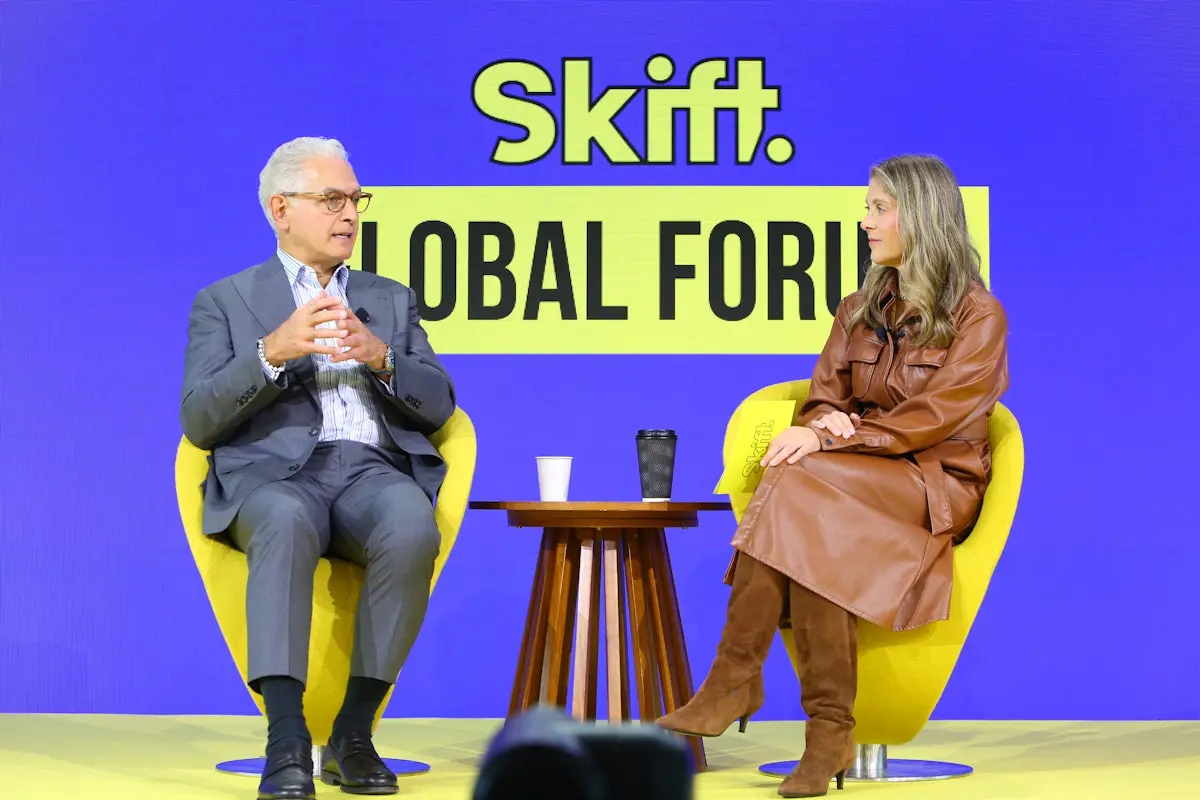
At the recent Skift Global Forum, Mark Hoplamazian, Chairman, President, and CEO of Hyatt Hotels Corporation, sat down with Skift Editor-in-Chief Sarah Kopit to discuss a fundamental truth in the hospitality industry: the relationship between a brand and its property owners.
For many global hospitality conglomerates, the modern business model is one of asset-light management—a strategy focused on rapid expansion through franchising and management contracts. However, Hyatt remains an outlier, rooted in a history where the company was, for the vast majority of its 70-year existence, the primary owner of its own hotels. This legacy, Hoplamazian argues, is not merely a historical footnote; it is the engine that drives Hyatt’s current strategic decisions, specifically in the high-stakes arena of digital transformation.
Main Facts: The Tech Transformation
The centerpiece of the discussion was Hyatt’s recent, massive overhaul of its core digital infrastructure. While most corporations pass the costs of system upgrades down to property owners via "innovation fees" or capital expenditure assessments, Hyatt took a different path.
Hyatt successfully replaced all four of its core hotel operating systems simultaneously. The scope of this project was monumental, requiring seamless integration across global properties, varying ownership structures, and legacy software environments. The result was a 40% reduction in costs related to their property management system (PMS).
Crucially, Hyatt absorbed the entirety of the financial burden for this transition. As Hoplamazian emphasized, “We did that without sending a bill for even one penny to any of our owners.” This move serves as a case study in alignment: by choosing to bear the risk and the cost of technological advancement, Hyatt has solidified its position as an owner-advocate, rather than just a brand manager.
Chronology of a Corporate Pivot
The Ownership Legacy
To understand why Hyatt’s recent tech move was so significant, one must look back at the company’s foundation. For 67 of its 70 years, Hyatt operated as a major asset owner. In the hotel industry, this is rare. Most competitors moved to "asset-light" models decades ago to satisfy shareholders looking for high-margin, low-risk fee income.
The Digital Debt Era
As the hospitality industry entered the 2010s, hotel chains faced a "digital debt" crisis. Legacy systems, often siloed and incompatible with modern guest expectations, hindered efficiency. Most chains addressed this by mandating that owners pay for upgrades. This led to frequent friction between brands and owners, as owners often felt they were paying for technology that benefited the brand’s data collection more than the individual hotel’s bottom line.
The Simultaneous Upgrade
In the last few years, Hyatt initiated its comprehensive system replacement. Rather than taking a modular approach—which would have minimized risk but extended the timeline—Hyatt opted to replace its core systems all at once. This synchronized approach was designed to eliminate "patchwork" connectivity issues, ensuring that the new ecosystem could talk to itself from the moment of implementation.
Supporting Data: Efficiency and ROI
The 40% savings on the property management system (PMS) is more than just a headline; it is a vital indicator of Hyatt’s operational efficiency. In the hotel world, the PMS is the "brain" of the property—handling everything from guest check-ins and room assignments to housekeeping schedules and billing.

- Cost Reduction: By standardizing the PMS across the portfolio, Hyatt minimized the need for expensive third-party integrations and reduced the training overhead for staff who move between Hyatt properties.
- Scale and Negotiation: By acting as the sole purchaser and developer, Hyatt leveraged its global scale to negotiate better software licensing terms, a benefit they passed directly to their owners by not charging for the transition.
- Customer Loyalty: Data shows that when hotel owners are financially stable and not burdened by unnecessary brand-imposed costs, they are more willing to invest in the guest experience, such as higher-quality staff, better amenities, and improved property maintenance.
Official Responses: The Philosophy of Alignment
During his conversation with Sarah Kopit, Mark Hoplamazian framed the decision through the lens of "owner value." He argued that the hospitality industry has lost sight of the fact that the brand and the owner are, ideally, partners in the same enterprise.
“Most hotel companies talk about owner value,” Hoplamazian noted. “But the actions they take often prioritize the brand’s corporate balance sheet over the property’s profitability.”
By absorbing the cost of the digital transformation, Hyatt effectively signaled to its owner-partners that the brand is willing to have "skin in the game." This is not just a gesture of goodwill; it is a strategic maneuver to reduce churn among hotel owners. In a market where owners are increasingly fickle about which flag (brand) flies above their doors, Hyatt’s commitment to reducing owner costs provides a powerful incentive for owners to remain within the Hyatt ecosystem.
Implications: The Future of Hotel Management
1. A New Benchmark for Brand-Owner Relations
Hyatt’s approach sets a new standard for how global chains should manage technological upgrades. It challenges the industry-wide practice of "passing the buck" to owners. Competitors may now face pressure from their own ownership groups to justify why they continue to offload technology costs, potentially leading to a shift in how management contracts are negotiated.
2. The Power of Integrated Systems
By replacing all four core systems simultaneously, Hyatt has leapfrogged many competitors who are still struggling with legacy system integration. A unified digital core allows for faster deployment of AI, personalized guest experiences, and real-time data analytics. This technological agility will likely manifest in higher revenue-per-available-room (RevPAR) figures for Hyatt properties compared to those running on fragmented, outdated systems.
3. Long-term Asset Loyalty
The hospitality industry is notoriously competitive regarding portfolio growth. If Hyatt can prove that its owner-centric model leads to better profitability for the owners themselves, it will become the "brand of choice" for hotel investors. This creates a virtuous cycle: more owners want to work with Hyatt, allowing the brand to be more selective, maintain higher quality standards, and grow its footprint without compromising its reputation.
4. The End of "Innovation Fees"
The success of this project may eventually lead to a decline in the use of "innovation fees" as a standard line item in management agreements. If the technology becomes a core part of the brand’s value proposition—as Hyatt has demonstrated—it may eventually be viewed as a cost of doing business for the brand, rather than an extra service provided to the owner.
Conclusion
The story of Hyatt’s digital transformation is, at its core, a story about corporate identity. By choosing to honor its heritage as an owner-operator, the company has navigated a complex technological challenge in a way that respects the bottom line of its partners.
As Mark Hoplamazian concluded, the companies that truly invest on behalf of their owners are the ones that ultimately build a different—and more resilient—kind of customer loyalty. In a digital age where guest expectations are rising, Hyatt’s ability to modernize its infrastructure without alienating its partners may well be its greatest competitive advantage in the decade to come. As the industry watches, the question remains: will others follow suit, or will the divide between owner-advocates and fee-gatherers continue to grow? For now, Hyatt is clearly leading the way.
 Azzam Bilal Chamdy
  Asro
Asro  Nana Wu