


In the fiercely competitive landscape of professional camera gear, manufacturers are constantly challenged to balance optical perfection with production efficiency. Developing a clean-sheet, high-end super-telephoto prime lens is traditionally an exercise involving staggering capital expenditures, years of rigorous research and development, and complex manufacturing hurdles. Yet, Sony has seemingly defied conventional industry economics with the simultaneous introduction of two stellar additions to its prestigious G Master lineup: the Sony FE 400mm f/4.5 GM OSS and the Sony FE 600mm f/6.3 GM OSS.
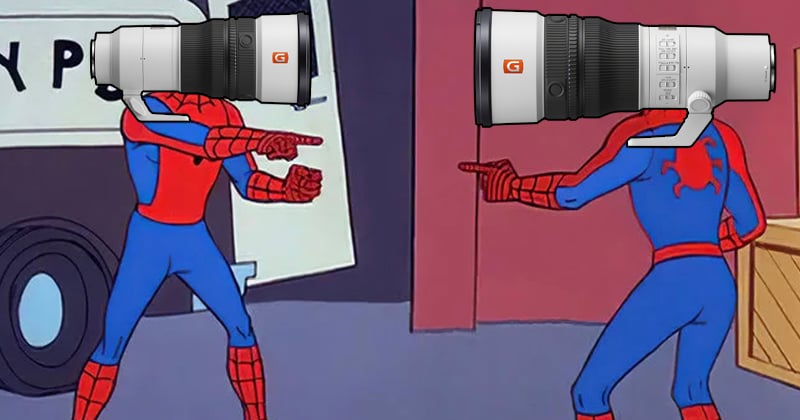
At a glance, these two white-bodied giants look remarkably similar, sharing the sleek aesthetic language that wildlife, sports, and aviation photographers have come to associate with Sony’s top-tier glass. But a closer inspection reveals a stroke of optical engineering so efficient it borders on the audacious. Beneath their rugged, weather-sealed exteriors, these lenses are fraternal twins—sharing fully half of their optical architecture, mechanical layouts, and electronic control systems.
This deep dive examines how Sony engineered this masterclass in resource sharing, what it means for the optics industry, and whether the shared lineage creates any compromises for photographers investing heavily in their kit.
Main Facts
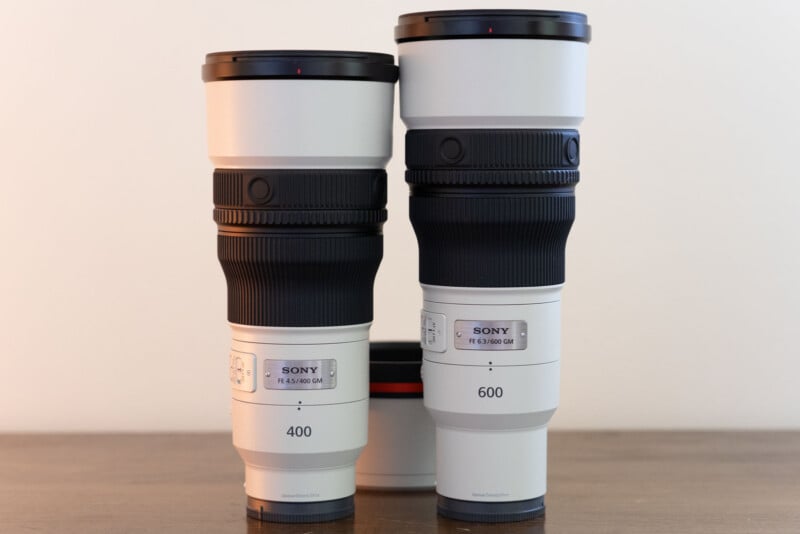
The headline-grabbing reality of the Sony FE 400mm f/4.5 GM OSS and the FE 600mm f/6.3 GM OSS lies in their uncanny physical and internal symmetry. Despite offering two distinct focal lengths and differing maximum apertures, the lenses are virtually indistinguishable in hand and on a scale.
- Weight Parity: The weight differential between the two lenses is a microscopic single gram—roughly equivalent to a standard paper clip, a single dollar bill, or a tiny pinch of salt.
- Physical Dimensions: While the 600mm f/6.3 variant is physically longer, the difference amounts to less than an inch.
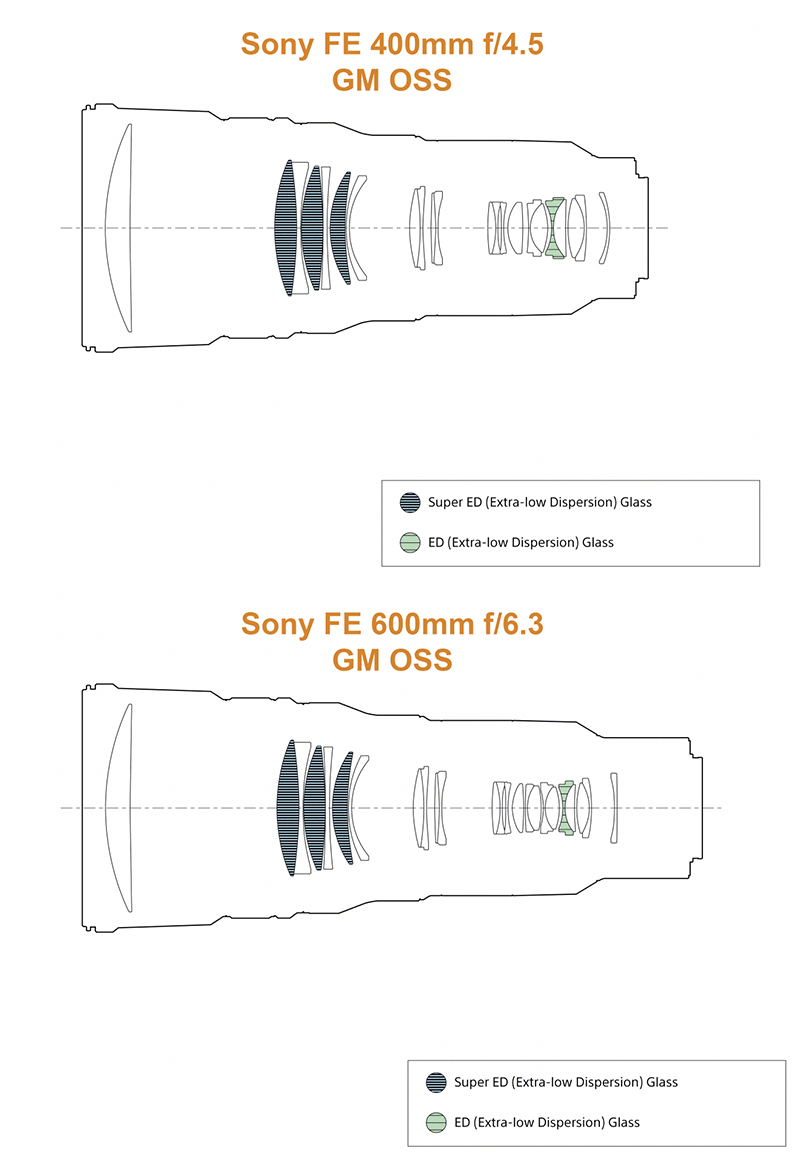
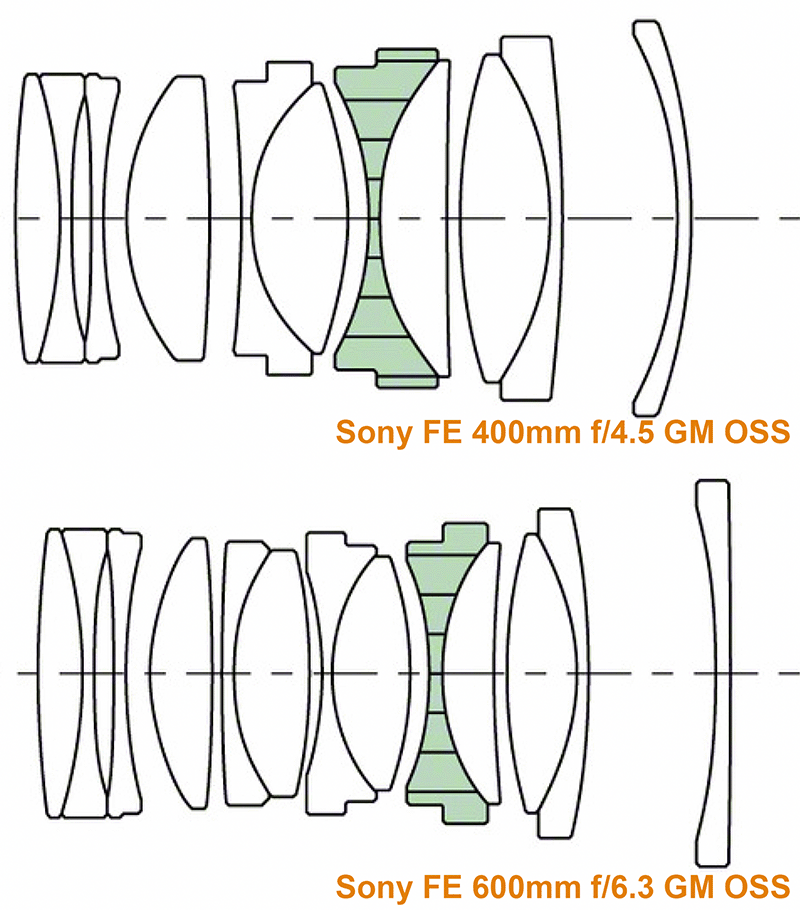
- Shared Optics: From the single large front element straight through to the central focusing group, the optical formulation of both lenses is mathematically identical. This includes the extensive use of Super ED (Extra-low Dispersion) glass elements engineered to suppress chromatic aberration and deliver exceptional corner-to-corner sharpness.
- Feature Parity: Both lenses share identical autofocus motor systems, minimum focusing distances, tactile on-barrel controls, and robust weather resistance.
- The Difference: To achieve the added magnification of the 600mm focal length, Sony added just two additional glass elements in a single extra group near the rear mount, bringing the 600mm’s total configuration to 24 elements in 17 groups.
Chronology: The Evolution of Shared Optical Platforms
While lens cross-pollination is not entirely new in the camera industry, the degree of shared DNA seen in Sony’s latest release represents a significant evolution in how manufacturers approach lens lineups.
The Traditional Approach
Historically, every focal length required a bespoke optical formula. Designing a 400mm f/4.5 and a 600mm f/6.3 meant two entirely separate teams working from scratch, calculating light refraction paths, designing distinct barrel molds, and configuring bespoke autofocus gear trains. This siloed approach maximized optical optimization for a single focal length, but it drove up research, development, and tooling costs—costs ultimately passed down to consumers.
The Modern Modular Paradigm
In recent years, forward-thinking manufacturers have sought ways to streamline development cycles. A notable precedent occurred when Fujifilm developed its Fujinon GF 500mm f/5.6 R LM OIS WR lens for the medium-format GFX system, then cleverly adapted the housing and mount to create the XF 500mm f/5.6 for its smaller APS-C X-Series cameras, instantly delivering a 750mm-equivalent super-telephoto prime.
Sony’s approach with the 400mm f/4.5 and 600mm f/6.3 pushes this concept even further within the same full-frame ecosystem. By designing a foundational front optical block that could serve as the bedrock for multiple focal lengths, Sony effectively bypassed the need to reinvent the wheel for the second lens. The development timeline likely saw the core optical block and mechanical chassis finalized as a modular platform, allowing engineers to branch off at the rear element stage to dial in either the wider aperture of the 400mm or the extended reach of the 600mm.
Supporting Data & Technical Analysis
To understand how Sony achieved this feat without compromising image quality, one must look at the internal cross-sections and optical physics governing these super-telephotos.

[ Front Element Group ] ---> [ Shared Super ED Glass Block ] ---> [ Central Focusing Group ] ---> [ Rear Mount Variations ]
      (Identical)                       (Identical)                    (Identical)             (400mm vs. 600mm +2 Elements)
The Physics of Aperture and Focal Length
The differing maximum apertures—f/4.5 on the 400mm and f/6.3 on the 600mm—are not a byproduct of inferior glass or optical choking, but rather pure mathematical necessity.
By maintaining a consistent physical entrance pupil size while stretching the focal length to 600mm, the mathematical ratio naturally shifts, resulting in a narrower f/6.3 aperture. Because the front half of the lens—including the massive front element and the critical Super ED glass assemblies—remains identical, light enters both systems under the exact same foundational conditions before being modified by the rear groups.
Field Performance Metrics
Independent reviews and field tests across diverse environments (ranging from fast-moving wildlife like hummingbirds and woodpeckers to domestic animals like border collies) indicate that both lenses perform at an elite level:

- Sharpness: Both units deliver edge-to-edge resolution that satisfies high-megapixel bodies without breaking a sweat.
- Autofocus Speed: Powered by the same internal linear motors, acquisition times are virtually instantaneous, tracking erratic subjects with equal tenacity.
- Image Stabilization (OSS): Optical SteadyShot performance is equally matched, yielding crisp handheld shots even at shutter speeds dipping into marginal territory.
Official Responses and Industry Perspectives
Industry analysts and veteran gear reviewers have greeted Sony’s engineering gambit with a mix of admiration and wry amusement.
Industry consensus points out that there is virtually no optical downside to this shared-platform strategy. Neither lens feels like a compromise, and field shooters utilizing either optic report stellar real-world reliability. However, pricing dynamics have sparked spirited discussions within the photography community.
While sharing an immense amount of internal architecture and manufacturing tooling saves Sony substantial sums in R&D and production overhead, retail pricing reflects market positioning rather than manufacturing cost alone. As industry commentators note, photographers purchasing both lenses—or weighing one against the other—are essentially buying variations of the same core lens architecture twice, with the longer focal length commanding a notable premium for those extra two rear elements and specialized housing tweaks.
Implications for the Future of Lens Design
Sony’s clever engineering feat carries profound implications for the broader photographic equipment market.
1. Accelerated R&D Cycles
By utilizing modular front optical blocks, manufacturers can theoretically expand their lens catalogs at a much faster pace. If a single foundational design can serve as the backbone for two, three, or even four distinct focal lengths, consumers may see wider product lineups roll out without multi-year waiting periods between releases.
2. Manufacturing Efficiencies and Supply Chain Resilience
Global supply chain disruptions have plagued hardware manufacturers over the last decade. By standardizing a significant percentage of internal components—such as glass grinding molds, electronic control boards, autofocus actuators, and barrel components—across multiple high-end lenses, Sony mitigates supply chain risk. Fewer unique parts mean streamlined inventory management and greater economies of scale.
3. Consumer Value vs. Pricing Strategy
The elephant in the room for consumers is how manufacturing savings translate to the retail tag. While manufacturing efficiencies lower production costs, specialized super-telephoto lenses remain luxury investments. The realization that two lenses share 50% of their DNA may prompt some buyers to look closely at whether owning both makes financial sense, or if teleconverters paired with the f/4.5 model might offer a more cost-effective alternative.
4. Setting a New Benchmark
Ultimately, Sony has raised the bar for optical efficiency. Competitors like Canon, Nikon, and Fujifilm will undoubtedly examine this blueprint closely. As sensor resolutions climb and user demands for lightweight, highly portable super-telephotos intensify, the era of building every single lens in isolation may be giving way to a smarter, more integrated approach to optical engineering.
For the end-user, the takeaway is simple: whether you choose the nimble light-gathering power of the FE 400mm f/4.5 GM OSS or the extended reach of the FE 600mm f/6.3 GM OSS, you are wielding the fruits of some of the most innovative optical engineering the camera industry has ever seen. Just try not to think too hard about the matching blueprints glowing under the hood.
 Nila Kartika Wati
  Jia Lissa
  Sagoh
Sagoh 