

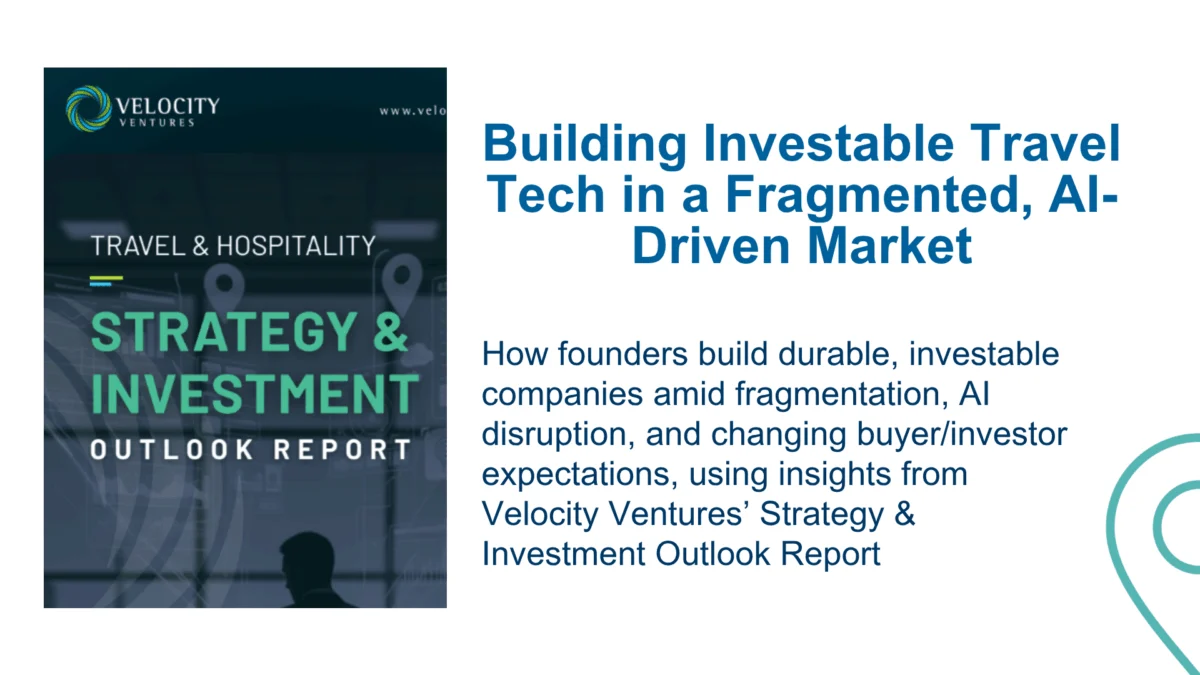
Thursday, August 25, 2026 — As the travel industry enters the second half of 2026, the landscape for emerging technology companies has become increasingly complex. Between the rapid proliferation of generative AI, persistent geopolitical volatility, and shifting consumer expectations, the barriers to entry—and success—have never been higher.
To address these challenges, the Travel Tech Association (Travel Tech) hosted its August Start-Up Member Monthly Meet-Up this week. The session featured a deep-dive conversation with Nicholas Cocks, Partner at Velocity Ventures, centered on the critical theme: “Building Investable Travel Tech in a Fragmented, AI-Driven Market.” The event offered a masterclass for early-stage founders on how to build durable, scalable businesses in an era where traditional playbooks are being rewritten.
The Core Challenge: A Market in Flux
The travel technology sector is currently navigating a period of profound structural change. According to discussions held during the meet-up, founders are no longer simply competing on product utility; they are competing on their ability to navigate macro-uncertainty.
Geopolitical and Economic Fragmentation
The global travel market is facing significant headwinds from regional conflicts, fluctuating currency valuations, and the tightening of cross-border data regulations. These factors have created a fragmented environment where "one-size-fits-all" solutions are struggling to gain traction. Founders are finding that the ease of global scaling, once a hallmark of SaaS-based travel solutions, is now hindered by localized compliance requirements and fractured market access.
The AI Disruption
Artificial Intelligence has shifted from a buzzword to an operational imperative. However, the sheer volume of AI-driven tools entering the market has created a "noise" problem. Investors are now looking past the inclusion of AI as a feature and are scrutinizing the underlying data moats, the cost of compute, and the tangible ROI for the end user. The consensus at the meet-up was clear: AI is not a business model; it is an accelerator that must be applied to a fundamentally sound business problem.
Chronology of the 2H 2026 Strategy Outlook
The insights shared during the event were anchored in the newly released Velocity Ventures 2H 2026 Strategy & Investment Outlook Report. This report serves as a roadmap for the current investment climate, tracking the evolution of the market from the start of the year through August.
- Q1 2026: Initial optimism regarding AI integration in travel booking systems was met with market skepticism regarding long-term profitability.
- Q2 2026: Data from the report indicated a pivot in investor sentiment toward "durable" growth. Start-ups focusing on operational efficiency and B2B infrastructure saw higher valuation multiples than those focusing on B2C consumer-facing apps.
- August 2026: The current "Meet-Up" phase represents a shift toward consolidation. Founders are being advised to build companies that can integrate into larger enterprise ecosystems rather than attempting to disrupt them entirely.
Supporting Data: What Investors Are Looking For
The Velocity Ventures report outlines four key pillars that define an "investable" company in the current cycle. For founders, these metrics are no longer optional but essential for securing Series A and beyond funding.
1. The "Moat" Beyond Algorithms
Investors are moving away from companies that rely solely on third-party APIs (like basic LLM wrappers). Instead, the focus has shifted to proprietary data sets. Companies that own unique, non-public data—whether it be historical travel patterns, proprietary inventory management, or unique behavioral insights—are commanding significantly higher interest.
2. Capital Efficiency
With the cost of capital remaining elevated compared to the early 2020s, "growth at all costs" is officially out of fashion. Velocity Ventures emphasizes that the best-positioned start-ups are those demonstrating a clear path to profitability (or at least unit-level break-even) within 18–24 months of funding.
3. Customer Retention and Stickiness
In a fragmented market, acquiring a customer is expensive. The report highlights that successful start-ups are those that prioritize "land and expand" strategies. By solving one specific, painful problem for a travel partner—such as automated ticketing, dynamic pricing adjustments, or regulatory compliance reporting—start-ups are building the necessary trust to upsell additional services later.
4. Regulatory Resilience
Given the evolving landscape of AI governance and global data privacy laws, founders who bake compliance into their product architecture from day one are viewed as lower-risk investments. Companies that ignore these guardrails are increasingly being flagged as "high-risk" by due-diligence teams.
Official Responses and Perspectives
The collaboration between Travel Tech and industry leaders like Velocity Ventures is designed to bridge the gap between high-level economic theory and the daily realities of the founder experience.
Bethany Reitsma, Senior Manager of Industry Relations at Travel Tech, emphasized the necessity of these dialogues. “Nicholas gave our start-up members a practical investor perspective on building durable companies in today’s travel technology market,” Reitsma stated. “Discussions like this strengthen our start-up community by giving founders direct access to insights and relationships that can help them grow. When founders understand exactly what the ‘other side of the table’ is thinking, they can pivot their strategies to be more resilient.”
The fireside Q&A, which allowed members to submit questions in advance, covered sensitive topics ranging from the "AI bubble" to strategies for maintaining company culture during rapid pivot cycles. The session underscored that mentorship and networking are the primary currencies for success in the current climate.
Implications: The Road Ahead for Travel Tech
What does this mean for the future of the travel industry? Several long-term implications are beginning to emerge.
The Rise of the "Niche" Innovator
We are moving away from the era of the "all-in-one" travel super-app. Instead, the market is favoring niche, highly specialized technology providers that solve very specific pain points—such as carbon accounting for corporate travel, personalized itinerary optimization for luxury segments, or automated crisis management for regional carriers.
Institutional Integration
The next wave of "Unicorns" in the travel space is unlikely to come from the consumer-facing sector. Rather, they will likely emerge as the backbone of the industry—the companies providing the infrastructure that allows legacy airlines, hotel chains, and tour operators to modernize their operations.
The Human-AI Hybrid Model
The most successful companies will be those that use AI to augment human talent rather than replace it. In travel, the human touch—particularly in hospitality and complex crisis management—remains a premium. Technology that allows humans to perform their jobs more effectively is seeing much higher adoption rates than technology that attempts to remove the human element entirely.
How Travel Tech Supports the Ecosystem
The Travel Tech Association remains at the center of this evolution. By fostering a community that connects pre-seed and seed-stage founders with seasoned investors and enterprise leaders, the association is helping to ensure that the next generation of travel tech companies is built on a foundation of stability, innovation, and strategic foresight.
Through initiatives like the monthly Start-Up Meet-Ups, quarterly Start-Up & Investor Connects, and the prestigious annual Start-Up Summit, Travel Tech provides the scaffolding upon which new ideas become industry-standard solutions.
Are you building what’s next in travel technology?
The industry is changing rapidly, but the need for connection remains constant. Travel Tech offers a platform for founders to access the resources, regulatory insights, and peer networks that are difficult to reach alone.
About Travel Tech Association (Travel Tech):
Travel Tech is the unified voice for the global travel technology ecosystem. Representing a diverse range of enterprise leaders, growth-stage companies, and emerging innovators, Travel Tech advocates for public policies that encourage competition, foster technological innovation, and sustain a robust, technology-enabled travel marketplace. Through dedicated advocacy, deep regulatory intelligence, and cross-sector collaboration, the organization is committed to defining the next era of modern travel.
For media inquiries or to schedule an interview with a Travel Tech spokesperson, please contact Jessica Matthias at [email protected].
 Pevita Pearce
  Neng Nana
  Evan Lee Salim