

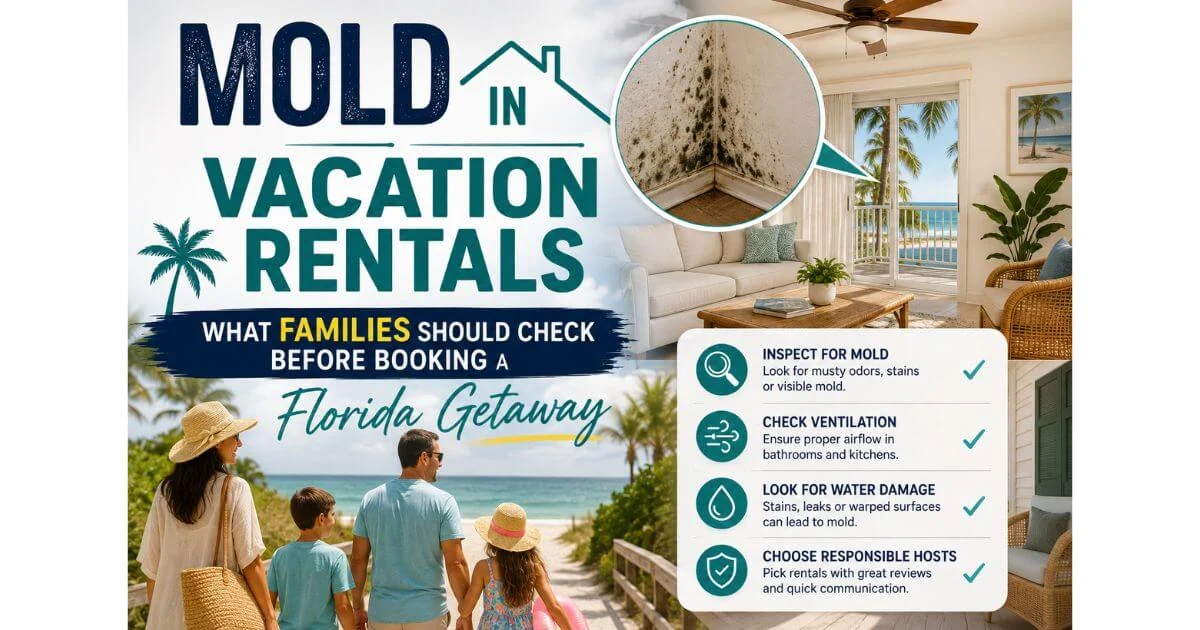
For many families, the quintessential Florida getaway is a well-choreographed dream: five minutes from the pristine coastline, a sparkling private pool, and enough room to sleep eight comfortably. You book the property, the countdown begins, and the excitement builds. However, the moment you unlock the front door, that dream can be momentarily derailed by a heavy, damp, and unmistakable scent—a smell that no amount of ocean breeze can mask.
While the majority of Florida vacation rentals offer a safe and enjoyable environment, the prevalence of mold in the subtropical climate is a reality that travelers must acknowledge. For most guests, a faint mustiness is a minor inconvenience, but for children, seniors, or those suffering from asthma and allergies, it can transform a week of relaxation into a medical ordeal. Protecting your family does not require a degree in mycology; it requires a proactive checklist, a keen sense of smell, and the confidence to advocate for your health.
The Perfect Storm: Why Florida Is a Mold Hotspot
To understand why mold is a recurring issue in the Sunshine State, one must look at the environmental factors. Florida’s climate is defined by high humidity, intense heat, and a susceptibility to tropical weather systems.
Environmental and Structural Factors
Vacation rentals are unique in their usage patterns. Unlike a primary residence, which is consistently ventilated and climate-controlled, vacation homes often sit vacant for weeks at a time between bookings. When a property is sealed off in a humid environment, the air conditioning system—if set to an energy-saving mode—may not adequately dehumidify the interior. This creates a stagnant, moisture-rich environment where mold spores can settle and germinate on everything from drywall and wood to upholstery and curtains.
The Impact of Recent Hurricane Seasons
The structural integrity of Florida’s real estate has been tested significantly over the past several years. Following major events like Hurricane Ian in 2022 and the 2024 seasons involving Hurricanes Helene and Milton, a surge of properties sustained water intrusion. While many owners performed extensive repairs, the rapid demand for contractors led to varying standards of remediation. In some cases, improper repairs—such as painting over water-damaged drywall without addressing the underlying source of moisture—have created "ticking time bombs" that remain hidden until the next humid season or a particularly rainy week.
A Chronology of a Rental Issue: From Booking to Arrival
Understanding the lifecycle of a mold problem helps families identify the signs before they ever pack a bag.
- The Booking Phase: This is your first line of defense. Savvy travelers look beyond the star ratings and curated photos. A deep dive into the "Reviews" section is essential. Keywords such as "musty," "damp," "mildew," or "water stain" are red flags. If a property has a history of these complaints, it is a clear warning sign.
- The Communication Phase: Before finalizing a reservation, engage the host. A simple, professional inquiry regarding the property’s history with leaks, the age of the HVAC system, and their maintenance schedule for dehumidification can be revealing. A host who provides a transparent, detailed response is usually one who takes property management seriously.
- The Arrival Phase: The first ten minutes upon entry are the most critical. By performing a sensory walkthrough, you can identify potential hazards before your family settles in.
- The Resolution Phase: If an issue is discovered, time is of the essence. Prompt, documented communication with the host or the booking platform is necessary to ensure a resolution, whether that involves cleaning by a professional service or a relocation to a different unit.
Supporting Data: The Health Implications
The reason for concern is not born of alarmism, but of biology. Mold is a fungus that thrives on moisture, and its reproductive units—spores—are ubiquitous in the outdoor environment. However, when concentrated indoors, they become a significant respiratory irritant.
According to medical experts, while mold is not inherently "toxic" to every individual, the inflammatory response it triggers in the human body can be severe. For children, whose respiratory systems are still developing, exposure to high levels of mold spores can lead to:
- Chronic coughing or wheezing.
- Eye, nose, and throat irritation.
- Exacerbation of pre-existing asthma symptoms.
- Skin rashes or allergic dermatitis.
Because these symptoms often mirror common colds or seasonal allergies, families may not immediately connect their physical distress to their living environment, leading to prolonged exposure throughout their stay.
Official Standards: What Constitutes Professional Remediation?
When a rental property exhibits significant mold growth, it is not a situation that can be rectified by a housekeeper with a spray bottle of bleach. Professional remediation is a specialized field governed by strict standards, such as those set forth by the IICRC (Institute of Inspection, Cleaning and Restoration Certification).
The IICRC S520 standard provides the industry benchmark for professional mold remediation. This involves:
- Containment: Isolating the affected area to prevent the migration of spores to other parts of the home.
- Removal: The physical extraction of contaminated materials. If porous materials like drywall or insulation are heavily infested, they must be removed, not just cleaned.
- HEPA Filtration: Using industrial-grade air scrubbers to clean the air of microscopic spores.
- Clearance Testing: This is the most vital step. Following the physical work, an independent third party should conduct air quality testing to verify that the spore count has returned to acceptable levels.
Reputable property managers often retain specialized firms, such as Mold Removal in Naples, to handle these crises. Such companies do not merely "treat" the mold; they manage the entire lifecycle of the recovery, ensuring that the property is safe for the next family.
Implications for Property Owners and Future Guests
The onus of maintaining a healthy environment rests with the property owner and the management team. For owners, the implication is clear: routine maintenance is a cost-saving measure. By investing in regular HVAC servicing, humidity sensors, and prompt responses to minor leaks, owners can prevent the high costs associated with major mold remediation and potential litigation.
For the guest, the implication is a call for empowerment. You are the consumer, and you have the right to a safe, sanitary environment. The stigma of "complaining" should be discarded in favor of health-conscious decision-making.
Essential Checklist for the Ten-Minute Walkthrough
- The Nose Test: Upon entry, ignore the scent of cleaning products. Is there an underlying, heavy, musty smell?
- The HVAC Check: Inspect the return air vents. Do they look clean, or is there visible dust and growth?
- The Bathroom Inspection: Check the grout, the corners of the shower, and the ceiling above the shower.
- The Water Source Check: Look under the kitchen and bathroom sinks for signs of previous leaks or damp wood.
- The Visual Sweep: Look for bubbling paint, warped baseboards, or yellowish-brown stains on the ceiling.
Final Thoughts: A Balanced Perspective
The goal of this guidance is not to instill a phobia of travel or to suggest that all Florida rentals are compromised. On the contrary, thousands of families enjoy safe and healthy vacations in the Sunshine State every year. The intent is to provide the knowledge necessary to navigate potential risks.
If you find yourself in a situation where a rental does not meet health standards, document everything. Take high-resolution photos of the areas of concern. Send a written message through the official booking platform to create a paper trail. In most cases, a professional host will be eager to rectify the situation, either by offering a different unit or assisting you in finding alternative accommodations. By being prepared, you ensure that your Florida vacation remains exactly what it was meant to be: a time for family, sunshine, and lasting memories, rather than a health-related setback.
 Neng Nana
  Jia Lissa
  rifanmuazin