

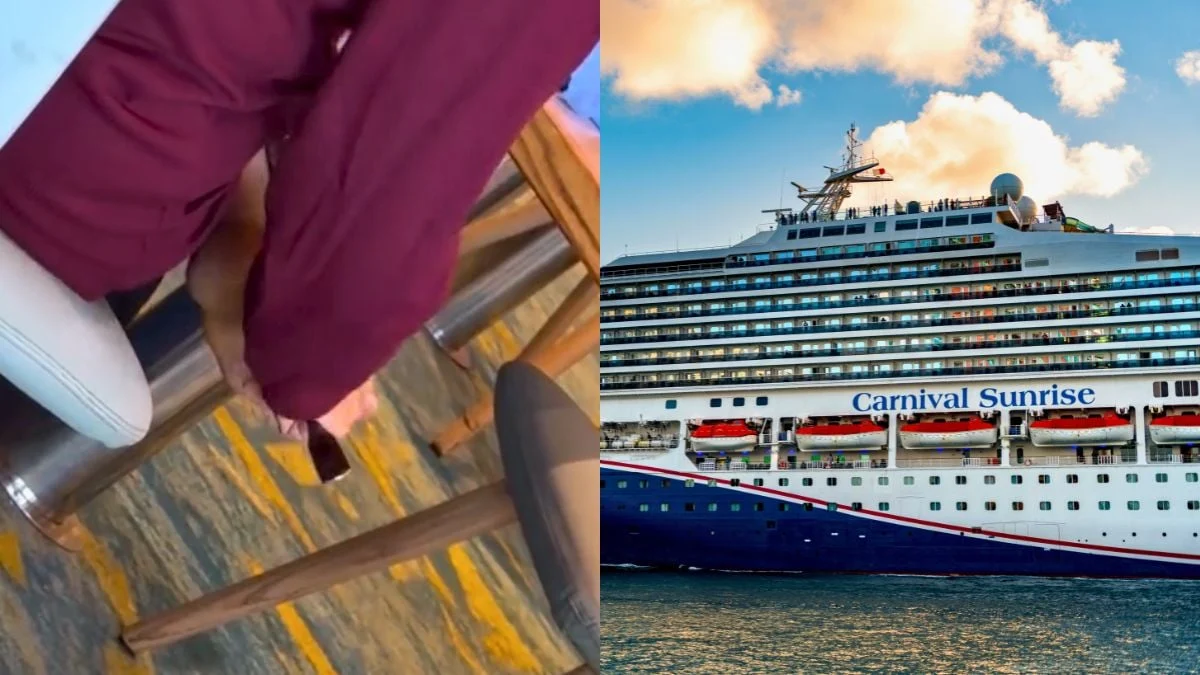
A series of disturbing videos circulating on social media has ignited a firestorm of debate regarding cruise ship hygiene and passenger conduct. The footage, which captures an unidentified passenger on a Carnival cruise ship engaging in deeply unsanitary behavior involving her feet in public dining areas, has garnered hundreds of thousands of views and prompted a wave of disgust among seasoned cruisers and casual travelers alike.
The incident, which took place aboard the Carnival Sunrise, highlights the ongoing tension between personal freedom in communal spaces and the collective responsibility required to maintain health and safety standards on high-density vessels.
The Chronology of the Incident
The footage was brought to public attention by Instagram user lucky_charmedcourt, who documented the events over the course of several days in July 2026. The series of four videos paints a grim picture of disregard for public health.
The Restaurant Contamination
In the first video, the subject is seen seated in a ship restaurant surrounded by other guests. While a crew member is visible nearby cleaning an adjacent table, the woman is filmed vigorously scratching her bare foot. As she picks at the skin, visible white flakes—likely dead skin or fungal debris—fall onto the table and surrounding area. The most jarring moment occurs seconds later when, after inspecting her fingers, the woman reaches for a slice of pizza and begins to eat, seemingly unfazed by the debris now likely transferred to her food.
The "Fork Incident"
The second video escalates the situation significantly. Captured in the same dining environment, the footage shows the woman using a metal dinner fork to scrape the bottom of her foot. The act is prolonged, with the woman methodically running the utensil across her skin. The video cuts off before the woman’s final interaction with the fork, leaving viewers to speculate whether the utensil was returned to the dining service, left on the table, or otherwise disposed of in a way that could endanger other guests.
The Deck and Guest Services Intervention
A third, shorter clip shows the same individual sitting on the open deck of the ship, continuing to scratch her foot. By this point, the viral nature of the footage had begun to alarm fellow passengers. The fourth video documents the aftermath, featuring a confrontation at the Guest Services desk. In the clip, the original poster and other concerned passengers are heard questioning the staff about the ship’s sanitation protocols.
"At this point, the whole ship is really at risk," one passenger tells the staffer. "I do have a close-up of her foot and it looks horrible, it looks infected with something, and the fact that that fork is in limbo throughout this whole ship, you’re putting the whole ship at risk. We can’t eat."
Official Response and Corporate Protocol
Following the public outcry, Carnival Cruise Line issued a formal statement to address the concerns raised by the viral footage. The cruise operator emphasized that they maintain rigorous cleaning and sanitation standards for all dining utensils and public surfaces.
"We take cleanliness on our ships seriously, so when this matter came to our attention, we took quick action to speak with the guest and to ensure the behavior was immediately addressed," the statement read. "Maintaining high standards of cleanliness and hygiene across our fleet is a top priority, and our crew remains vigilant in enforcing policies designed to provide a safe and comfortable environment for all guests."
While Carnival did not disclose the specific disciplinary actions taken against the passenger, industry experts note that cruise lines have broad latitude in their "Passenger Conduct Policy," which allows for the removal of guests who pose a health or safety threat to others.
The Legacy of the Carnival Sunrise
The incident has gained additional traction due to the ship’s historical reputation. Sharp-eyed social media users quickly identified the vessel as the Carnival Sunrise, formerly known as the Carnival Triumph.
The ship became infamous in 2013 following an engine room fire that left passengers stranded without power, air conditioning, or functional plumbing for days. The event, dubbed the "poop cruise" by international media, became a case study in crisis management and public relations failure. In June 2025, the incident was featured in the Netflix documentary anthology Trainwreck, which brought the vessel back into the public consciousness.
The coincidence of another "gross-out" incident occurring on the same ship has led to a barrage of dark humor and criticism online, with many users questioning the ship’s continued association with negative publicity.
Implications for Cruise Sanitation and Passenger Conduct
The "foot-scratching" incident serves as a case study for the challenges of managing public health on cruise ships. Unlike a hotel, where guests generally interact with private spaces, a cruise ship is a "closed loop" environment where thousands of people share the same ventilation, dining facilities, and common areas for days or weeks at a time.
The "Ick" Factor vs. Reality
While the viral video is undeniably repulsive, public health officials emphasize that the primary risk to cruise ship passengers remains communicable diseases—such as Norovirus or influenza—rather than skin conditions. However, the psychological impact of seeing such behavior significantly diminishes the "vacation experience" for other passengers.
Sanitation Protocols
Modern cruise ships employ strict sanitation protocols. Used silverware is processed through high-temperature industrial dishwashers that meet or exceed public health standards for sanitization. Even if a fork were used improperly, the standard operating procedure for any utensil that hits the floor or is suspected of contamination is immediate removal and re-sanitization. The concern raised by the passengers at the Guest Services desk was not necessarily about the process, but about the visibility of the contamination and the potential for a "rogue" fork to bypass standard collection points.
The Ethics of Public Shaming
The incident also reignites the debate over "citizen journalism" in public spaces. While the passengers who filmed the woman believe they were protecting the public interest, others argue that recording and posting videos of individuals without their consent—especially when the subject may be suffering from a medical condition—crosses a moral line.
Moving Forward: What Guests Should Expect
For Carnival Cruise Line and the broader cruise industry, this incident highlights the need for increased crew vigilance. As ships grow larger and passenger counts increase, the ability of crew members to police every table in a buffet or restaurant becomes increasingly difficult.
Moving forward, cruise lines may look to:
- Increase signage regarding hygiene expectations in dining areas.
- Empower waitstaff to be more assertive when they observe guests violating health codes.
- Implement more robust feedback loops between guest services and food and beverage departments to ensure that reported incidents are investigated with transparency.
Ultimately, the Carnival Sunrise incident is a reminder of the fragility of the social contract on a cruise ship. When a guest engages in behavior that compromises the health or comfort of the collective, the expectation of privacy is forfeited in favor of the safety of the wider passenger population. Whether this incident leads to policy changes or is simply remembered as another bizarre chapter in the storied history of the Carnival Sunrise, it has undeniably left a sour taste in the mouths of potential cruisers everywhere.
As the industry continues to recover and expand, the focus on hygiene will remain a cornerstone of the guest experience. For now, passengers are advised to remain vigilant, report genuine health hazards to staff immediately, and hope that their fellow travelers keep their feet off the dinner table.
 Asep Darmawan
  Pevita Pearce
  Asro
Asro 