

As the Kingdom of Saudi Arabia continues its ambitious march toward the realization of Vision 2030, the construction landscape—once defined by a frenetic, all-consuming race to break ground on futuristic mega-developments—is entering a phase of strategic maturation. New data from the business intelligence platform MEED reveals that contract awards for the Kingdom’s signature "giga-projects" have hit $10.6 billion so far this year, continuing a downward trajectory that began in 2024.
While headlines may focus on this cooling trend, industry experts argue that this deceleration is not a sign of failure, but rather a calculated recalibration. By shifting from the initial excitement of massive, concurrent ground-breakings to a more phased, sustainable execution, Riyadh is signaling a shift in priorities: from sheer volume to financial efficiency and long-term project viability.
Main Facts: A Shift in Market Velocity
The data presented by Edward James, MEED’s head of content and research, during a recent Saudi projects market webinar, provides a clear, if sobering, statistical snapshot of the current environment.
The figures show a distinct "cool-down" period:
- 2023 Peak: Contract awards reached a staggering $31.7 billion, representing the zenith of the initial giga-project rollout.
- 2024 Retrenchment: Awards fell to $26.7 billion as the Kingdom began to reassess the scope of projects like Neom, the crown jewel of Crown Prince Mohammed bin Salman’s modernization agenda.
- 2025 Current Data: As of the latest reporting, awards have hit $13.6 billion for the year, with a year-to-date figure of $10.6 billion, reflecting a broader trend of tightening fiscal discipline.
Despite the perception that these giga-projects define the entire Saudi construction sector, the reality is more nuanced. MEED estimates that of the $700 billion awarded across the Kingdom over the past decade, only $117 billion—roughly 17%—is tied to these headline-grabbing giga-projects. Consequently, James notes, "The decline in giga-project awards is not the overriding reason for a drop in project awards in the kingdom." Instead, the market is seeing a broader redistribution of capital as the government prioritizes projects with immediate economic utility over those with longer gestation periods.
Chronology: From Ambition to Realignment
To understand where Saudi Arabia is today, one must look at the rapid-fire timeline of the last five years.
The Era of Hyper-Growth (2020–2023)
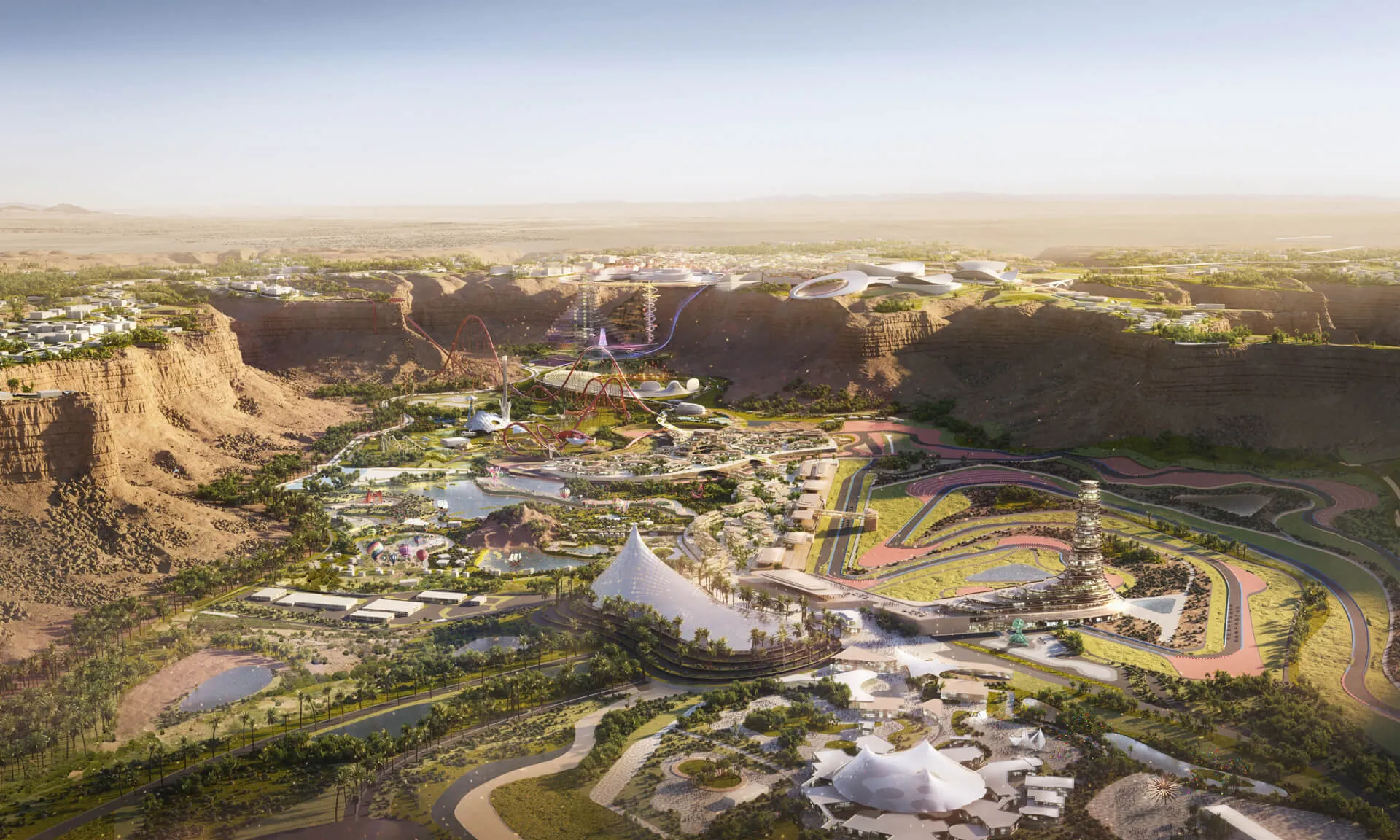
Following the global pandemic, Saudi Arabia accelerated its Vision 2030 goals. The period was marked by the announcement of massive infrastructure investments. Qiddiya, intended to be the entertainment capital of the world, and Diriyah, the cultural heart of the Saudi state, moved from concept to multi-billion-dollar construction sites. During this time, the "giga-project" became the dominant narrative of the Middle Eastern construction market.
The Pivot (2024)
As economic realities set in—specifically regarding the cost of labor, materials, and the sheer logistical complexity of building entire cities in remote desert locations—2024 became the year of the "strategic pause." The scaling back of Neom’s "The Line" was the most visible manifestation of this. The government opted to extend the construction timeline for the project, moving away from a single, rapid phase of delivery to a multi-decade development plan.
The Consolidation (2025)
We are currently in a phase of consolidation. The focus has narrowed to projects that offer immediate tourism, housing, or cultural value. Current contract awards are primarily flowing toward Qiddiya and Diriyah, with secondary funding for Rua Al Madinah and Roshn—the latter focusing on the urgent need for domestic housing stock.
Supporting Data: The Anatomy of the Construction Market
While the giga-projects often dominate international media, the domestic Saudi market is far more diverse. The "non-giga" portion of the $700 billion spend over the last decade includes critical investments in:
- Utilities and Energy: Massive investments in solar and wind power, as well as water desalination plants, to support the infrastructure of the future.
- Transportation: The expansion of airports and the development of new high-speed rail links connecting the Red Sea coast with Riyadh.
- Housing and Urban Renewal: Through the Roshn development group, the Kingdom is aggressively tackling a historic housing shortage, ensuring that the local population benefits from the economic boom.
- Social Infrastructure: Hospitals, schools, and local civic centers that form the backbone of a modernized Saudi society.
James’s analysis highlights that the decline in giga-project spending is not a collapse of the construction sector but a shift in the composition of project awards. Investors and contractors are being asked to provide more value-for-money, and the Saudi government is increasingly prioritizing Public-Private Partnerships (PPPs) to share the financial burden.
Official Responses: Managing Expectations
The Saudi government has been notably transparent about the need for this realignment. In official statements, leadership from the Public Investment Fund (PIF)—the primary engine behind the giga-projects—has emphasized that Vision 2030 is a "rolling plan."
Officials have characterized the shifts as "optimization," rather than "cancellation." The argument is that the original timelines were set to drive urgency and attract global investment. Now that those investments are secured, the focus has shifted to operationalizing those assets. By extending timelines, the Kingdom is avoiding inflationary pressures—such as the over-heating of the local construction market—and ensuring that the infrastructure is built to a standard that can accommodate future growth.
Furthermore, the focus on Qiddiya and Diriyah suggests that Riyadh is prioritizing "anchor projects" that generate immediate revenue through tourism, which in turn helps fund the more experimental phases of the broader Vision 2030 strategy.
Implications: What Lies Ahead?
The cooling of the giga-project market carries several implications for international investors, contractors, and the global construction industry.
1. A Market for Specialists, Not Generalists
In the early days of Vision 2030, the market favored firms that could move quickly and manage large-scale labor forces. Now, the market favors specialist firms capable of delivering high-tech infrastructure, sustainable materials, and long-term facility management. The "next wave" of projects, which MEED expects to emerge soon, will likely be tied to specific utility and social needs rather than purely aesthetic or tourism-focused builds.
2. The Rise of Sustainable Financing
With the era of "easy money" and rapid state-funded expansion slowing, projects will need to prove their internal rate of return. We are likely to see an increase in debt financing, green bonds, and international investment participation. The Kingdom is actively working to make the regulatory environment more hospitable to foreign direct investment (FDI), recognizing that the state cannot, and should not, fund every project alone.
3. Regional Competition
Saudi Arabia’s move to pace itself is also a response to the regional competitive landscape. With the UAE and Qatar also aggressively pursuing their own modernization agendas, Saudi Arabia is looking to secure its position as the premier hub for sustainable urban living. By pacing the development of Qiddiya and other hubs, the Kingdom is effectively managing its supply chain and labor resources to ensure long-term stability rather than short-term spikes.
4. The Human Element
Finally, the transition from building the "shell" of a city to "populating" it is the most critical hurdle. The current slowdown allows the Kingdom to focus on the human-capital side of Vision 2030: training a Saudi workforce to manage the high-tech, service-oriented economy that these projects are intended to support.
Conclusion: A Mature Strategy for a Future Kingdom
The narrative of "scaling back" is often misinterpreted as a lack of resolve. However, in the context of Saudi Arabia’s massive economic transformation, the current moderation in contract awards represents a move toward institutional maturity.
The Kingdom is demonstrating a capacity for self-correction—a vital trait for any nation attempting a societal and economic shift of this magnitude. By prioritizing financial sustainability and focusing on projects that deliver the most immediate impact, Riyadh is ensuring that the legacy of Vision 2030 is not just a collection of impressive blueprints, but a resilient, diversified economy capable of thriving in the post-oil era.
As the next wave of projects is announced, the global construction industry will be watching closely, not for the size of the contracts, but for the clarity of the vision behind them. The era of the giga-project is not ending; it is merely evolving into a more measured, professional, and sustainable reality.
 Sagoh
 Lina Irawan
