

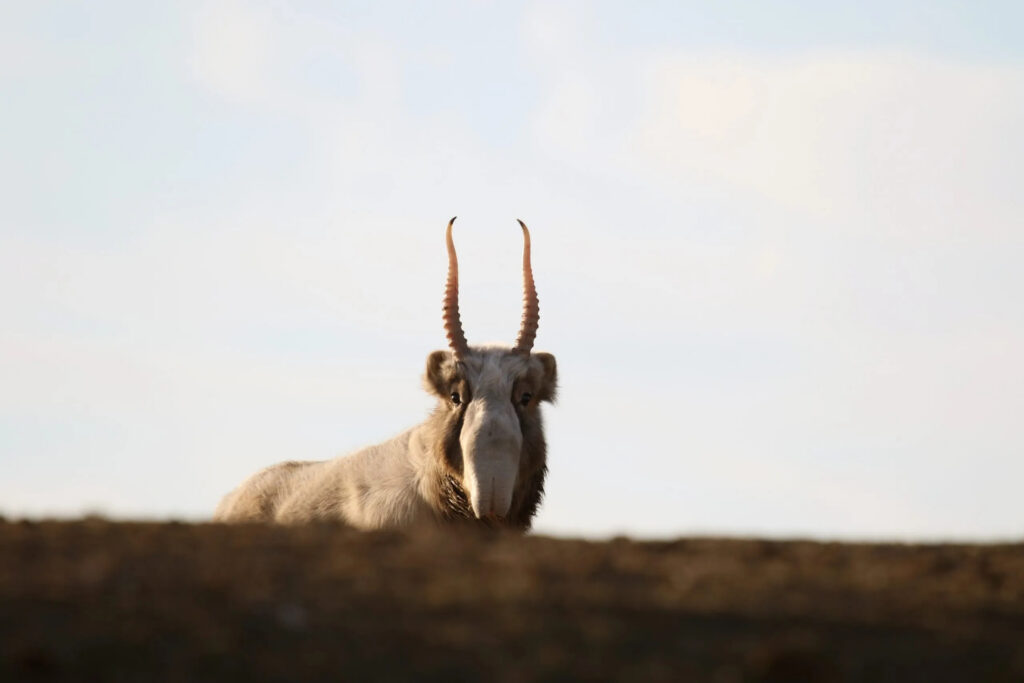
The Eurasian steppe is not merely a landscape; it is a repository of deep time. In the remote western reaches of Kazakhstan, where the Ural River marks the traditional boundary between Asia and Europe, a singular creature—the saiga antelope—continues to perform a migration that has outlasted the rise and fall of empires. With their bulbous, trunk-like noses and prehistoric lineage, these ungulates represent a living link to an era when woolly mammoths and saber-toothed cats still roamed the frozen plains.
However, as the modern world encroaches with railways, fenced borders, and sedentary agriculture, this ancient rhythm is stuttering. A new investigation into the state of the saiga population reveals a sobering reality: the fragmentation of the steppe is not just a logistical hurdle for animals; it is a profound erasure of ancestral knowledge.
The Geography of Survival: A Chronology of the Steppe
The history of the saiga is inextricably linked to the history of human nomadism. Since the Early Iron Age, the Central Asian steppe served as a transcontinental crossroads, facilitating the flow of the Great Silk Road. For the nomadic tribes who inhabited this land, the saiga was more than a food source; it was a guide. When the first human caravans navigated these unforgiving grasslands, they followed the antelope, whose innate sense of geography directed them toward water and shelter.
For nearly 300,000 years, humanity lived in mobile groups that mirrored the migratory patterns of the wild. This harmony was forcibly dismantled during the 20th century under Soviet rule, which mandated sedentarization. Nomads were coerced into agricultural plots—a policy that largely failed, given that the arid, windswept soil of the steppe was never intended for large-scale farming.
As human populations moved into urban centers, the vast, empty spaces they left behind were claimed by infrastructure. By the early 2000s, the once-unbroken expanse of the Eurasian steppe had been sliced into jagged parcels by roads, rail lines, and political borders. The saiga, however, remained a creature of motion. Today, they continue to sprint across the treeless plains, their movements dictated by the rutting season, a critical window where thousands of individuals congregate for competitive rituals that test the physical limits of the species.
Supporting Data: The Impact of Fragmentation
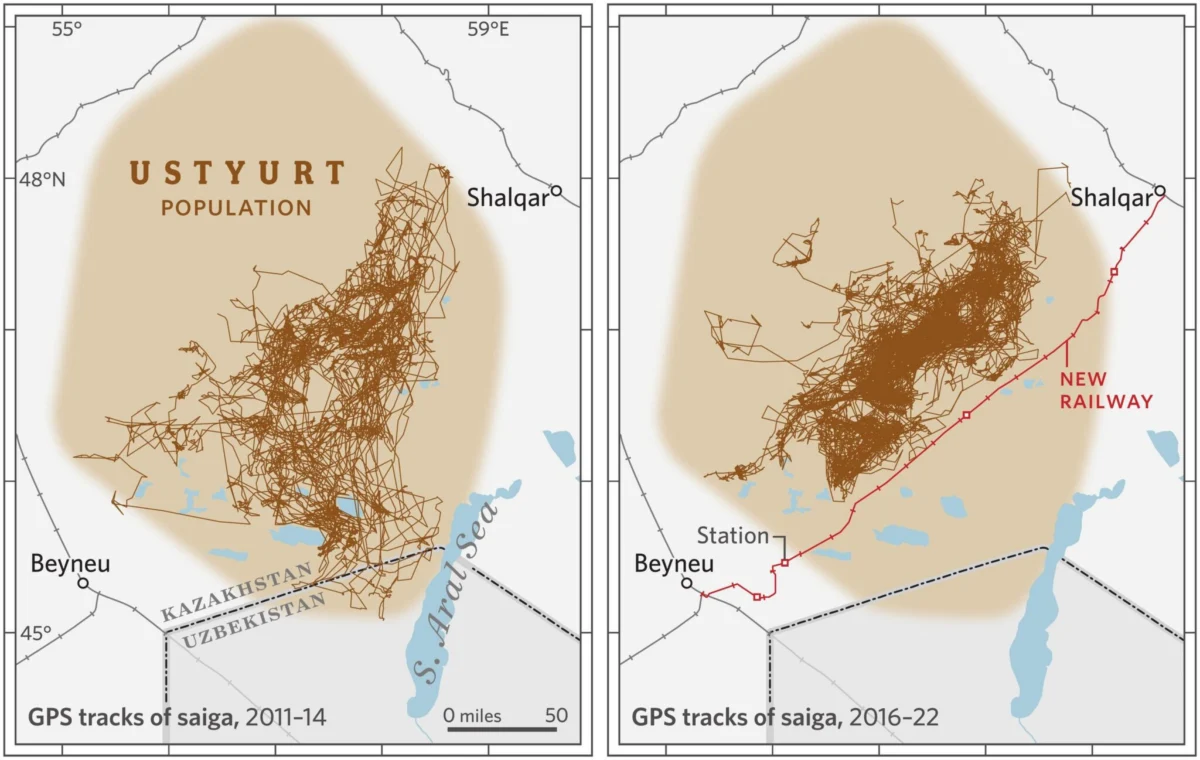
The Association for the Conservation of Biodiversity of Kazakhstan (ACBK) has been at the forefront of tracking these movements. By utilizing GPS collars, researchers have been able to map the antelope’s migratory corridors with unprecedented precision. The data is clear: infrastructure is the primary architect of decline.
One of the most damning pieces of evidence involves a rail line constructed in 2014. Before its completion, GPS data showed thousands of saigas traversing the border into Uzbekistan in a seasonal, rhythmic flow. Following the construction of the tracks, that flow effectively ceased. The data now shows a heart-wrenching pattern: groups of saigas "spinning" along the northern side of the tracks, unable to cross, while the grazing lands they historically relied upon remain just beyond reach.
This disruption leads to what scientists call a "collapse in spatial knowledge." Much like a language that is forgotten when the last speakers die, the routes of the saiga are passed down from generation to generation through active participation. When a path is blocked for several years, the collective memory of the herd is severed.
Official Responses and Conservation Efforts
In response to these findings, the ACBK has launched a series of "reconnection" initiatives, partnering with the Kazakh and Uzbek governments to mitigate the damage caused by human expansion.
The strategy is twofold:
- Engineering Wildlife Crossings: In areas where rail lines have historically acted as walls, the ACBK has worked to construct sloping dirt ramps that bridge the height of the tracks. These ramps create a visual illusion of a natural corridor, encouraging the skittish antelope to move across without the fear of being funneled into a trap.
- Border Permeability: Along the border between Kazakhstan and Uzbekistan, the traditional barbed-wire fences—which often claimed the lives of migrating herds—are being replaced with "X-shaped" barricades. These structures are specifically designed to block vehicles while allowing the saigas to pass through unhindered.
These efforts are not merely about preserving a species; they are about restoring the integrity of a landscape. Albert, a veteran researcher with the ACBK, notes that the success of these measures depends on the animals’ ability to "re-learn" the land. Rebuilding this trust is a slow, multi-generational process, but early signs suggest that where the paths are reopened, the saigas are tentatively returning.
The Implications: A Species at the Margin
The plight of the saiga offers a stark reflection on our own species’ trajectory. Filmmaker Werner Herzog once remarked, "Whatever went wrong and makes our civilization something doomed is the departure from the nomadic life." As we force the world into static, grid-like systems, we lose more than just wildlife; we lose the "in-between" spaces that have historically defined our existence.
For the intrepid merchants of the 13th century, the silence of the steppe was not a source of fear, but a source of assurance. To know that the land was not entirely empty—that there was life thriving beyond the margins of human civilization—provided a sense of belonging to a larger, wilder world.
The saiga’s survival is therefore a test of our own humanity. If we can accommodate the needs of a migratory species that has outlived the saber-toothed cat, we demonstrate that our infrastructure does not have to be an absolute barrier. We have the capacity to design a world where human progress does not necessitate the destruction of ancient, nonhuman rhythms.
Conclusion: Looking Toward the Horizon
As the sun sets over the Ural River, the landscape returns to its natural state: a stark, breathtaking expanse of black and white. Against the frost, the only traces of color are the deep, rust-red furrows left by the hooves of a herd on the move. They are, as the local saying goes, "freedom-loving animals."
Their future remains precarious, caught in the tension between a rapidly developing global economy and a deep-seated biological imperative to roam. However, through the integration of scientific tracking and proactive landscape management, there is a path forward. The Saiga Silk Road, while fractured, is not yet erased. By protecting these corridors, we do more than save an animal; we preserve the last, lingering echoes of a world in motion.
This article is adapted from the nonfiction travelogue "The Hidden Nations of Animals." It explores the intersection of human history, biological migration, and the future of our shared wild spaces.
 Nana Muazin
  Azzam Bilal Chamdy
  Siti Muinah