

Main Facts: The Evolution of AI-Assisted Content Creation
In the fast-paced world of digital publishing and content creation, efficiency is the ultimate currency. For professional freelance writers, interviewing subject matter experts (SMEs) is a foundational requirement, particularly for high-value B2B, finance, and technology articles. However, a standard 20-minute conversation with an industry insider easily translates into a dense, 3,000-word dialogue. Historically, capturing these insights accurately required an agonizing, multi-pass review of raw audio recordings—often turning a brief interview into an hour or more of tedious, manual transcription.
Enter automated speech-to-text artificial intelligence. Platforms like Otter.ai have dramatically reshaped modern media workflows by delivering real-time transcriptions the exact moment a call concludes. Having utilized Otter.ai since 2020 for client calls, conference recordings, and complex SME interviews across prominent fintech publications like The Financial Brand, industry professionals are increasingly weighing whether the platform’s $100 annual Pro tier justifies the expense.
The core value proposition centers on time recovery. By outsourcing the rote mechanics of transcription to machine learning algorithms, freelance journalists and content creators can reallocate precious hours toward higher-margin tasks: outlining, narrative structuring, and deep reporting. Yet, with accuracy rates hovering around 80% to 85% and minor technical hurdles regarding speaker identification and audio routing, the platform is not without its operational friction points.
Chronology: How AI Transformed the Writer’s Desk
To understand the current reliance on tools like Otter.ai, it is helpful to examine the historical timeline of transcription methods in freelance journalism:
- The Era of Manual Note-Taking (Pre-2010s): Writers relied on shorthand or frantically typed notes during live interviews. This dual-focus approach frequently resulted in compromised conversations, missed nuance, and incomplete quotes.
- The Traditional Human Transcription Boom (2010–2018): Freelancers began utilizing digital audio recorders and outsourcing transcription to human-centric platforms or offshore typists. While accuracy was high, turnaround times ranged from 48 hours to five days, introducing severe bottlenecks for tight editorial deadlines.
- The Rise of Early Speech-to-Text Software (2018–2020): Early desktop dictation and basic transcription utilities emerged, but they suffered from clunky interfaces, poor handling of industry-specific jargon, and a lack of cloud integration.
- The Modern AI Integration Phase (2020–Present): Cloud-native AI transcription apps like Otter.ai, Fireflies.ai, and Fathom entered the mainstream. Features evolved rapidly to include automated calendar syncing, AI-powered chat search functions, real-time speaker diarization, and immediate post-call availability, fundamentally altering the production timeline for digital media.
Supporting Data and ROI Analysis: Crunching the Numbers
For independent contractors operating on strict project-based fees, software investments must be justified by cold, hard return on investment (ROI) metrics. Consider a standard freelance assignment: a 1,000-word article backed by a single SME interview, yielding a flat rate of $1,200.
Under a traditional workflow, the time investment breaks down approximately as follows:
- Research & Prep: 1 hour
- Interview & Manual Transcription Review: 2 hours (including 1+ hour of re-listening and typing)
- Outlining, Drafting, & Polishing: 3 hours
- Total Time Invested: 6 hours
- Effective Hourly Rate: $200/hour
By integrating an AI transcription tool, that transcription and review window shrinks dramatically.
- Research & Prep: 1 hour
- Interview & Automated Transcript Cleanup: 1 hour (reading an instant transcript and verifying quotes via linked audio playback)
- Outlining, Drafting, & Polishing: 3 hours
- Total Time Invested: 5 hours
- Effective Hourly Rate: $240/hour
Over the course of a month involving three to four interview-driven articles, the time savings compound rapidly—frequently saving three to five hours of administrative drag. At an annual subscription cost of roughly $100 for the Pro tier, the platform essentially pays for itself within the first month of active deployment, effectively functioning as an earnings multiplier.
Official Insights: Features, Capabilities, and Real-World Limitations
Evaluating an essential workspace tool requires looking beyond marketing claims to examine practical functionality, strengths, and inherent limitations.
What Makes the Tool Worth It
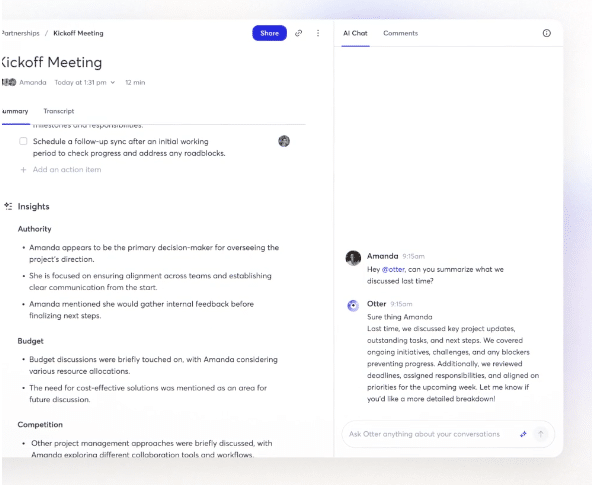
- Immediate Transcript Availability: Transcripts populate instantly upon the conclusion of a meeting. Even factoring in 10 minutes of light editing and structural cleanup, the delay is negligible compared to manual methods or human-reliant agencies.
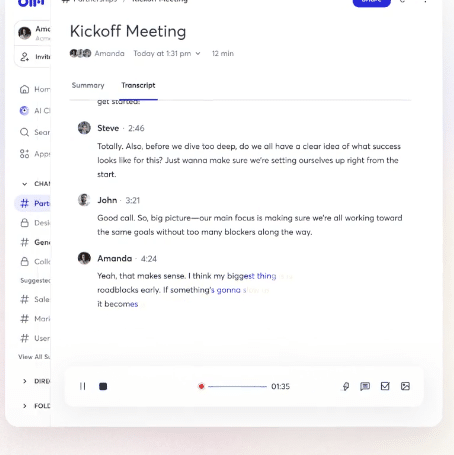
- AI Chat Search Functionality: Modern AI transcription apps allow users to query transcripts conversationally. If an expert discussed "AI personalization" or "fraud detection" during a sprawling, tangential interview, a writer can prompt the internal chatbot to instantly surface and summarize the exact segment.
- Synchronized Audio Playback: Clicking any line of text within the digital transcript immediately triggers the corresponding audio playback. This feature is indispensable for verifying mangled technical terms, unusual acronyms, or garbled dialogue before publishing a quote.
- Generous Free Tiers: Platforms typically offer robust trial models (such as 300 monthly minutes with 30-minute per-recording caps), allowing prospective users to stress-test the software against their unique workflow before spending capital.
The Real Limitations and Operational Hurdles
- Audio Routing and Speaker Modes: Many desktop transcription utilities capture system audio via computer speakers rather than direct internal routing when headphones are plugged in. Consequently, users must operate in quiet environments or private home offices to ensure both sides of a conversation are clearly captured.
- Sub-100% Accuracy Rates: While developers often advertise up to 95% accuracy, real-world conditions involving diverse accents, overlapping speech, and complex industry jargon usually yield an 80% to 85% accuracy rate. Proper nouns, niche acronyms, and regional dialects frequently require manual correction.
- Inconsistent Speaker Diarization: Automated identification of multiple speakers can falter when participants possess similar vocal tones or during large multi-person webinars, requiring writers to manually correct attributions (e.g., changing "Speaker 1" to the expert’s actual name).
Implications for the Future of Freelance Writing
The integration of artificial intelligence into the reporting and writing pipeline carries broad implications for the media landscape. As administrative friction is systematically engineered out of the writing process, editorial expectations are shifting. Publishers increasingly demand faster turnarounds, deeper reporting, and higher content volume from independent contributors.
For freelance writers, adopting tools like Otter.ai is no longer merely a luxury; it is a vital competitive advantage. By cutting down the non-billable hours spent wrestling with audio files, creators can reinvest their energy into what matters most: cultivating high-level industry sources, asking sharper interview questions, and crafting compelling, deeply reported stories.
Pricing and Adoption Verdict
For most working journalists and freelance content creators, the Pro subscription tier ($8.33/month billed annually, or roughly $100/year) represents the optimal sweet spot. It provides ample monthly minutes and generous recording limits that easily accommodate standard interview schedules. While human transcription services remain useful for ultra-high-accuracy legal or academic transcription, and alternative AI platforms like Fireflies.ai or Fathom offer strong competitive feature sets, the tried-and-true reliability of established transcription apps makes them a cornerstone of modern digital publishing workflows.
Interested in accelerating your freelance career? Industry training programs and educational courses continue to help thousands of writers scale their income past their first $1,000 and beyond, leveraging modern software tools to build sustainable, location-independent media businesses.
 Asep Darmawan
  Raul Delapena Setiawan
  Asro
Asro 