

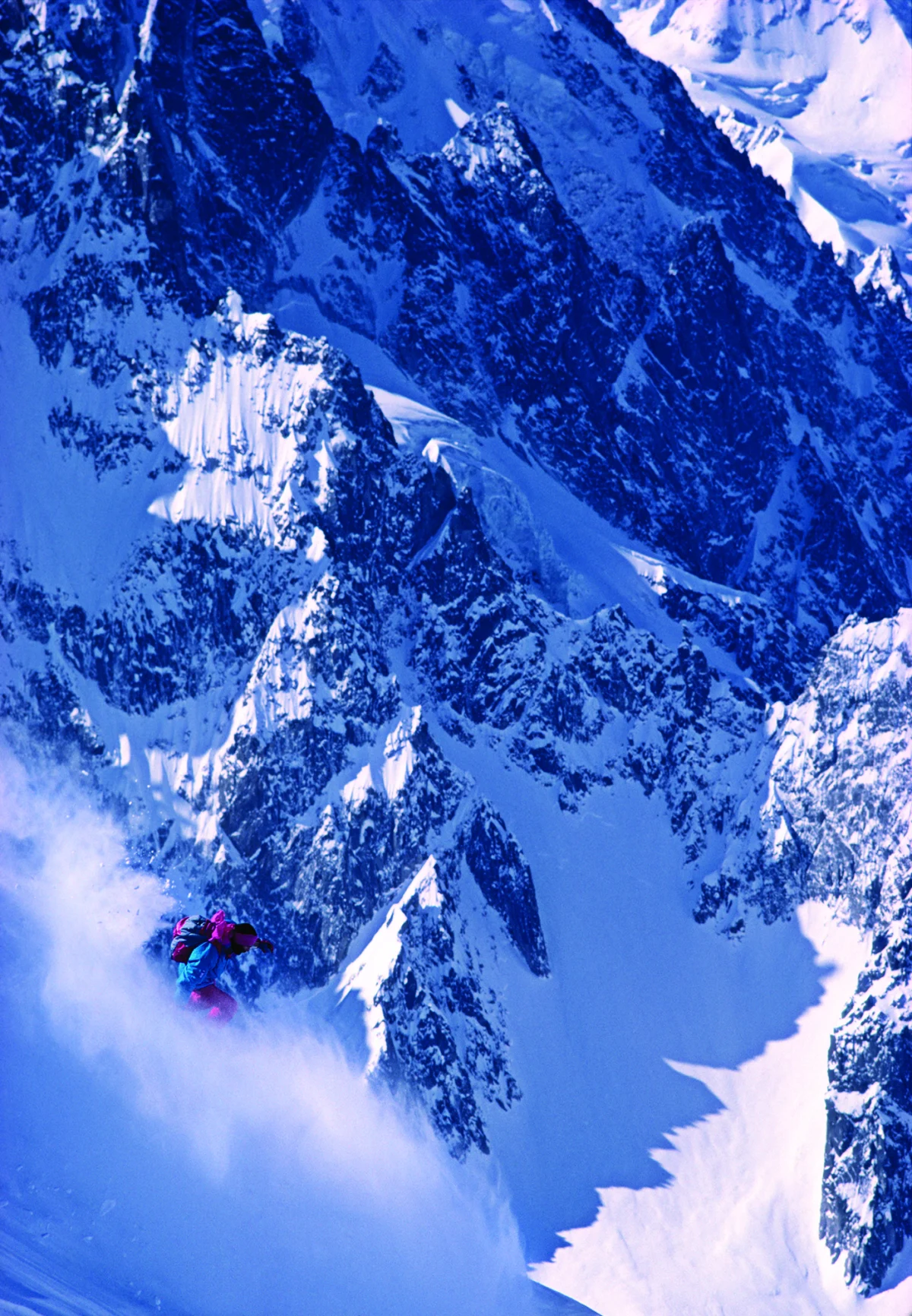
In the late 1980s, the high-altitude amphitheater of Chamonix, France, served as the global epicenter for a radical shift in human performance. While the rest of the world was still grappling with the rigid definitions of "skiing" or "mountaineering," a cohort of French pioneers—including the legendary Jean-Marc Boivin, Bruno Gouvy, and the ill-fated, iconic Patrick Vallençant—were busy rewriting the laws of gravity.
Amidst this crucible of vertical ambition, photographer and writer Chris Noble observed a cultural phenomenon that transcended simple athletic terminology. He brought back a word from the French Alps that captured the essence of this high-angle energy: glisse. To the uninitiated, it was a simple verb meaning "to glide." To the mountaineers of the Haute-Savoie, it was an entire philosophy of movement, a linguistic umbrella that fundamentally altered how we perceive the act of traversing snow, water, and air.
A Chronology of the Vertical Frontier
To understand glisse, one must first understand the era of its ascent. The 1970s and 80s were the "Wild West" of extreme sports.
- 1970s: The birth of extreme skiing as a distinct discipline. Athletes like Patrick Vallençant began tackling descents that were previously considered "unskiable" by traditional alpine standards.
- 1985: The zenith of the Chamonix movement. The influence of French practitioners began to bleed into the North American consciousness as media coverage of European "steep skiing" grew.
- Late 1980s: Chris Noble returns to the United States, introducing the concept of glisse to the American adventure lexicon.
- 1990s: The term "action sports" gains traction in the U.S. media, a sanitized, market-driven counterpart to the more fluid, European-rooted concept of glisse.
- 2008–Present: The ongoing evolution of mountain culture, as glisse remains the philosophical undercurrent for those who prioritize the "flow" over the "conquest."
The Etymology of Flow: Why ‘Glisse’ Matters
The word glisser—to slide or glide—carries a Gallic insouciance that the American term "action sports" entirely lacks. "Action" implies struggle, aggression, and a competitive drive to dominate the landscape. Glisse, by contrast, implies a partnership with the medium. It is the act of sliding over a surface rather than fighting against it.
When Noble shared the term, it resonated because it felt both foreign and oddly precise. It captured the slippery, ephemeral nature of the sport. In the French cultural context, glisse encompasses skiing, snowboarding, surfing, and even skateboarding. It acknowledges that the sensation—the frictionless movement—is the primary goal, regardless of the apparatus strapped to one’s feet.
Supporting Data: The Shift in Mountain Performance
The transition from traditional alpine skiing to the era of glisse can be measured through the technical achievements of the era’s protagonists.
| Athlete | Primary Innovation | Impact on Sport |
|---|---|---|
| Patrick Vallençant | Steep skiing techniques | Opened 50-60 degree slopes previously thought impossible. |
| Jean-Marc Boivin | Multisport integration | Blended paragliding and extreme skiing, emphasizing "flow." |
| Bruno Gouvy | Style-focused movement | Shifted focus from survival to aesthetic, fluid performance. |
These athletes weren’t just faster; they were smoother. They sought the path of least resistance on the most dangerous terrain on Earth. By analyzing the footage of these pioneers, researchers and historians of sport have noted a marked decrease in "staccato" movement—the sharp, defensive turns of traditional racing—and an increase in fluid, sweeping arcs. This is the physical manifestation of glisse.
The Implications of Linguistic Shifts
Why did the term "action sports" win the linguistic war in North America? The answer lies in the commodification of the culture. In the 1990s, the X Games and other corporate-backed entities needed a term that suggested intensity, danger, and consumerism. "Action" sells energy drinks and high-performance gear; "Gliding" sells a lifestyle of grace and environmental connection.
However, the implications of this shift are profound. By labeling these activities as "action sports," we have arguably distanced the participant from the environment. The focus shifted from the experience of the slide to the execution of the trick.
For the practitioners of the 1980s, the mountain was a partner. For the modern professional, it is often a stage. As we look toward the future of mountain sports, there is a growing movement—a return to the roots—where athletes are reclaiming the concept of glisse. They are moving away from the "extreme" label, which often implies a reckless disregard for the terrain, and back toward the nuance of the glide.
Official Perspectives: A Legacy of Style
The late Patrick Vallençant once noted that the difference between a master and a novice on a steep face was not the equipment, but the relationship to the slope. "If you fight the snow," he argued, "you have already lost."
This sentiment is echoed by modern freeriders who trace their lineage back to the Chamonix era. The shift back toward glisse represents a maturation of the sport. It marks the transition from adolescence—where the goal is to prove one’s courage through danger—to adulthood, where the goal is to achieve harmony through movement.
Conclusion: The Lasting Echo of Chamonix
The influence of the French school of mountain performance remains as relevant today as it was in the shadow of the Grandes Montets. While the North American market may have branded these activities as "extreme" or "action-oriented," the underlying truth remains tucked away in the word glisse.
It is a reminder that at the heart of every great descent, every wave caught, and every arc carved into the earth, there is a simple, beautiful act of gliding. We are not conquering the mountain; we are simply sliding across its surface, and for a brief, fleeting moment, we are part of the landscape.
As we continue to push the boundaries of what is physically possible in the mountains, perhaps it is time to stop searching for new words for "revolution" and return to the one that started it all: glisse. It is the most honest way to describe the pursuit of the infinite, one glide at a time.
 Raul Delapena Setiawan
  Pevita Pearce
  Siti Muinah