

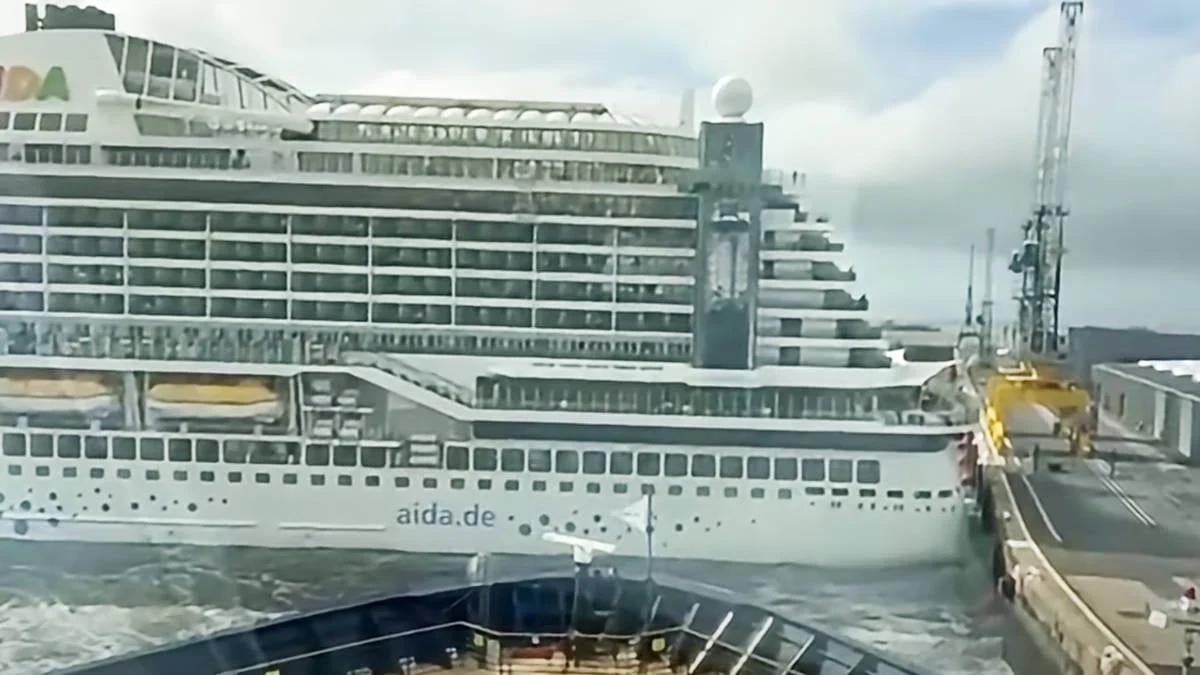
LE HAVRE, France — What was meant to be a relaxing afternoon of sightseeing during a European coastal voyage turned into a heart-pounding ordeal for guests and crew aboard the AIDAperla on September 8, 2026. Docked at the historic Port of Le Havre on the northern coast of France, the massive 3,286-passenger cruise ship was battered by sudden, violent wind gusts that snapped her forward mooring lines.
The unexpected failure sent the vessel drifting backward from her berth, culminating in a heavy impact with the concrete quay wall. The dramatic incident, captured on video by stunned onlookers, triggered immediate emergency responses, temporary port closures, structural damage to both the ship and shore facilities, and a ripple effect of itinerary alterations that left hundreds of passengers temporarily stranded ashore.
Despite the alarming nature of the breakaway and the subsequent collision, port authorities and AIDA Cruises confirmed that no injuries were reported among the thousands of guests and crew members onboard or among dockworkers on the pier. However, the vessel now faces rigorous technical inspections and classification society clearances before she is permitted to resume passenger operations.
Main Facts
The incident aboard the AIDAperla underscores the unpredictable and formidable nature of maritime weather, even when ships are securely tied to modern port infrastructure.
- The Vessel: AIDAperla, a large-capacity cruise ship owned and operated by German cruise line AIDA Cruises (a subsidiary of Carnival Corporation & plc), with a maximum capacity of 3,286 passengers.
- The Itinerary: A 7-night roundtrip voyage that departed Hamburg, Germany, on September 5, 2026. Prior to arriving in Le Havre, the ship had successfully completed a scheduled call in Southampton, United Kingdom, on September 7.
- The Incident: At approximately 4:00 p.m. local time on September 8, 2026, intense wind gusts snapped the forward mooring lines holding the vessel to her berth at the Port of Le Havre. The ship broke free, drifted backward, and collided with the quay wall.
- Impact and Damages: Both primary passenger gangways were torn away from the ship, plunging into the harbor basin and creating floating navigational hazards. The ship’s stern made direct contact with the concrete pier. Fortunately, structural assessments by technicians later confirmed no hull breaches, and zero injuries were recorded.
- Passenger Disruption: Roughly 500 guests were participating in organized shore excursions at the time of the breakaway and were temporarily unable to return to the vessel. Meanwhile, guests onboard experienced a dramatic disruption as alarms sounded and emergency protocols were initiated.
- Collateral Disruptions: TUI Cruises’ Mein Schiff 3 was also berthed in Le Havre during the storm. Due to the volatile harbor conditions, her departure was delayed by two hours, and she required the active assistance of port tugboats to remain safely pinned to her berth.
- Itinerary Adjustments: The scheduled 8:00 p.m. departure from Le Havre on September 8 was canceled. The subsequent port call in Zeebrugge, Belgium, slated for September 9, was dropped entirely. The ship’s later calls, including Rotterdam on September 10 and the eventual return to Hamburg on September 12, remain on track as of the latest operational updates.
Chronology of Events
The unfolding crisis at the Port of Le Havre occurred rapidly, challenging port captains, harbor pilots, and the ship’s bridge crew to react under severe time constraints and adverse weather conditions.
Early Afternoon: The Approach of Severe Weather
The AIDAperla had arrived smoothly in Le Havre earlier that morning, following her Channel crossing from Southampton. Conditions during the morning hours were manageable, allowing hundreds of passengers to disembark for afternoon excursions exploring Normandy, including trips to Monet’s garden in Giverny, historical WWII landing beaches, and local cultural landmarks within Le Havre.
4:00 p.m.: The Breakaway
By mid-afternoon, a rapidly shifting weather system swept over northern France. Meteorological data from Weather Underground recorded sustained high winds and sudden gusts reaching approximately 35 miles per hour (56 kilometers per hour) across the Le Havre region.
The localized wind forces caught the vast, high-profile hull of the AIDAperla like a sail. The immense lateral pressure proved too much for the forward mooring lines. Witnesses and video footage captured the sudden parting of the heavy-duty ropes. Relieved of her forward tension, the bow swung outward, and the ship began to drift backward across the slipway, pushing her stern squarely into the reinforced quay wall.
The Immediate Aftermath and Floating Hazards
As the ship drifted away from the pier, the physical connections between the vessel and the terminal infrastructure were violently severed. Both passenger gangways—heavy, aluminum-and-steel bridging structures—were ripped from their moorings. One gangway collapsed into the harbor waters, while the other remained precariously suspended, dangling off the port side of the ship as she drifted.
Passengers aboard the ship reported a heavy shudder as the stern met the concrete. "Our ship, AIDAperla, had this accident. We are still docked in Le Havre," shared one German passenger on social media, echoing the initial confusion and shock onboard.
With the ship drifting and infrastructure compromised, HAROPA PORT authorities enacted emergency harbor protocols. Vessel traffic services temporarily closed the port’s navigational channels to prevent other marine traffic from entering the hazard zone.
Late Afternoon: Stranded Ashore and Tugboat Intervention
Back on land, roughly 500 guests who had chosen independent or cruise-line-sponsored afternoon excursions arrived back at the terminal area only to find access blocked. They were temporarily locked out of the port zone as emergency services, harbor pilots, and terminal staff rushed to secure the area.
Recognizing the gravity of the situation, port authorities scrambled multiple harbor tugboats. These powerful vessels converged on the AIDAperla, pushing against her massive starboard flank to steady the ship and gently guide her back toward the berth.
Evening: Securing the Vessel and Resuming Boarding
Through the coordinated efforts of the ship’s deck crew and local marine pilots, the AIDAperla was pushed back against the quay and secured with fresh lines. At 9:22 p.m., HAROPA PORT released an official statement confirming that the vessel had been successfully secured and that safe passenger boarding could resume.
Stranded ashore, the 500 excursion guests were cleared to re-enter the secure port facility and board the ship in an orderly fashion. Concurrently, navigation channels through the port were gradually reopened as floating debris, including the fallen gangways, were accounted for by harbor recovery boats.
Supporting Data and Meteorological Context
Maritime accidents involving moored cruise ships are relatively rare thanks to advanced weather forecasting, dynamic positioning systems, and robust port infrastructure. However, sudden microbursts, squall lines, and high-velocity winds present severe challenges to ultra-large cruise ships due to their high "windage"—the massive surface area above the waterline that acts as a giant sail.
+--------------------------------------------------------------------------+
|                        AIDAperla Incident Metrics                        |
+------------------------------+-------------------------------------------+
| Date of Incident             | September 8, 2026                         |
| Location                     | Port of Le Havre, France                  |
| Peak Wind Gusts              | ~35 mph (~56 km/h)                        |
| Passengers Onboard           | Up to 3,286                               |
| Passengers Stranded Ashore   | ~500                                      |
| Injuries Reported            | None (0)                                  |
| Primary Damage               | Mooring lines snapped, gangways destroyed |
| Itinerary Alterations        | Zeebrugge call canceled                   |
+------------------------------+-------------------------------------------+
According to regional meteorological archives for Le Havre on September 8, 2026, atmospheric instability generated fast-moving squalls along the English Channel coastline. While 35 mph winds are not hurricane-force, their sudden application on the broadside profile of a cruise ship exerting multi-ton pressure on individual bollards can easily fatigue and snap standard mooring lines if the angle of the wind creates compounding leverage.
Furthermore, the simultaneous presence of TUI Cruises’ Mein Schiff 3 in the same port highlighted that the weather event was not isolated to a single berth. Mein Schiff 3 was forced to rely on active tugboat assistance to maintain its position at the pier, delaying its departure schedule by two hours as harbor masters managed the compounding risks in the busy French port.
Official Responses and Technical Inspections
In the wake of any marine contact incident, regulatory frameworks require stringent safety protocols before a commercial passenger vessel can resume revenue operations.
AIDA Cruises Statement
Representatives for AIDA Cruises confirmed that the AIDAperla made unintended contact with the quay wall following sudden severe weather changes in Le Havre. The cruise line emphasized that guest and crew safety remained the absolute priority throughout the incident.
Teams of marine technicians, naval architects, and company superintendents immediately boarded the vessel to conduct exhaustive non-destructive testing and physical inspections. Divers were also deployed to inspect the underwater profile of the hull, ensuring that the ship’s propellers, rudders, and bulbous bow sustained no structural compromises during the impact with the quay.
Port Authority and Classification Society Oversight
Under international maritime law, a cruise ship involved in a structural collision or breakaway event must receive clearance from its designated classification society—the independent organization that establishes and verifies technical standards for hull integrity and marine engineering.
German media sources reported that local authorities and maritime inspectors insisted on a full sign-off from the classification society before granting the AIDAperla permission to cast off lines and leave French waters. HAROPA PORT coordinated closely with the ship’s master to ensure that all harbor safety regulations were fully satisfied before reopening the basin to normal traffic flows.
Implications for Passengers and Future Itineraries
While the physical damage to the AIDAperla was superficial and quickly managed, the operational consequences rippled directly through the ship’s current voyage and threatened future scheduling plans.
Canceled Call in Zeebrugge
The most immediate impact on the guest experience was the cancellation of the ship’s scheduled visit to Zeebrugge, Belgium, which had been planned for September 9. Because the ship remained detained in Le Havre overnight for inspections, paperwork clearances, and the finalization of repairs, the transit time required to reach the Belgian port became unfeasible.
Instead of walking the historic streets of Bruges or touring coastal Belgium, guests spent an extended day in Le Havre or at sea as the captain steered a direct course toward the Netherlands.
Adjusted Timeline and Upcoming Cruisers
Despite skipping Zeebrugge, AIDA Cruises confirmed that the rest of the current itinerary remains largely intact. The AIDAperla is scheduled to make her next port call in Rotterdam on September 10, allowing passengers to experience the vibrant Dutch port city. The final leg of the cruise—returning to the homeport of Hamburg on September 12—is proceeding as originally planned.
For travelers booked on the subsequent 7-night voyage departing Hamburg on September 12, no delays or itinerary cancellations have been announced. That upcoming cruise is slated to visit iconic Norwegian fjords, including Bergen, Nordfjordeid, Ålesund, and Stavanger, before concluding back in Hamburg on September 19.
Combined Cruises and Operational Resilience
Because AIDA Cruises frequently structures its European deployments around overlapping, combined itineraries—allowing German-speaking travelers to stitch two separate 7-night loops into an extended 14-night vacation—the disruption in Le Havre impacted a cross-section of multi-week guests. AIDA management communicated directly with onboard guests via daily newsletters and public announcements, offering transparent updates regarding the technical assessments and itinerary modifications.
Ultimately, while the breakaway incident at Le Havre served as a dramatic and stressful reminder of the ocean’s raw power, the swift response of the ship’s crew, local tug operators, and port authorities ensured that a potentially dangerous maritime emergency concluded without injury, structural disaster, or prolonged interruption to the broader European cruise season.
 Lina Hope
  Suro Senen
  Asep Darmawan