

The Eurasian steppe, a vast, undulating expanse of grassland stretching from the Caucasus to Mongolia, has long been defined by the rhythm of movement. Here, in the remote corners of western Kazakhstan, the land is etched with the invisible, ancestral highways of the saiga antelope—a creature that has outlasted woolly mammoths and saber-toothed cats. Yet, as the modern world pushes further into these wild corridors, this prehistoric traveler faces a silent, existential crisis.
The Nomadic Legacy: A Living Fossil
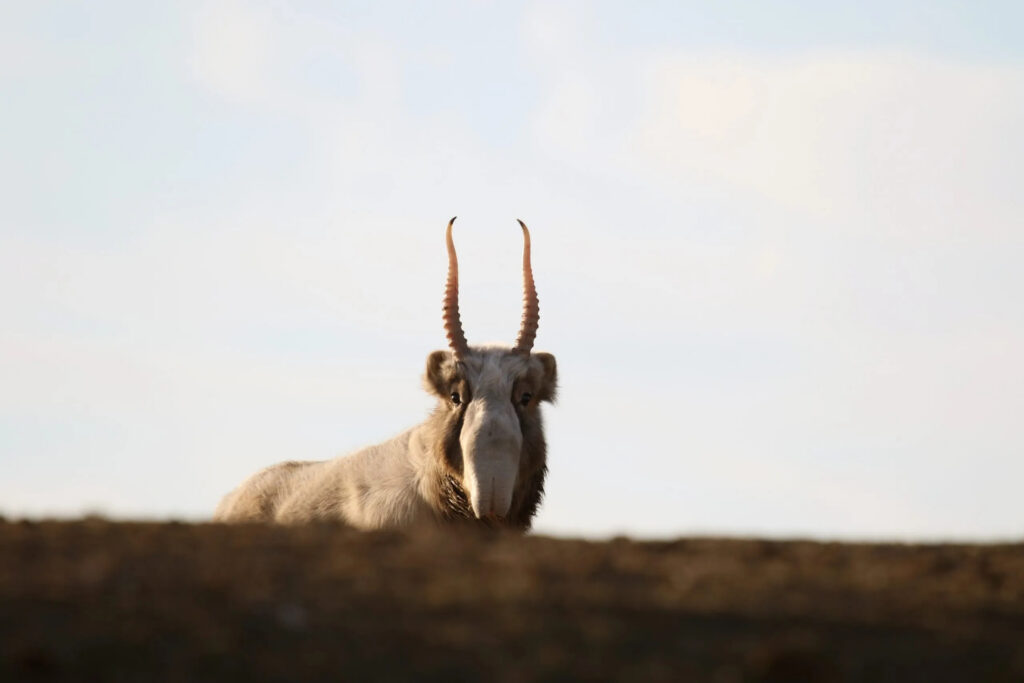
The saiga (Saiga tatarica) is a biological marvel, a remnant of the Pleistocene epoch that has survived climatic shifts and human encroachment for millennia. Characterized by their distinct, bulbous, trunk-like noses—designed to filter dust and warm freezing air—these ungulates are the definition of endurance.
For the nomadic peoples of Kazakhstan, the saiga has always been more than mere wildlife; they were guides. Long before the rise of the Soviet Union or the establishment of national borders, human nomads traversed this landscape in sync with the antelope. The term "Kazakh" itself is rooted in the Turkic word qaz, meaning "wanderer." For thousands of years, the human and nonhuman inhabitants of the steppe shared a symbiotic existence, moving with the seasons, following the melting snows to greener pastures, and retreating to sheltered valleys as the harsh Siberian winds descended.
Chronology of a Disappearing Corridor
The history of the steppe is one of fluid movement, which began to solidify into static borders during the 20th century.
- Pre-20th Century: A golden age of nomadism. The steppe functioned as a "Silk Road" of sorts, not a single path, but a shifting web of transit corridors connecting Europe and Asia.
- The Soviet Era: A pivotal turning point. The Soviet policy of forced sedentarization aimed to anchor nomadic populations to agricultural plots. This shift not only fractured human culture but began the systematic fragmentation of the landscape.
- 1990s–2010s: Post-independence development, including the expansion of railways and paved roads, accelerated. These infrastructures acted as "hard" barriers, effectively bisecting the migration routes that the saiga had used for millennia.
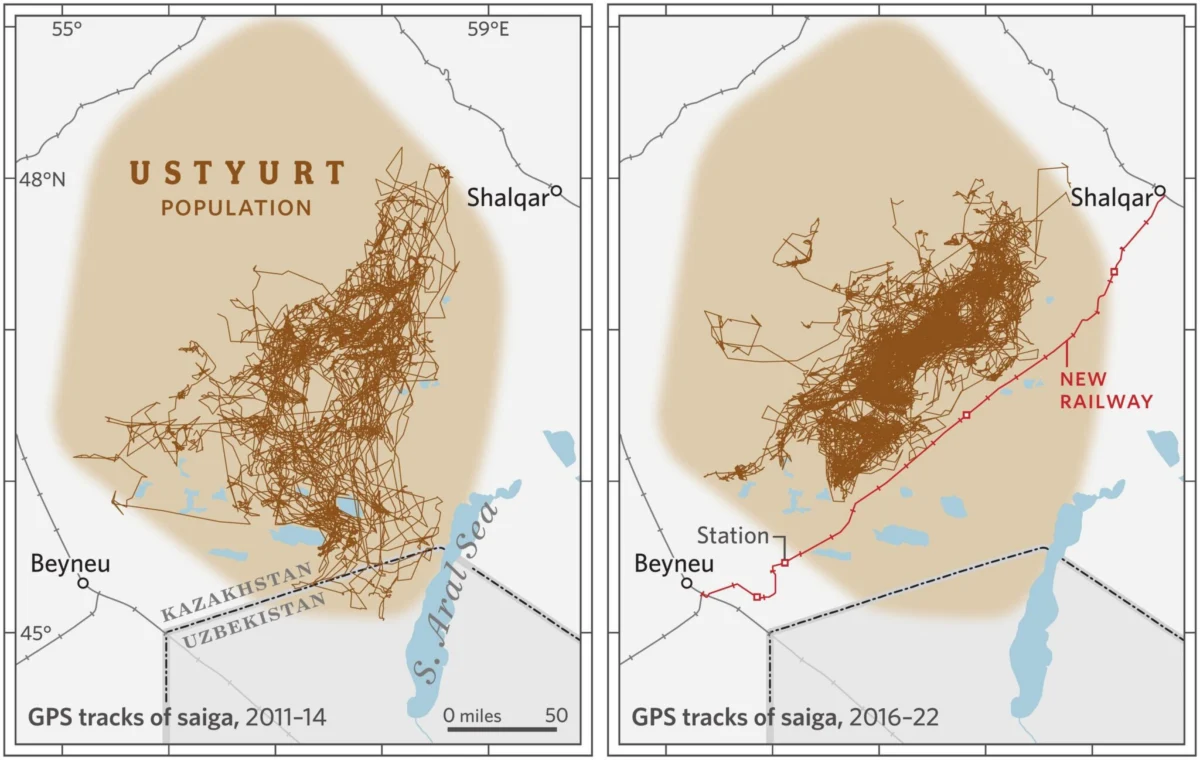
- 2014: A critical moment in modern conservation history when a new rail line in Kazakhstan effectively cut off a major migratory population from their traditional grazing grounds in Uzbekistan.
- 2025–Present: Ongoing efforts by the Association for the Conservation of Biodiversity of Kazakhstan (ACBK) to utilize GPS telemetry and data-driven sanctuary design to restore connectivity.
The Mechanics of the Rut: A Ritual Under Pressure
To understand the saiga’s plight, one must witness their seasonal behavior. The rutting season is the peak of their social and biological cycle. During this period, males engage in intense, energy-sapping combat to prove their fitness to females.
The importance of the nose—the "schnoz"—cannot be overstated. It is a visual indicator of genetic vigor. However, this competitive display requires vast, uninterrupted space. When human infrastructure fragments the steppe, it forces these animals into smaller, isolated pockets. This isolation disrupts the natural "cultural exchange" of the herds. Much like the loss of a language, the loss of migratory knowledge—knowing where the water is, where the grass is, and where the predators lurk—is passed down from generation to generation. When a barrier cuts a herd off from its memory of the land, the population’s long-term survival probability plummets.
Data-Driven Conservation: The ACBK Approach
Field biologists like Alexandr and Albert of the ACBK are working to reverse these trends. Their work, which provided the blueprint for the newly designated wildlife sanctuaries, relies on high-resolution GPS tracking. By mapping the daily pings of collared saigas, researchers have been able to identify exactly where the "Saiga Silk Road" has been broken.
"The data shows a flurry of squiggly lines representing individual animals zipping back and forth before a rail line is built," Albert explains. "After construction, you see those same animals spinning around despondently on one side of the tracks, while the resources they rely on wither away on the other."
To mitigate this, the ACBK has partnered with the Kazakh and Uzbek governments to implement "wildlife-friendly" infrastructure:
- Sloping Ramps: Constructed alongside train tracks, these ramps create a visual illusion that allows the animals to traverse the line without sensing a barrier.
- Strategic Fencing: Replacing barbed wire with X-shaped barricades allows saigas to pass while preventing the entry of unauthorized vehicles.
- Corridor Restoration: Using historical data to identify ancient transit routes and ensuring these zones are legally protected from development.
The Implications of a Stationary World
The plight of the saiga is a mirror held up to human history. Filmmaker Werner Herzog once remarked, "Whatever went wrong and makes our civilization something doomed is the departure from the nomadic life."
The forced sedentarization of the Kazakh people resulted in the atrophy of navigational instincts and a disconnection from the environment. Similarly, the saiga is now being forced into a stationary life it was never designed for. The fragmentation of the steppe is an architectural tragedy; it treats the earth as a series of isolated plots rather than a unified, living system.
However, there is a glimmer of hope. In the quiet, frozen expanse of the Kazakh winter, thousands of saigas can still be seen "flying like banshees" across the steppe. This sight is a testament to their resilience, but it also serves as a warning. As long as the "in-between" spaces are treated as empty, the survival of the saiga remains at risk.
Conclusion: Life Beyond the Margins
As the sun sets over the Ural River—the literal boundary between East and West—the landscape reminds us that for centuries, the "empty" spaces were actually the center of a grand, nomadic civilization. The survival of the saiga depends on our ability to acknowledge that these animals are not just inhabitants of the steppe; they are the architects of it.
Restoring the connectivity of the Eurasian steppe is not merely an act of animal conservation; it is an act of historical reclamation. By repairing the pathways we have broken, we give the saiga the chance to continue their ancient, endless journey—a journey that proves, even in a world increasingly cordoned off by iron and wire, there is still life beyond the margins.
This article is adapted from the nonfiction travelogue "The Hidden Nations of Animals," exploring the intersection of human history and nonhuman migration.
 Raul Delapena Setiawan
  Pevita Pearce
  Siti Muinah