

Introduction: A Strategic Alliance for Global Heritage
In a significant reaffirmation of its commitment to global cultural stewardship, the Republic of Korea, represented by the Korea Heritage Service (KHS), has announced a new voluntary contribution of KRW 5 billion to UNESCO. Spanning the 2026–2030 period, this financial commitment—distributed in annual installments of KRW 1 billion—solidifies a quarter-century of collaboration aimed at safeguarding the world’s most precious tangible and intangible assets.
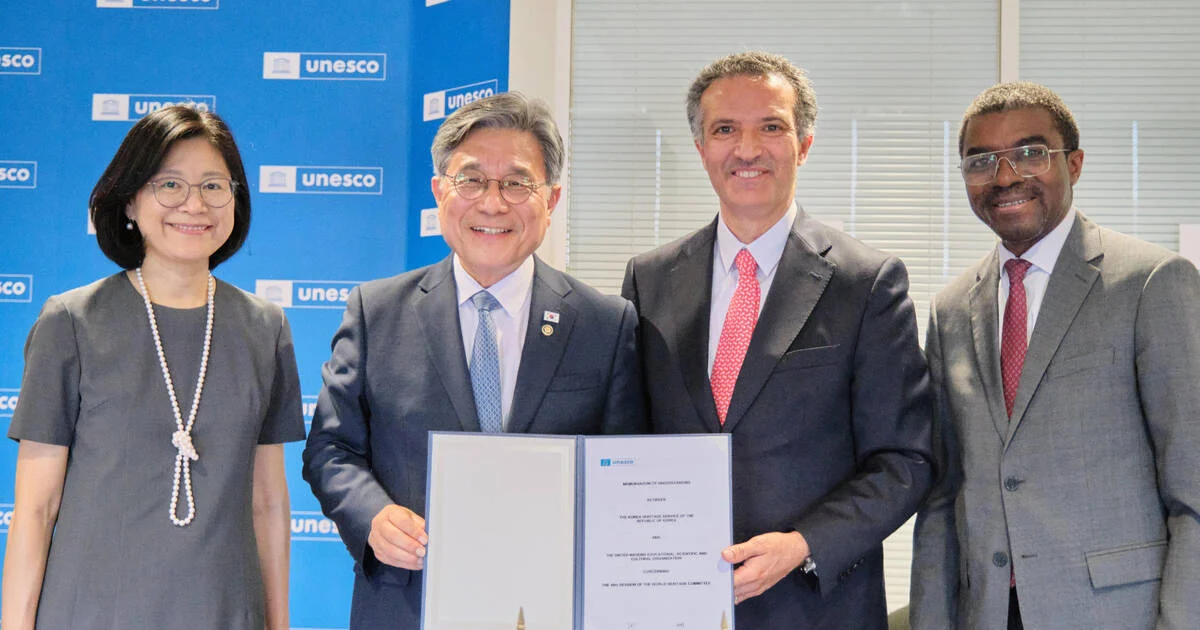
The agreement was formalized at UNESCO Headquarters in Paris, marking a pivotal moment in the ongoing partnership between the South Korean government and the international body. Key dignitaries present at the ceremony included Mr. Huh Min, Administrator of the Korea Heritage Service; Mr. Nayef H. Al-Fayez, UNESCO Assistant Director-General for Culture; and H.E. Jihee Kim, Ambassador and Permanent Delegate of the Republic of Korea to UNESCO. This latest pledge serves as a testament to the enduring diplomatic and cultural bond between Seoul and the Paris-based organization, ensuring that the legacy of the World Heritage Convention remains robust in an era of rapid environmental and geopolitical change.
Chronology: Two Decades of Sustained Engagement
The relationship between the Republic of Korea and UNESCO is not merely transactional; it is deeply rooted in the shared belief that heritage is a cornerstone of sustainable development and social cohesion.
The Foundation (1990s–2010s)
For over 25 years, South Korea has been a leading voice in heritage conservation. Early cooperation focused primarily on the nomination and management of Korean sites, such as the Seokguram Grotto and Bulguksa Temple. Over time, this evolved from a national-centric approach to a global leadership role, with Korea actively sharing its expertise in digital heritage management, conservation technology, and community-based site management.
The Recent Cycle (2021–2025)
The current contribution follows a highly successful five-year cycle (2021–2025), during which the Republic of Korea provided KRW 5.8 billion (approximately USD 3.85 million). This period was marked by the successful implementation of various Funds-in-Trust (FiT) projects that bridged the gap between heritage conservation and contemporary challenges, such as the digital transformation of archive management and the modernization of World Heritage monitoring systems.
The Future Horizon (2026–2030)
The upcoming commitment represents a strategic pivot. While continuing the legacy of previous projects, the 2026–2030 framework places a heightened emphasis on climate resilience and inclusivity. By securing funding through 2030, the KHS ensures that long-term research and capacity-building projects—which often require multi-year planning—have the financial security necessary for completion.
Supporting Data: Where the Funding Goes
The allocation of KRW 5 billion is structured to maximize impact across three primary pillars: capacity building, climate adaptation, and regional cooperation.
1. Capacity Building and Inclusive Interpretation
A central tenet of the new agreement is the advancement of "inclusive heritage interpretation." This initiative seeks to move beyond traditional, top-down narratives of World Heritage sites. The funding will support workshops and training programs designed to ensure that local communities, indigenous groups, and marginalized populations are active participants in the storytelling and management of heritage sites.
2. Technical Assistance for the Korean Peninsula
The agreement explicitly highlights the need for technical assistance for heritage sites within the Korean Peninsula. Given the unique geopolitical landscape, the KHS-UNESCO partnership provides a vital, neutral platform for cross-border heritage cooperation, fostering dialogue through the lens of shared historical and cultural values.
3. Climate Action Policy
Perhaps the most critical aspect of the new funding is its alignment with the UNESCO Climate Action Policy for World Heritage. As climate change poses an existential threat to historical structures—ranging from the erosion of coastal sites to the degradation of forests—the funding will support:
- Risk Assessments: Developing standardized methodologies for assessing the climate vulnerability of heritage properties.
- Mitigation Strategies: Implementing sustainable site management practices that reduce the carbon footprint of tourism and maintenance activities.
- Emergency Preparedness: Creating rapid-response frameworks for sites impacted by extreme weather events.
4. Transboundary and Regional Cooperation
The KHS will provide support for preparatory assistance for future transboundary nominations. By assisting under-represented States Parties in Africa, the Pacific, and Central Asia, the partnership aims to create a more balanced and representative World Heritage List, ensuring that the diversity of human achievement is accurately reflected on the global stage.

Official Responses: Strengthening the Diplomatic Bond
The ceremony in Paris was characterized by a spirit of mutual appreciation. In his official statement, Mr. Nayef H. Al-Fayez, UNESCO Assistant Director-General for Culture, underscored the significance of South Korea’s role:
"I would like to express UNESCO’s appreciation to the Republic of Korea, in particular to the Korea Heritage Service, for their sustained commitment and generous support, which continue to contribute significantly to the safeguarding of World Heritage and the strengthening of international cooperation."
The presence of Mr. Huh Min and Ambassador Jihee Kim reinforced the notion that heritage diplomacy is a cornerstone of South Korean soft power. By championing the protection of global heritage, the Republic of Korea positions itself not only as a protector of its own cultural treasures but as a responsible stakeholder in the preservation of the "common heritage of humanity."
Implications: A Global Model for Heritage Stewardship
The renewal of this partnership carries profound implications for the future of international cultural governance.
Setting a Global Standard
By committing to a multi-year, predictable funding model, the Republic of Korea is setting a benchmark for other UNESCO Member States. In an era where international funding is often volatile, the KHS’s long-term approach allows UNESCO to engage in high-level strategic planning that is not subject to the whims of annual budget fluctuations.
Navigating the Climate Crisis
The integration of the Climate Action Policy into the core of this partnership signals a maturation of the heritage conservation field. It acknowledges that heritage is not a static concept; it is a living entity that must adapt to a changing climate. The KHS-UNESCO collaboration is expected to produce actionable data and protocols that can be adopted by other nations struggling with the intersection of environmental degradation and site preservation.
Promoting Equitable Representation
The focus on "under-represented States Parties" addresses a long-standing criticism of the World Heritage system: the geographical and thematic imbalance of the list. By providing the technical and financial support needed to navigate the complex nomination process, the Republic of Korea is helping to democratize the World Heritage list, ensuring that the voices of the Global South are heard and that their heritage is recognized.
The Role of Funds-in-Trust (FiT)
The continued use of the Funds-in-Trust mechanism allows for a high degree of transparency and accountability. Each project under this agreement—ranging from site-specific conservation missions to regional workshops—will be subject to rigorous monitoring, ensuring that the KRW 5 billion investment yields tangible, measurable outcomes.
Conclusion: Looking Ahead to 2030
As the international community approaches the 2030 deadline for the UN Sustainable Development Goals, the collaboration between the Korea Heritage Service and UNESCO stands as a beacon of constructive multilateralism. Through the protection of our shared past, this partnership is actively building a more resilient, inclusive, and culturally rich future.
The next five years will be critical. With the financial foundations now secured, the challenge shifts to execution. As the KHS and UNESCO embark on this new chapter, the global heritage community will be watching closely, anticipating that this robust investment will catalyze meaningful change in how we identify, protect, and celebrate the diverse tapestry of human civilization. The Republic of Korea, through its unwavering dedication, continues to prove that heritage is more than just stone and mortar—it is a bridge between nations, a tool for climate resilience, and a legacy for generations yet unborn.
 Asep Darmawan
  Evan Lee Salim
  Jia Lissa