

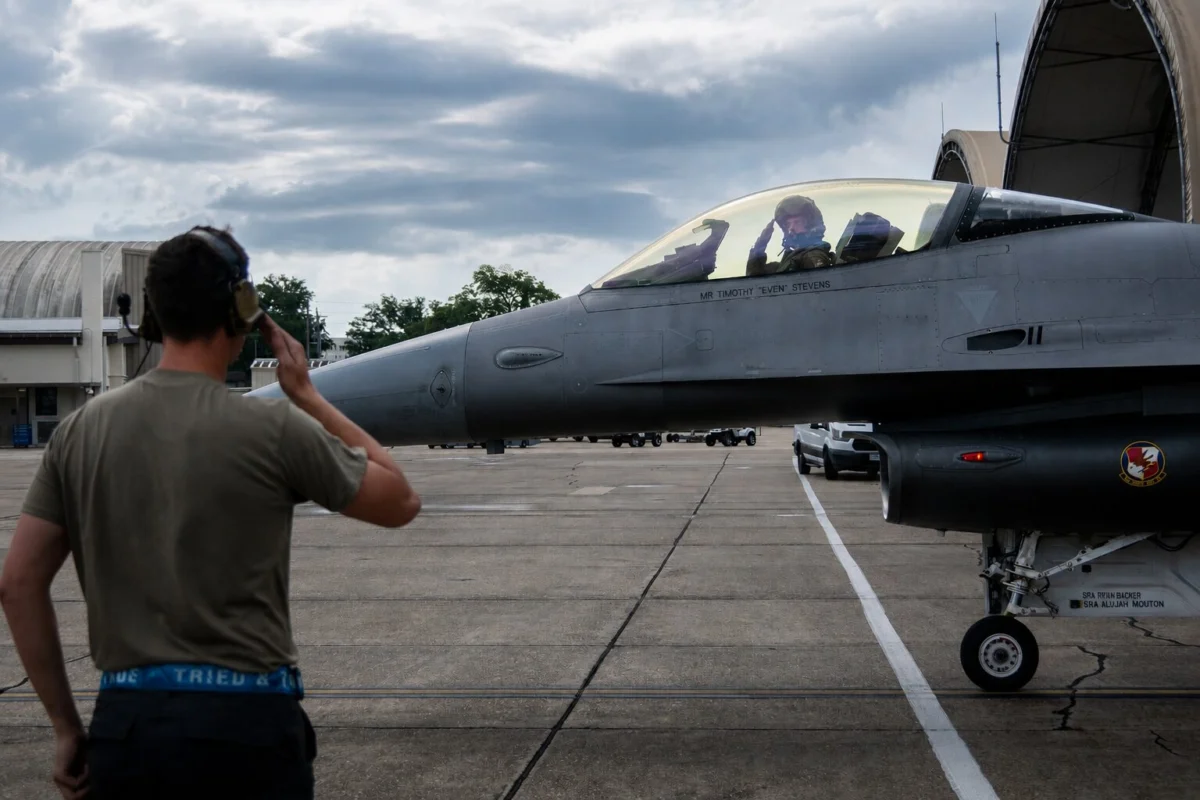
EGLIN AIR FORCE BASE, Fla. – The United States military has taken a significant leap forward in the development of autonomous aerial combat capabilities, transitioning from experimental prototypes to the integration of artificial intelligence (AI) within modified frontline fighter jets. The Defense Advanced Research Projects Agency (DARPA) and the U.S. Air Force have successfully conducted flight tests of an F-16 fighter jet under the direct control of an AI agent, marking a pivotal moment in the evolution of air warfare.
This groundbreaking initiative, officially known as the Viper Experimentation and Next-generation Operations Model – Autonomy Flying Testbed (VENOM-AFT), signifies a move from isolated research projects to the tangible application of AI in actual combat aircraft. The program aims to accelerate the development and deployment of trusted, autonomous air combat systems, promising to reshape the future battlefield.
A Phased Approach to Autonomous Flight
The VENOM program’s journey to AI-controlled flight has been meticulously planned and executed, emphasizing safety and incremental progress. The initial phase, commencing in June 2026, involved flying VENOM-modified F-16 aircraft to meticulously confirm the operational integrity and safety of both the jets and their newly integrated autonomous systems. This critical step ensured that the complex hardware and software modifications were functioning as intended and did not compromise the aircraft’s fundamental airworthiness.
Following the successful completion of these initial safety and system validation flights, the program advanced to its next crucial milestone: allowing an AI agent to take direct control of an F-16 in flight. These historic flights, which took place in July 2026, were conducted with a human pilot remaining in the cockpit. The pilot’s role was not merely to observe but to actively monitor the AI’s performance, the aircraft’s systems, and the overall mission parameters. Crucially, the pilot retained the ability to assume immediate control of the aircraft if any deviations from safe operation or mission objectives were detected. This "human-in-the-loop" approach underscores the program’s commitment to building trust and ensuring human oversight in the development of autonomous combat systems.
Engineering the Future of Autonomous Flight
The VENOM program’s success hinges on sophisticated engineering and technological integration. The F-16 fighter jets selected for the VENOM modifications have been equipped with additional specialized hardware, advanced software, and comprehensive instrumentation. This suite of upgrades is specifically designed to enable AI agents to safely and effectively fly the aircraft. DARPA emphasizes that these modifications focus on automating the aircraft’s flight controls and sensors without altering the F-16’s core flight software. This approach minimizes risk and allows for a more efficient integration of AI capabilities.
A key feature of the VENOM system is the seamless transition between conventional human control and autonomous operation. During a flight, a human pilot can effortlessly switch between piloting the aircraft manually and entrusting its control to the AI agent. This flexibility is paramount for training, testing, and operational scenarios where human intervention might be required. The pilot remains a constant presence in the cockpit, diligently monitoring the AI’s actions, the aircraft’s vital signs, and the overarching mission goals. This continuous oversight is essential for validating the AI’s performance and for gathering crucial data for further refinement.
Official Endorsement and Strategic Vision
The significance of these advancements has been underscored by key figures within DARPA and the Air Force. DARPA Program Manager Brig. Gen. James Valpiani articulated the profound impact of these flight tests, stating, "These groundbreaking flight tests of VENOM-modified F-16s advance the infrastructure needed to develop trusted, autonomous air combat capabilities." This statement highlights the program’s strategic importance in building the foundational elements for future autonomous warfare.
Brig. Gen. Valpiani further elaborated on the program’s operational advantages, noting that the VENOM system provides the Air Force and DARPA with a significantly accelerated pathway for developing and rigorously testing AI technologies specifically designed for aerial combat. This speed in development and testing is critical in an era of rapid technological evolution, ensuring that the U.S. military maintains a competitive edge.
While the specifics of the AI’s maneuvers and mission tasks during the recent test flights remain undisclosed by the Air Force, and the identity of the autonomy software and its commercial partner have not been revealed, the underlying objective is clear: to create AI systems capable of performing complex aerial combat roles.
A Foundation Built on Rigorous Testing
The successful transition to flight testing was the culmination of extensive preparation and ground-based validation. DARPA reports that the early flight sorties were primarily focused on confirming the safe operation of the modified aircraft with the VENOM equipment installed. Prior to any aerial maneuvers, engineers meticulously completed months of detailed work, including engine runs, comprehensive aircraft system checks, and extensive simulation exercises. The foundational ground-test work for the VENOM program actually dates back to 2024, demonstrating a long-term commitment to its development.
Tim Stevens, a VENOM Test Pilot, eloquently described the profound significance of achieving flight. He stated, "Getting the aircraft into the air is always a monumental milestone for a complex test program. It represents years of design, modification and test planning poured into this project by a dedicated team of hundreds." This sentiment reflects the immense effort and collaborative spirit required to bring such advanced technological projects to fruition.
The 40th Flight Test Squadron has been at the forefront of the early developmental testing, conducting much of the work at Eglin Air Force Base in Florida. They are collaborating closely with the 53rd Wing and the 96th Test Wing, with crucial support from DARPA, to ensure the program’s comprehensive execution.
VENOM: Building Upon the Legacy of X-62 VISTA
The VENOM program is not operating in a vacuum; it represents a strategic evolution and expansion of prior groundbreaking research. It builds directly upon the foundational work conducted with the X-62A Variable Stability In-flight Simulator Test Aircraft, commonly known as VISTA.
DARPA utilized the highly specialized and heavily modified F-16 test aircraft, the X-62A, to demonstrate AI-controlled air combat maneuvers under its Air Combat Evolution (ACE) program. In those earlier tests, an AI agent successfully engaged human pilots in close-range dogfighting scenarios. While the X-62A served as an invaluable platform for pioneering AI-driven air combat, it remains a unique, one-of-a-kind research asset.
The VENOM program offers a critical advancement by enabling the Air Force to install and test autonomy systems on more conventional F-16s. This approach bypasses the need for a complete redesign of the aircraft, making the integration of AI more scalable and cost-effective. The Air Force received its initial three F-16 aircraft for VENOM conversion at Eglin Air Force Base in 2024. At that time, the service outlined a vision where developmental and operational test pilots would work collaboratively at the same location, fostering a direct and immediate exchange of data and feedback with the autonomy developers.
Charting the Path Towards Collaborative Combat
The VENOM-modified F-16s are slated to play a crucial role in supporting DARPA’s broader Artificial Intelligence Reinforcements (AIR) program. This initiative is specifically focused on developing AI-controlled, multi-aircraft combat capabilities for engagements beyond visual range. A key aspect of the AIR program’s strategy involves initially testing autonomy software aboard crewed F-16s, with the ultimate goal of seamlessly transferring this advanced software to uncrewed combat aircraft.
Furthermore, the VENOM program will be instrumental in helping the Air Force develop sophisticated command and control methodologies. This includes enabling human pilots to effectively direct and manage groups of autonomous aircraft, shifting from the current paradigm of individually controlling every movement to a more strategic, team-based approach.
This research and development effort aligns with the Air Force’s overarching strategic objective to field uncrewed combat aircraft that can operate seamlessly alongside traditional crewed fighters. The service is actively exploring this future through its Collaborative Combat Aircraft (CCA) program, which is currently testing platforms such as the General Atomics YFQ-42A and the Anduril YFQ-44A.
The Air Force has indicated that the VENOM team will adopt an iterative development process. Following each flight, the aircraft and the autonomy systems will be refined, and the complexity of the test scenarios will be progressively increased. While a specific timeline for the next phases of the VENOM program has not yet been released, the successful execution of these initial AI-controlled flights marks a definitive turning point, ushering in a new era of intelligent and autonomous air power.
 Asro
Asro  Reynand Wu
  Dwi Wanna