

As the vehicle skidded off the asphalt and onto a treacherous mud path maintained only by the deep, rhythmic impressions of previous tire treads, the boundary between the modern world and the prehistoric past began to blur. Before us lay the vast, unforgiving expanse of the Kazakh steppe—a landscape that has remained largely unchanged since the era of the Neanderthals.
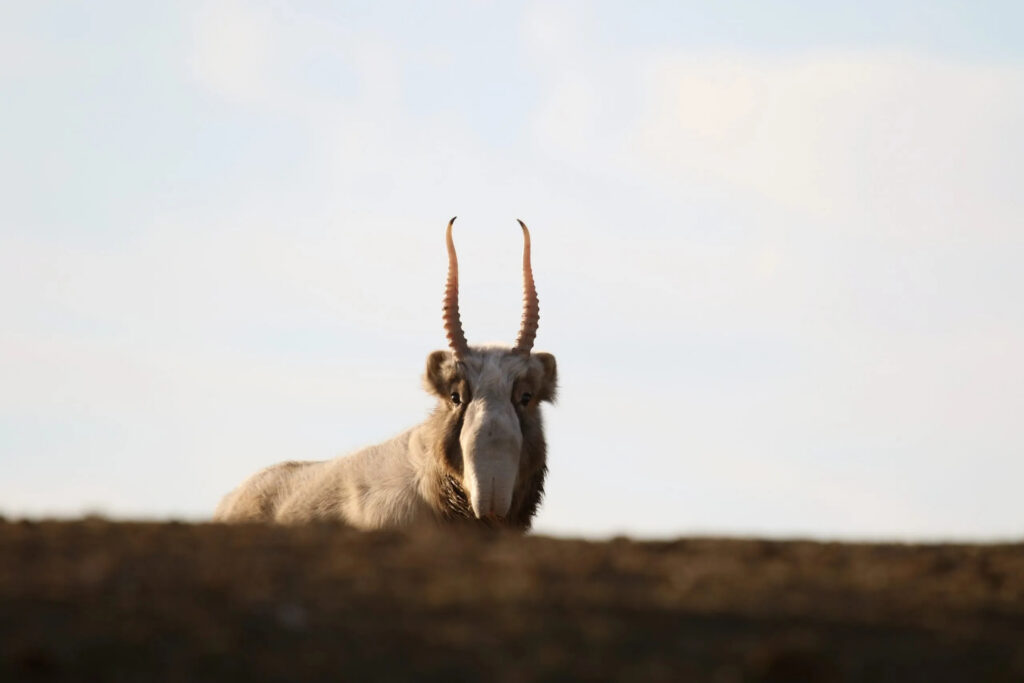
Flanking our two-track trail were parallel lanes, barely a foot wide, crisscrossing the terrain like a chaotic web of veins. In the distance, a sight emerged that defied immediate explanation: a ghostly, shifting silhouette propelled by the howling Siberian winds. Through the lens of borrowed binoculars, the vision clarified into an ancient tableau. Hundreds of saiga antelope—a species that once shared the earth with woolly mammoths and saber-toothed cats—were sprinting across the desolate plain. Their iconic, ringed horns pierced the frigid air, and their distinctive, bulbous snouts inhaled the brittle, icy atmosphere. To watch them is to witness a living relic of the Pleistocene, an animal defined by a single, enduring mantra: "The saiga is a freedom-loving animal."
Chronology of a Survival Story
The saiga’s history is a testament to resilience. For millennia, these ungulates have blazed trails across Central Asia, navigating a world where human empires rose and fell. When early human caravans first attempted to traverse the harsh Eurasian interior, they often looked to the saiga herds as their guides. The antelope understood the land in a way that humans, bound by maps and static settlements, were only just beginning to comprehend.
The decline of the nomadic way of life began in earnest during the 20th century. Under the Soviet Union, mandatory sedentarization policies forced nomadic human populations into agricultural plots, effectively extinguishing a cultural flame that had burned for thousands of years. As human migration patterns were artificially stifled, the "navigational muscles" of the people—the intuitive understanding of the steppe’s seasonal rhythms—began to atrophy.
For the saiga, however, the nomadic life continued, albeit in an increasingly restricted environment. While humans settled into urban centers, the landscape around the saiga was being systematically partitioned by new roads, railways, and border fences, creating an existential threat to an animal whose survival depends entirely on the ability to move.
Supporting Data: The Cost of Fragmentation
Our expedition was facilitated by the Association for the Conservation of Biodiversity of Kazakhstan (ACBK), represented by field veterans Alexandr and Albert. With over twenty-five years of collective experience tracking these animals, they provided a grim assessment of how infrastructure has altered the saiga’s reality.
During the rutting season—a critical period of competitive display and mating—the saiga gather in massive, single-file lines. Males engage in exhausting bouts of headbutting, driven by the need to demonstrate their fitness to females who prioritize the size of a male’s "snuffleupagus" nose, which serves as a biological filter for dust and a heating chamber for sub-zero air.
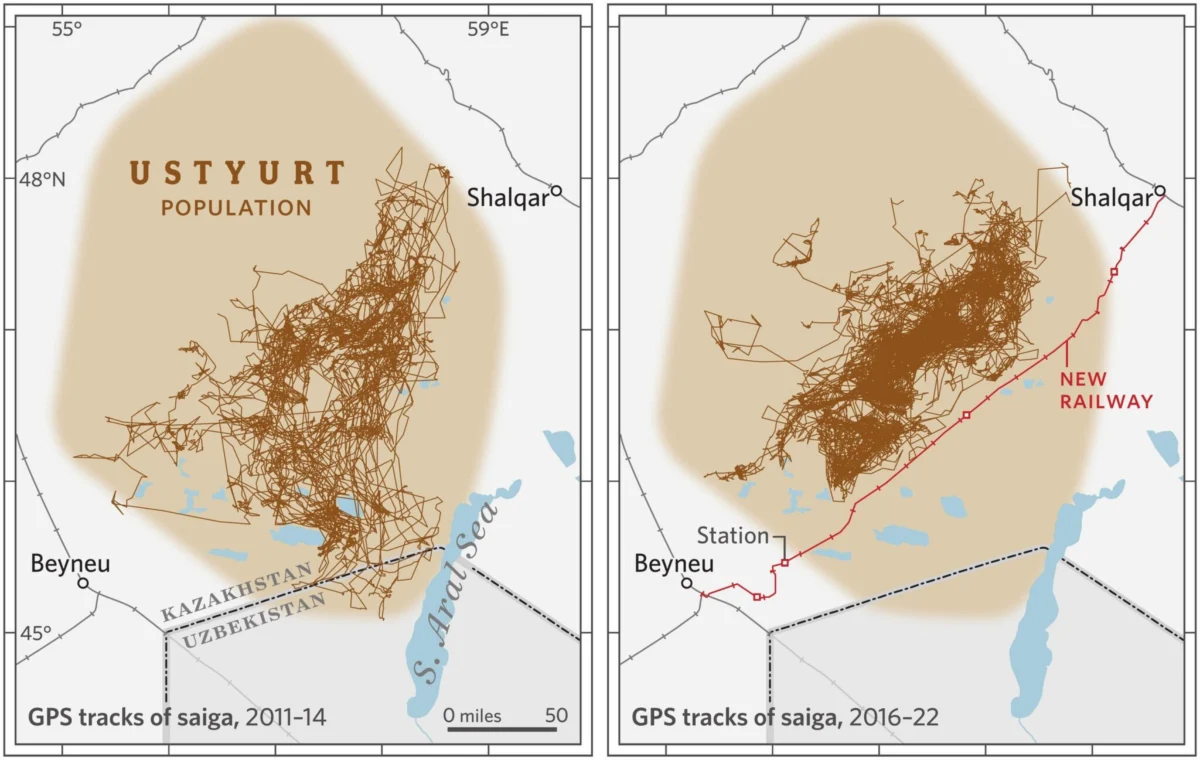
However, modern GPS tracking data tells a story of interrupted migration. Albert shared a map showing a population of collared saigas that, prior to 2014, routinely traveled deep into Uzbekistan. Following the construction of a new rail line, those same herds were "clipped off," left to circle despondently on the northern side of the tracks while their traditional southern grazing grounds withered away.
This is more than a physical barrier; it is a loss of spatial knowledge. As science writer Ben Goldfarb has noted, the erasure of these ancestral migratory routes is "as thorough as the erasure of a language." Young saigas learn their world through observation; when that world is fractured, the cultural heritage of the herd begins to fade.
Official Responses and Conservation Strategy
The response to this crisis has been a sophisticated, science-led intervention. ACBK, working in close coordination with the Kazakh and Uzbek governments, has begun to implement "saiga-friendly" infrastructure.
- Crossing Points: Engineers have constructed sloping dirt ramps that match the height of train tracks, creating a visual illusion that allows the saiga to cross without sensing a "hard" barrier.
- Strategic Fencing: In collaboration with the Uzbek government, barbed-wire walls are being replaced with X-shaped barricades. These structures allow the agile antelopes to pass through while still effectively blocking motor vehicles.
- Sanctuary Designation: New wildlife sanctuaries have been established, with boundaries specifically informed by the tracking data collected by ACBK researchers.
These interventions aim to rebuild the "trust" between the animals and the land, ensuring that the fragmented paths of the steppe can once again function as a cohesive corridor.
Implications: The In-Between Spaces
As we hunkered down in a village near the Russian border to escape a blistering whiteout, the conversation turned toward the broader philosophy of the steppe. The filmmaker Werner Herzog once famously remarked, "Whatever went wrong and makes our civilization something doomed is the departure from the nomadic life."
The loss of the nomadic perspective—both human and animal—is a significant diversion from the history of our species. For the first 288,000 years of Homo sapiens’ existence, we lived in small, mobile groups that followed the migratory patterns of animals. By forcing both humans and wildlife into sedentary, fragmented plots, we have severed a connection to the physical landmarks of our ancestors’ journeys.
The following morning, the landscape was transformed. The muddy, browning grass of the previous day had been replaced by a crisp, black-and-white blanket of snow. Against this stark canvas, the paths of the saiga were etched in clear, rust-red streaks—a reminder that in the "in-between" spaces, away from humanity’s urban margins, life continues to thrive.
Standing on the vast prairie, looking toward the horizon, one can imagine the caravans of the 13th century. For those ancient merchants, the steppe was not an empty void, but a vibrant, well-traveled highway. They took solace in the knowledge that they were not alone; the saiga were there, moving in sync with the earth.
The challenge of the 21st century is to reconcile our need for progress with the fundamental requirements of the wild. If we continue to view the steppe as an empty resource to be subdivided, we risk losing not just the saiga, but the memory of what it means to be a traveler on this earth. The road ahead is perilous, but as the thousands of saigas flying like banshees across the frozen plains remind us, the journey is not yet over. There is still time to mend the fractures, to restore the flow, and to honor the freedom-loving spirit of the last nomads of the steppe.
This article is adapted from the nonfiction travelogue "The Hidden Nations of Animals" and is published exclusively for Adventure Journal.
 Lina Irawan
 Asro
 Asep Darmawan
