

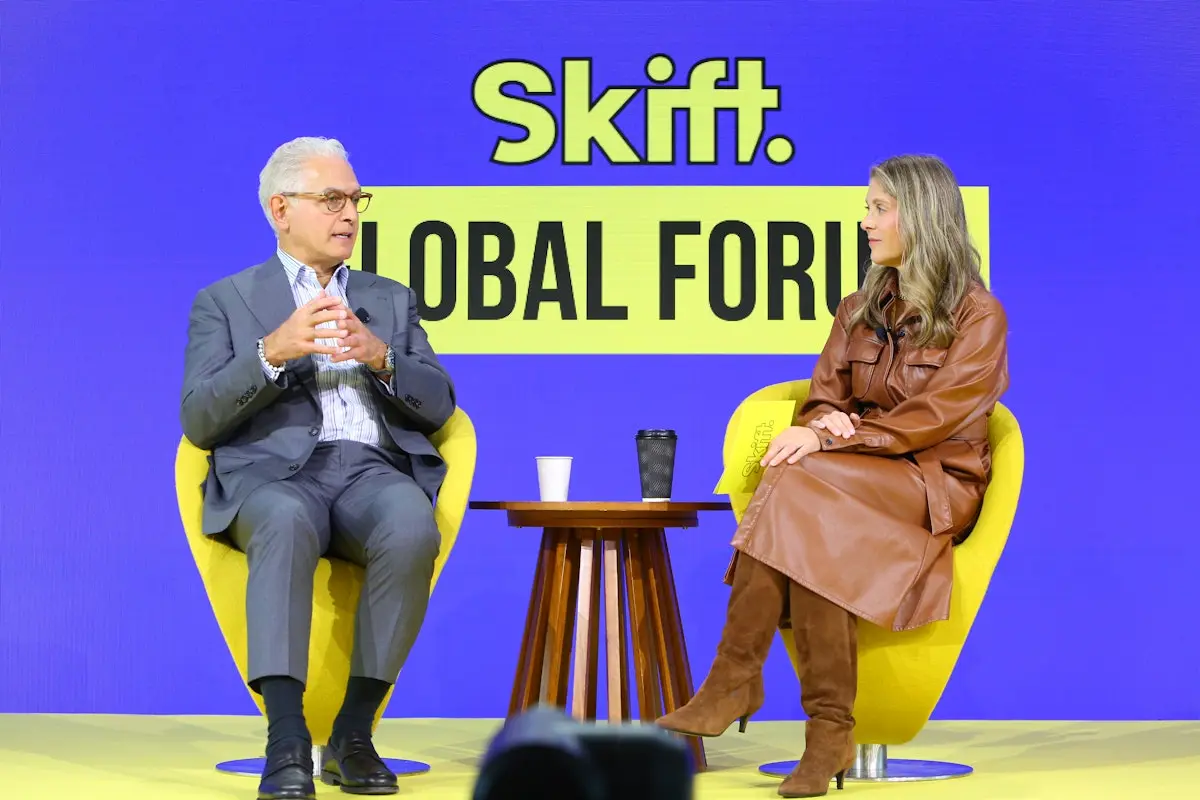
At the recent Skift Global Forum, Mark Hoplamazian, Chairman, President, and CEO of Hyatt Hotels Corporation, sat down with Skift Editor-in-Chief Sarah Kopit to discuss a fundamental question in the hospitality sector: what separates a global hotel brand from its competitors?
While many industry giants focus on asset-light models and aggressive expansion, Hoplamazian argued that Hyatt’s historical roots—specifically its tenure as a hotel owner—define its strategic decision-making process. This philosophy, which prioritizes the long-term health of property owners, has led to a radical approach to digital infrastructure and a unique standard for brand loyalty.
The Core Philosophy: Owners First
For 67 of its 70 years, Hyatt operated primarily as an owner-operator. This is a critical distinction in an industry that has largely shifted toward franchising and management contracts to shed real estate risk. According to Hoplamazian, this historical DNA influences every major investment the company makes today.
"Most hotel companies talk about owner value," Hoplamazian noted during the forum. "But our history shapes a fundamentally different set of decisions."
When a hotel company views itself as a partner to property owners rather than merely a licensor of a brand, the cost-benefit analysis of infrastructure upgrades shifts. Hyatt’s recent digital transformation serves as the primary case study for this philosophy. In a move that surprised many industry analysts, the company overhauled its entire core operating system—replacing all four core platforms simultaneously—while bearing the total financial burden of the transition.
Chronology: A Multi-Year Digital Overhaul
The transformation of Hyatt’s technical backbone was not an overnight success story; it was a multi-year project rooted in long-term fiscal discipline.
Phase 1: The Assessment
Recognizing that legacy systems were creating friction for both staff and guests, Hyatt leadership began an exhaustive audit of their property management systems (PMS). The goal was to unify disparate platforms that had been cobbled together through years of brand acquisitions and organic growth.
Phase 2: The Simultaneous Migration
Rather than phasing in updates over a decade, Hyatt opted for a "rip and replace" strategy across all four core operating systems. This is notoriously risky in the hospitality sector, where downtime can result in millions of dollars in lost revenue and catastrophic guest experience failures.
Phase 3: The Financial Absorption
The most significant aspect of this project was the cost structure. Instead of passing the implementation fees, training costs, or licensing premiums onto the property owners, Hyatt absorbed the entire cost.
Phase 4: Optimization and Savings
The project resulted in a 40% reduction in costs associated with the property management system. By consolidating the technology stack, Hyatt streamlined operations, reduced the training burden on staff, and improved data visibility across the global portfolio.
Supporting Data: Efficiency as a Competitive Advantage
The efficiency gains reported by Hyatt are not merely anecdotal; they represent a significant shift in the company’s operating margin. By reducing the overhead of its PMS by 40%, Hyatt effectively lowered the barrier to profitability for its individual property owners.
- Operational Cost Reduction: A 40% saving on the PMS translates to higher net operating income (NOI) for property owners, which in turn fosters stronger relationships between the corporate brand and the local owners.
- System Consolidation: By migrating from four disparate systems to a unified architecture, Hyatt reduced the "data siloing" that often prevents large hotel chains from executing personalized guest experiences.
- Scalability: The unified system allows Hyatt to integrate new acquisitions much faster than it could when the core architecture was fragmented.
Official Responses and Strategic Rationale
When asked by Sarah Kopit about the decision to shield owners from the cost of this digital overhaul, Hoplamazian was blunt: "We did that without sending a bill for even one penny to any of our owners."
This statement highlights a divergence in industry strategy. Many global hotel conglomerates treat their technology stack as a "pass-through" expense, often charging franchisees for mandatory upgrades. Hyatt’s decision to internalize these costs functions as a long-term investment in loyalty. By proving that they are willing to shoulder the financial risk of modernization, Hyatt builds a level of trust that encourages owners to stick with the brand during market downturns or periods of industry-wide volatility.

Hoplamazian’s perspective is clear: loyalty is not just something you solicit from guests through rewards programs; it is something you earn from owners through operational support.
Implications for the Future of Hospitality
The "Hyatt model" raises several questions about the future of the hotel industry. As technology becomes the primary differentiator in guest satisfaction—from mobile check-in to AI-driven concierge services—the cost of staying relevant is skyrocketing.
1. The Death of the "Fee-Heavy" Model?
If Hyatt can successfully modernize its infrastructure without offloading costs to owners, competitors may find themselves under pressure to follow suit. In a market where owner retention is a key metric for Wall Street, the ability to minimize owner-side capital expenditure (CapEx) will be a massive competitive advantage.
2. The Tech-First Brand
Hyatt is positioning itself not just as a hospitality company, but as a technology-enabled hospitality company. By centralizing its systems, the company can deploy new software features across its entire global portfolio in weeks rather than months. This agility allows for rapid prototyping of guest-facing features, such as personalized room preferences or seamless loyalty app integration.
3. Consolidation and Standardization
The industry is currently witnessing a trend toward consolidation, with smaller boutique chains being absorbed into larger networks. Hyatt’s successful migration suggests that technical interoperability will be the primary hurdle for future mergers. Companies that fail to modernize their core operating systems will likely become targets for acquisition, as their legacy debt becomes too expensive to fix.
4. Human-Centric Innovation
Despite the focus on technology, Hoplamazian remains adamant that these tools exist only to empower people. By removing the technical friction—the slow systems, the complex menus, the disconnected data—Hyatt staff can focus on the "human" element of hospitality. When technology works in the background, the guest experience remains front-and-center.
Looking Ahead: The Skift Global Forum Perspective
The discussions at the Skift Global Forum underscore a growing trend: the hospitality sector is moving away from the era of "brand proliferation" toward an era of "operational excellence."
For investors, the takeaway from the Hyatt session is clear: look for companies that are willing to reinvest their profits into the infrastructure of their partners. The era of charging owners for every upgrade may be coming to an end, replaced by a model where the brand acts as a true steward of the property’s success.
As Hyatt moves into its eighth decade, the challenge will be maintaining this high-touch, owner-centric approach while navigating a rapidly changing digital landscape. With 40% cost savings already secured and a unified tech stack in place, the company is well-positioned to leverage its legacy to define the next era of luxury and business travel.
Conclusion: The Path Forward
The path forward for Hyatt involves a delicate balance of aggressive digital growth and conservative financial stewardship. By proving that internalizing costs can lead to better outcomes for both the corporate entity and the owner, Mark Hoplamazian has set a new standard for the industry.
While the hotel business will always be fundamentally about people, the tools that enable those people are becoming the primary gatekeepers of success. In the competition for owner loyalty and guest retention, Hyatt’s willingness to "pick up the check" for the future of hospitality may be the company’s most effective strategy yet.
For industry observers and competitors alike, the lesson of the Skift Global Forum is definitive: the brand that invests in its own foundation is the brand that will withstand the tremors of an uncertain global economy. Hyatt has demonstrated that the most effective way to lead is by building a house that is strong enough to shelter everyone under its banner.
 Nana Wu
  Laily UPN
  Layla Zulfa