

As Norwegian Cruise Line (NCL) continues to look toward the horizon with modern, record-breaking megaships like the newly debuted Norwegian Luna and the highly anticipated Norwegian Aura, the company’s ongoing evolution serves as a striking reminder of how much the cruise industry has transformed over the last six decades. Today’s passengers expect sprawling waterparks, high-tech entertainment complexes, and dozens of specialty dining venues. Yet, getting to this golden age of cruising required decades of experimentation, structural innovations, corporate acquisitions, and, ultimately, the retirement of nearly 20 vessels that once anchored the NCL fleet.

From its humble beginnings as a cross-channel car ferry operator in the late 1960s to its status as a global cruising powerhouse, NCL’s history is written in the logs of the ships that helped build the brand. Below is a deep dive into the fascinating stories of the retired vessels that shaped the company, tracing their journeys from maiden voyages to their final days at ship-breaking yards.

1. Main Facts: The Arc of NCL’s Fleet Development
The narrative of Norwegian Cruise Line is one of continuous adaptation. Founded in 1966 as Norwegian Caribbean Line, the enterprise started with a single, converted car ferry named Sunward. Over the subsequent decades, the company transitioned from operating modest, multi-purpose vessels to ordering purpose-built cruise ships, acquiring competing lines, and eventually shifting entirely toward massive, contemporary megaships designed to maximize passenger capacity and onboard revenue.

Throughout its history, NCL has navigated shifts in global travel trends, economic recessions, and changing consumer tastes. As ships aged or became economically unviable to operate under stricter environmental and safety regulations, the cruise line systematically pruned its fleet. While older vessels were frequently transferred to subsidiary brands, sold to international operators, or retrofitted into floating hotels, the vast majority of NCL’s retired tonnage has ultimately met its end at major ship-breaking facilities in South Asia and Turkey.

2. Chronology of Retired Vessels
To understand how NCL evolved into the modern titan it is today, one must examine the chronological lifespan of the nearly 20 ships that have flown its banner before departing the fleet.

The Pioneering "White Fleet" Era (1966–1980s)
- Sunward (1966–1973): Originally built as a car ferry to operate between the United Kingdom and Spain, Sunward was acquired by the newly formed Norwegian Caribbean Line to pioneer short cruises from Miami to the Bahamas. Carrying just over 500 passengers, it offered a novelty for its time: air conditioning. After leaving NCL in 1973, it served various roles across Europe and the Middle East before being scrapped in Bangladesh in 2004.
- Starward (1968–1995) & Skyward (1969–1991): Encouraged by Sunward’s success, NCL ordered its first purpose-built ships. Interestingly, both vessels retained car-carrying capabilities in their early days, though these spaces were later converted into passenger cabins and public areas. Known alongside others as the "White Fleet" due to their stark white hulls, they offered short Caribbean itineraries out of Miami. Skyward faced challenges including outbreaks of waterborne illness and a 1979 fire. Starward eventually served as a U.S. government evacuation ship in 2006 before being scrapped in 2018. Skyward was broken up in India in 2021.
- Southward (1971–1994): Marking a departure from its predecessors, Southward was the first NCL ship built without car-carrying capabilities. Its deployment on short itineraries out of Los Angeles prompted a pivotal rebrand: because the ship no longer sailed exclusively in the Caribbean, the company officially changed its name from Norwegian Caribbean Line to Norwegian Cruise Line. It was scrapped in 2013.
- Sunward II (1977–1991): Formerly Cunard’s Cunard Adventurer, this ship was acquired to replace the original Sunward. It operated Greek Isle cruises for Epirotiki Lines after leaving NCL and was ultimately scrapped in India in 2014.
The Mega-Ship Transformation and Corporate Expansion (1980s–2000s)
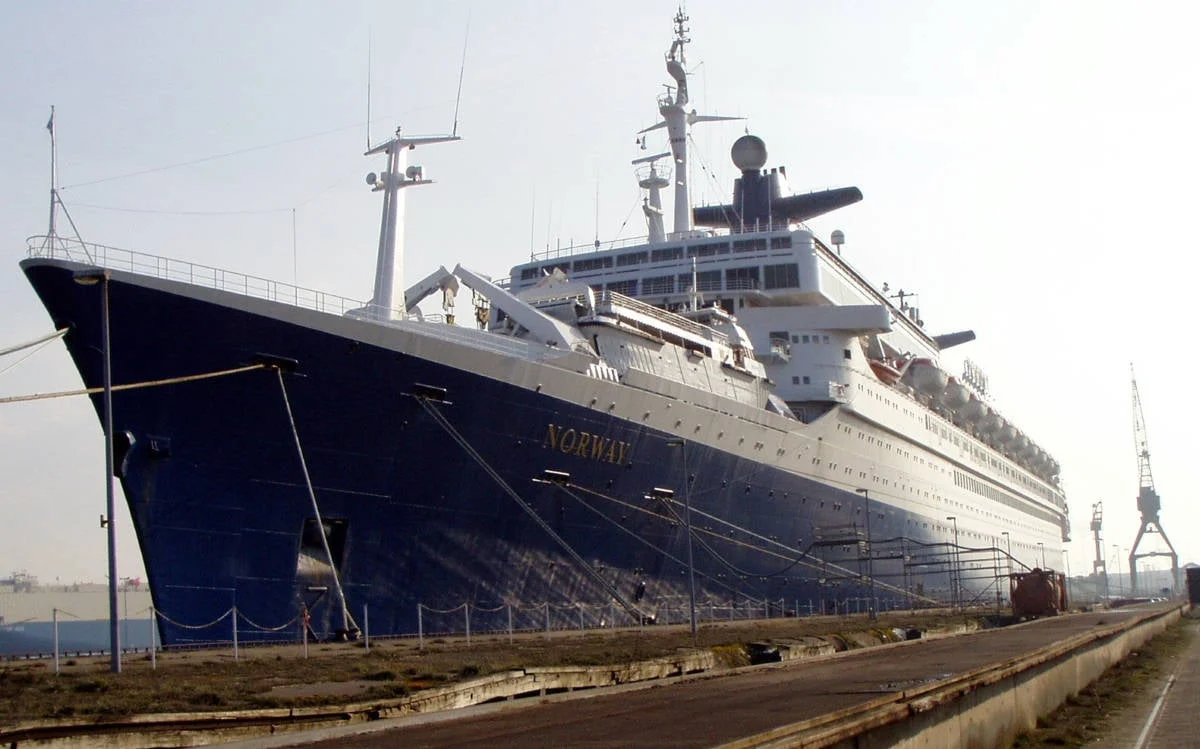
- SS Norway (1980–2003): Perhaps the most legendary ship in NCL’s history, the Norway was not built for the line, but rather began life as the prestigious transatlantic liner SS France. Purchased for roughly $80 million, NCL transformed her into a Caribbean giant. Because she was too large for traditional Caribbean ports, NCL introduced unique tender vessels (Little Norway I and II) to ferry passengers ashore. Retired following a boiler explosion in 2003, her final scrapping was a lengthy and delicate process due to extensive asbestos abatement.
- Seaward / Norwegian Sea (1988–2005): After an earlier 1970s contract for a ship named Seaward fell through, NCL finally took delivery of a new-build Seaward in Finland for $120 million. Accounting for about 20% of NCL’s total capacity by the mid-1990s, she was renamed Norwegian Sea in 1997 before transferring to Star Cruises as the SuperStar Libra, eventually meeting the scrapyard in Turkey in 2022.
- Westward (1991–1993) & Sunward (1991–1992): Acquired via NCL’s parent company’s purchase of Royal Viking Line, both vessels had extremely brief stints under the NCL banner. Westward later sailed as the Black Watch for Fred. Olsen Cruise Lines until becoming a hotel ship and being scrapped in 2022. The third ship to bear the name Sunward cycled through more than ten operators before being scrapped in 2021.
- Norwegian Star (1997–2001): Another former Royal Viking ship, this vessel was assigned to a short-lived subsidiary known as Norwegian Capricorn Line, intended for the Australian market. It was transferred to Star Cruises in 2001 and scrapped in 2021.
- Dreamward / Norwegian Dream (1992–2004) & Windward / Norwegian Wind (1993–2007): Built with modular designs intended to allow physical lengthening, both sister ships were stretched in 1998. Despite this expansion, their time in the NCL fleet was relatively brief. Both were transferred to Star Cruises, where they underwent further service before being sold for scrap in 2022.
- Leeward (1995–2000): Starting its life partially as a ferry in 1980, this vessel endured a dramatic history marked by fires and partial sinkings before NCL operated it for five years. It later sailed as the Celestyal Crystal until 2023, before being sold to a UAE buyer and scrapped at Alang in India in early 2025.
- Norwegian Crown (1996–2006): Originally Royal Cruise Line’s Crown Odyssey, the ship bounced between NCL and Orient Lines before joining Fred. Olsen Cruise Lines in 2006 as the Balmoral. Remarkably, she remains in active service today as the smallest ship in the Fred. Olsen fleet.
- Norwegian Dynasty (1997–1999) & Norwegian Majesty (1997–2008): Acquired through NCL’s purchase of Majesty Cruise Line, Norwegian Dynasty spent nearly two decades with Fred. Olsen before being acquired by Villa Vie Residences in 2024 to operate ultra-long residential world cruises. Norwegian Majesty was lengthened by NCL, transferred to Star Cruises, and currently sails as Mano Cruise’s Crown Iris.
The Modern Consolidation and Recent Retirements (2020s–Present)
Following the departure of Norwegian Majesty, NCL largely stepped away from acquiring older, secondhand tonnage, focusing instead on designing proprietary new-build classes. For over a decade and a half, no major fleet reductions occurred until strategic realignment announcements were made in 2025 regarding two of its older contemporary vessels:

- Norwegian Sun (2001–2027): Launched in 2001, this Sun-class ship has long been one of NCL’s more modest vessels. In a joint transfer agreement announced alongside Norwegian Sky, she is scheduled to transition to Cordelia Cruises in 2027 to serve the Indian cruise market.
- Norwegian Sky (1999–2026): Originally ordered as a Costa Cruises ship before being completed for NCL, Norwegian Sky also served as the Pride of Aloha during NCL America’s inter-island Hawaii venture. Having completed its final passenger voyage for NCL on August 31, 2026—a 9-night sailing out of Barcelona—the ship is officially transitioning to Cordelia Cruises as the Cordelia Sky.
3. Supporting Data: Fleet Demographics and Scrapping Trends
Analyzing the lifecycle of NCL’s retired fleet reveals clear patterns regarding the economics of modern cruising:

- Average Fleet Tenure: Ships purpose-built for NCL or heavily integrated early on (such as Starward and Southward) typically spent 20 to 25 years in active service before retirement. Conversely, secondhand acquisitions from sister companies or external lines often saw remarkably brief tenures with NCL, sometimes lasting fewer than three to five years.
- The Ultimate Destination: Out of the nearly 20 retired ships, over 70% have ultimately been decommissioned and dismantled at major ship-breaking yards, predominantly at the Alang ship-breaking yard in India, Gadani in Pakistan, or Aliaga in Turkey.
- Adaptive Reuse: A select few vessels achieved rare second acts outside the scrapyard. Most notably, Norwegian Dynasty (originally Crown Dynasty) found new life as a residential cruise ship under Villa Vie Residences, offering multi-year voyages for long-term travelers.
4. Official Responses and Industry Implications
The announcement regarding the planned departures of Norwegian Sky and Norwegian Sun initially sparked concern among loyal passengers who had booked itineraries on the beloved mid-sized vessels. However, corporate communications from Norwegian Cruise Line Holdings have emphasized that these transitions are part of a calculated modernization strategy.

Fleet Modernization and Capacity Growth
Industry analysts point out that retiring older, less efficient hardware allows NCL to optimize operating margins. While Norwegian Sky and Norwegian Sun offered intimate cruising experiences that appealed to traditionalists, they lacked the high-yield revenue spaces—such as expansive thermal suites, massive specialty dining complexes, and sprawling upscale enclave areas like The Haven—that define NCL’s contemporary bottom line.

Maintaining Passenger Confidence
To mitigate the impact of canceled future sailings, NCL leadership has consistently assured booked guests that the capacity reduction is being deliberately offset by the introduction of larger, state-of-the-art vessels. By systematically phasing out ships that require increasingly costly maintenance and environmental retrofits, NCL ensures that its capital is concentrated on cutting-edge ships like the Prima and Prima-Plus class vessels, maintaining the line’s competitive edge in an increasingly crowded global market.

5. Conclusion
The story of Norwegian Cruise Line’s retired fleet is a microcosm of the cruise industry at large. It illustrates a transition from the romantic, utilitarian era of converted car ferries and classic ocean liners to an era of floating resorts engineered for maximum entertainment, comfort, and efficiency. While vessels like the Sunward, SS Norway, and Norwegian Sky have passed into maritime history—either living on under new flags or being responsibly recycled—they laid the structural and cultural foundation for the modern fleet that continues to sail worldwide today.
 Suro Senen
  Asep Darmawan
  Pevita Pearce