

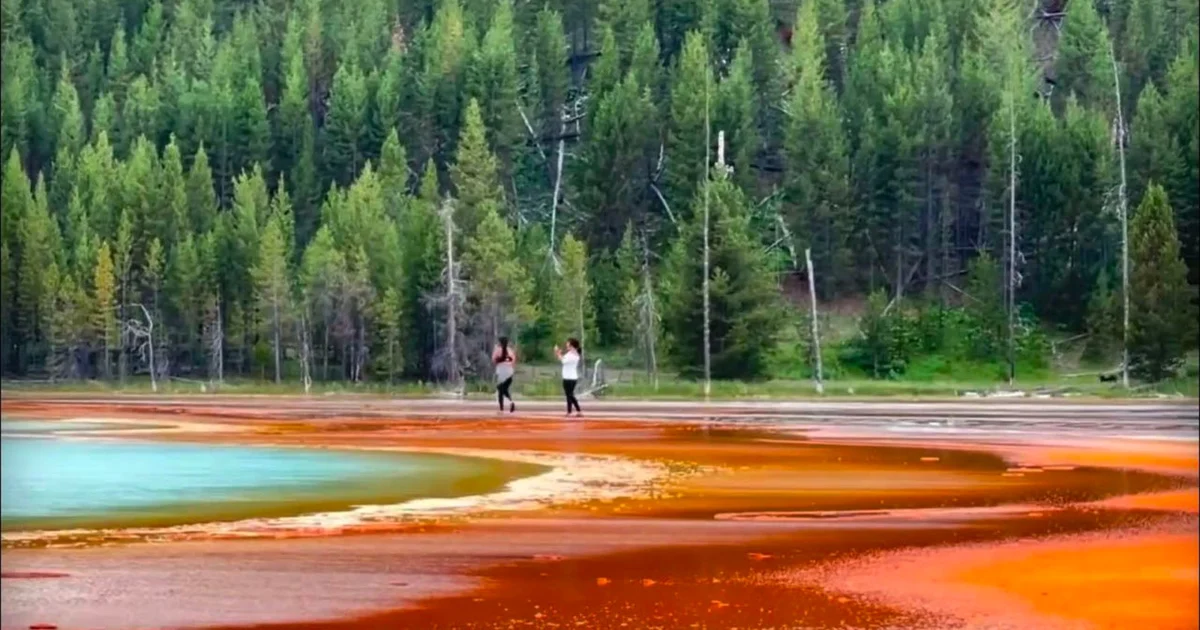
In a stunning display of disregard for both personal safety and environmental preservation, two tourists were captured on camera this week wandering illegally onto the fragile, boiling-hot surface of Yellowstone National Park’s Grand Prismatic Spring. The incident, which occurred at approximately 7:00 P.M. on Sunday, has ignited a firestorm of public outrage and renewed calls for stricter enforcement of thermal safety regulations within America’s oldest national park.
The Grand Prismatic Spring is not merely a scenic landmark; it is a volatile geothermal feature with temperatures reaching upwards of 188 degrees Fahrenheit. Beyond the immediate threat of a gruesome, agonizing death, the tourists’ actions caused irreversible damage to the rare microbial mats that give the spring its iconic, vibrant rainbow hues. As the women strolled across the crust—oblivious to the thin, breakable surface beneath them—they trampled centuries of biological evolution in their pursuit of social media content.
A Chronology of Carelessness: The Sunday Incident
For Tanya Saueressig, a visitor who was observing the park from the designated safety of the Grand Prismatic boardwalk, the scene unfolded like a nightmare. What began as a routine evening of sightseeing quickly morphed into a tense, agonizing observation of potential tragedy.
"I stopped in my tracks and was just stunned," Saueressig told the Cowboy State Daily. "I remember thinking, ‘Is that people? That can’t be people. Nobody’s that dumb.’"
According to witnesses, the two women bypassed clearly marked warning signs and protective fencing, stepping off the established boardwalk to walk directly onto the delicate, crusty surface of the spring. They moved with a casual, leisurely pace, stopping periodically to adjust their positions, pose, and snap selfies. To those watching from the boardwalk, the sight was surreal—two individuals treating a lethal, boiling cauldron as if it were a local public park.
"You could tell they were just strolling along, taking their selfies, without a care in the world," Saueressig recounted. "They were totally oblivious to what was right under their feet. You’re causing so much damage with every step you take, and you don’t care."
The incident was further documented by others in the vicinity, including a post shared by Xander Geographic on social media, which quickly went viral. The footage showed the pair wandering through the steaming, iridescent landscape, their presence a jarring intrusion against the pristine, protected environment. By the time park authorities could be alerted, the women had reportedly exited the thermal area, leaving behind a trail of trampled, crushed microbial life. As of this report, it remains unclear whether the individuals have been identified or if formal charges have been filed by the National Park Service (NPS).
The Lethal Reality of Thermal Trespass
The Grand Prismatic Spring is a masterpiece of nature, but it is a hostile one. The water, heated by deep-seated volcanic activity, is highly acidic and hot enough to cause severe, life-altering burns upon contact. The ground surrounding these features is often merely a thin, fragile shelf of sinter—mineral deposits that can collapse without warning.
Underneath these thin layers lie pools of boiling, caustic water. History in Yellowstone is littered with tragic accounts of those who strayed from the boardwalks. In years past, visitors have fallen into similar features, resulting in fatalities so extreme that recovery of remains was impossible. The environment is so chemically aggressive that it dissolves organic matter with terrifying efficiency.
The danger extends to the local fauna as well, highlighting the indiscriminate nature of these geothermal hazards. Just last year, a bison fell into the Grand Prismatic Spring and perished. The carcass remained in the water, serving as a gruesome reminder of the unforgiving nature of the ecosystem. Despite the warnings, the sight of a massive animal succumbing to the heat failed to deter these specific tourists from their reckless course of action.
The Ecological Toll: Trampling the Rainbow
While the risk of death captures the headlines, the ecological damage caused by "thermal trespassers" is equally devastating. The vibrant colors of the Grand Prismatic—the deep blues, greens, yellows, and oranges—are not the result of mineral refraction alone. They are the work of thermophiles: heat-loving microorganisms that form thick, living mats.
These microbial communities are incredibly sensitive. Foot traffic destroys the structure of these mats, killing the organisms that create the pigments. Once destroyed, these mats can take years, or even decades, to recover. When a tourist walks on the spring, they are not just walking on dirt; they are physically crushing a living, breathing biological wonder.
"It was so mind-boggling to me that they would be out there in the first place," Saueressig added, noting the sense of helplessness she and others felt while watching the destruction unfold. "I was so angry."
Official Perspectives and the "Infrastructure of Trust"
The National Park Service faces an ongoing battle against a segment of the public that appears increasingly resistant to rules, signs, and common sense. Greg Jackson, formerly the deputy chief of enforcement and security at the NPS, offered a candid assessment of why these incidents continue to occur despite the threat of heavy fines, permanent park bans, and even jail time.
"Some people see the world differently than the mainstream," Jackson explained. "You build an infrastructure that’s dedicated to the 99.9% of people that don’t do this, and then you get people who don’t see that infrastructure or decide it doesn’t apply to them."
This "infrastructure of trust" relies on the assumption that visitors will prioritize their own lives and the integrity of the park. However, in an era of social media-driven tourism, the desire for the "perfect shot" often overrides the survival instinct and the moral imperative of conservation. Park rangers frequently report that when confronted, rule-breakers often display a mix of entitlement and ignorance, failing to comprehend the magnitude of their actions.
Broader Implications for National Park Management
The incident at Grand Prismatic is part of a larger, troubling trend within Yellowstone and other high-traffic national parks. Earlier this month, a separate incident saw a man tossed eight feet into the air by a bison—a direct result of a tourist attempting to get too close for a photograph.
These events force the NPS to consider increasingly restrictive measures. If visitors refuse to respect the boundaries of the boardwalks, the park may be forced to install more aggressive barriers, security cameras, or even increased ranger patrols, all of which detract from the natural, wild experience that millions travel to see.
Furthermore, the legal consequences for thermal trespass are designed to be severe. Federal magistrates regularly impose thousands of dollars in fines and, in cases of severe damage or endangerment, can impose custodial sentences. Yet, as long as the allure of an exclusive, dangerous, and "viral" photograph outweighs the fear of punishment, the cycle is likely to continue.
Conclusion: A Call for Responsibility
The actions of the two women at Grand Prismatic Spring serve as a stark indictment of the "me-first" culture that has infiltrated our natural spaces. When visitors prioritize a fleeting digital image over the preservation of a national treasure and the safety of their own lives, they diminish the experience for everyone.
Yellowstone National Park exists as a sanctuary for the wild—a place where humans are meant to be observers, not participants. The boardwalks are there for a reason: to protect the visitor from the spring, and to protect the spring from the visitor. As the park continues to grapple with record-breaking visitor numbers, the hope remains that public shaming, stricter enforcement, and a renewed emphasis on park etiquette will eventually stem the tide of such reckless behavior. Until then, the fragile beauty of the Grand Prismatic remains under threat from those who fail to see the value of anything beyond their own camera lens.
 Reynand Wu
  Suro Senen