

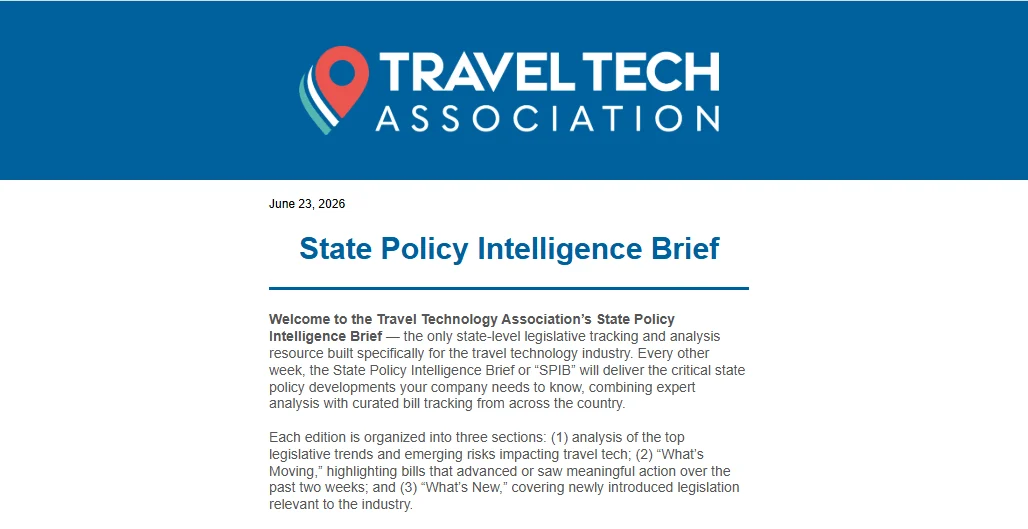
Wednesday, June 24, 2026 — In an era defined by rapid technological acceleration and increasingly complex legislative scrutiny, the Travel Tech Association (Travel Tech) has taken a decisive step to fortify the travel technology ecosystem. Today, the organization announced the launch of its State Policy Intelligence Brief (SPIB), a groundbreaking resource designed to track and decode the labyrinthine legislative and regulatory developments occurring at the state level across the United States.
Concurrent with this launch, Travel Tech has rolled out a modernized, tiered membership framework. By offering specialized access levels for startups, growth-stage companies, and established enterprise leaders, the association aims to foster a more unified, collaborative, and informed front to address the challenges facing the digital travel economy.
The Landscape of Regulatory Complexity: Why Now?
The travel technology sector sits at a precarious intersection. From the integration of generative AI in customer service bots to the evolving standards of data privacy and the granular regulation of digital marketplaces, travel platforms are facing an unprecedented volume of state-level oversight.
For years, the federal government held the primary role in setting the tone for travel policy. However, the current trend shows a distinct shift toward state-level activity. States are increasingly taking the lead on platform accountability, pricing transparency, and the ethics of algorithmic decision-making. This fragmented approach—where a travel tech company might be required to comply with vastly different sets of rules in California, New York, and Texas simultaneously—has created a "compliance bottleneck" that threatens to stifle innovation.
The State Policy Intelligence Brief is specifically engineered to mitigate these risks. By providing real-time, expert-led analysis of state legislative trends, Travel Tech is moving from a reactive stance to a proactive, predictive one, ensuring that its members are not merely reading the news, but anticipating it.
Chronology of a Shifting Policy Environment
To understand the necessity of the SPIB, one must look at the recent evolution of digital travel policy:
- 2023–2024 (The Awareness Phase): Initial legislative focus centered on basic data privacy and the emergence of "junk fee" legislation. Travel tech firms began to notice a surge in local bills targeting transparent pricing.
- 2025 (The Regulatory Acceleration): AI integration became ubiquitous in the travel sector. Legislative bodies responded by proposing wide-ranging frameworks for AI safety, algorithmic transparency, and bias mitigation, often without a clear understanding of how these technologies function within travel distribution systems.
- Q1–Q2 2026 (The Fragmentation Crisis): As of June 2026, the legislative volume has reached a fever pitch. States are no longer just looking at privacy; they are delving into "platform accountability," which threatens to hold digital marketplaces liable for the actions of individual service providers.
- June 24, 2026 (The Pivot Point): Travel Tech launches the SPIB to provide a centralized hub for tracking these disparate regulatory threads, offering members the intelligence required to participate effectively in the legislative process.
Supporting Data: The Impact of Policy on Innovation
The urgency of this initiative is backed by the growing reality that policy is now a top-three operational cost for many tech-enabled travel firms. According to internal industry estimates, mid-sized travel tech companies have seen their legal and compliance spending increase by roughly 22% year-over-year as they scramble to navigate local state-by-state requirements.
Furthermore, market data suggests that the "regulatory tax"—the cost of adapting products to meet varying state standards—is disproportionately impacting emerging innovators. Startups with limited legal budgets are increasingly forced to choose between delaying market entry in specific states or risk non-compliance. By providing the SPIB and a tailored membership model, Travel Tech is attempting to democratize access to the strategic advocacy usually reserved for only the largest industry titans.
Official Responses and Strategic Vision
Laura Chadwick, President & CEO of Travel Tech, emphasizes that the goal of this initiative is to harmonize the voice of the industry amidst a cacophony of state-level activity.
"Travel technology companies are operating in an environment where policy and regulation increasingly shape innovation, competition, and growth," said Chadwick. "Travel Tech exists to bring clarity, alignment, and a collective voice to that complexity. The State Policy Intelligence Brief and our other member benefits are designed to help our members anticipate what’s coming, understand what matters, and engage strategically before policy decisions become barriers to innovation."
Chadwick’s message is clear: the era of the "siloed" travel company is over. In a connected ecosystem, a policy failure in one state can have a ripple effect on the entire digital marketplace. By fostering cross-industry collaboration, Travel Tech aims to ensure that legislators hear a consistent, evidence-based perspective on how travel technology actually creates value for consumers and the economy.
The New Membership Framework: A Tiered Approach
Recognizing that a one-size-fits-all approach is no longer effective, Travel Tech has overhauled its membership structure to better serve a diverse membership base:
- Start-up Membership: Tailored for early-stage companies, providing essential access to policy monitoring and networking events to ensure they remain informed as they scale.
- Growth-Stage Membership: Designed for companies moving into multiple markets, offering deeper regulatory intelligence and opportunities for targeted advocacy efforts.
- Enterprise Membership: Providing global industry leaders with comprehensive policy tracking, deep-dive analytical reports, and a seat at the table for high-level coalition building and strategic engagement.
This structure allows Travel Tech to act as a force multiplier for the entire sector, ensuring that the smallest startup has access to the same intelligence that guides the largest OTA (Online Travel Agency) or travel management software provider.
Implications for the Future of Travel
The launch of the SPIB marks a definitive shift in how the travel technology sector interacts with government entities. The implications for the industry are profound:
1. Shift Toward Proactive Advocacy
Instead of responding to legislation after it has been introduced, the SPIB will allow members to engage in "pre-legislative advocacy." By understanding the trends—such as the emerging interest in AI-driven dynamic pricing—members can work with policymakers to help draft sensible, pro-innovation regulations before they are solidified into restrictive law.
2. Industry Cohesion
By bringing enterprise leaders and emerging innovators into the same room, the new membership framework breaks down the walls that often keep these groups apart. This collaboration is essential for addressing systemic issues, such as the cross-industry impact of data portability and platform liability.
3. Increased Competitiveness
For the United States to remain a global leader in travel innovation, the policy environment must be predictable. By mitigating the "regulatory chill" caused by confusion and fear of non-compliance, Travel Tech is ultimately protecting the future of digital travel as a primary driver of the global economy.
Conclusion: Navigating the Road Ahead
As travel continues to become more tech-driven, the boundary between "technology" and "travel" will continue to blur. The issues of today—AI safety, data security, and consumer protection—are only the beginning. Tomorrow’s challenges will involve even more complex intersections with climate policy, infrastructure, and international interoperability.
No company should have to navigate this pressure alone. Through the combination of the State Policy Intelligence Brief and its revamped membership tiers, the Travel Tech Association is positioning itself as the critical infrastructure for the industry’s legislative survival and growth.
As the regulatory landscape continues to evolve, Travel Tech remains committed to its mission: connecting enterprise leaders, growth-stage companies, and next-generation innovators around the shared goal of an open, competitive, and highly innovative travel marketplace. By staying informed, aligned, and prepared, the industry is not just surviving the current wave of regulation—it is actively shaping the future of modern travel.
For more information on the State Policy Intelligence Brief or to explore membership opportunities, visit the Travel Tech Association website.
For media inquiries or to schedule an interview with a Travel Tech spokesperson, please contact [email protected].
 Nana Muazin
  Asro
Asro  Reynand Wu