

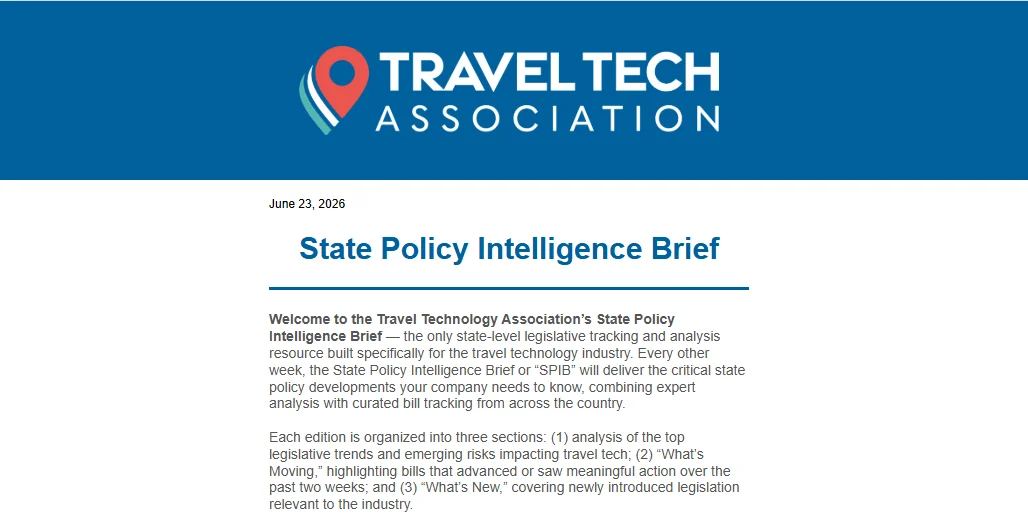
WASHINGTON, D.C. — June 24, 2026 — In a move designed to reshape how the digital travel sector engages with governance, the Travel Tech Association (Travel Tech) today announced the launch of its State Policy Intelligence Brief (SPIB). This initiative marks the industry’s first-ever dedicated resource focused exclusively on tracking, analyzing, and synthesizing the rapidly shifting legislative and regulatory landscape at the state level.
Concurrent with the launch of the SPIB, the association unveiled a revamped, multi-tiered membership framework—categorized into Start-up, Growth, and Enterprise tiers. This restructuring is intended to democratize access to high-level policy intelligence, strategic advocacy, and cross-industry collaboration for companies ranging from fledgling innovators to global travel technology behemoths.
The Main Facts: A New Shield for Innovation
The travel technology ecosystem is currently facing a "regulatory tsunami." As artificial intelligence (AI), dynamic pricing algorithms, and granular data privacy mandates become standard features of digital travel marketplaces, state legislatures across the United States have accelerated their efforts to impose new oversight.
The SPIB is positioned as a strategic asset for Travel Tech members, providing:
- Legislative Tracking: Real-time monitoring of state-level bills affecting digital platforms.
- Regulatory Analysis: Expert interpretation of how new administrative rules impact product development and user experience.
- Predictive Insights: Forward-looking assessments that allow companies to anticipate hurdles before they manifest into binding law.
By consolidating these functions, Travel Tech aims to move the needle from reactive compliance to proactive industry stewardship.
Chronology: The Path to the SPIB Launch
The launch of the SPIB follows a period of unprecedented policy volatility that began in early 2024.
- Q1 2024: A surge in state-level "junk fee" legislation began to emerge, targeting pricing transparency in travel and hospitality.
- Q3 2024: Artificial intelligence regulation moved to the forefront of statehouse agendas, with several states proposing mandatory bias audits for algorithmic decision-making tools.
- Q1 2025: Travel Tech leadership identified a "knowledge gap" among its smaller and mid-sized members who lacked the in-house legal resources to track 50-state legislative trends.
- Q4 2025: The association initiated a pilot program for the Intelligence Brief, testing the delivery of policy insights with a select group of growth-stage members.
- June 24, 2026: The official public rollout of the SPIB and the formalized tiered membership structure, providing a unified regulatory roadmap for the entire ecosystem.
Supporting Data: The Regulatory Landscape
The need for this initiative is underscored by the complexity of the current environment. According to recent internal assessments by Travel Tech, the volume of state legislation impacting digital travel platforms has increased by approximately 35% year-over-year.
Key areas of legislative focus currently include:
- AI Governance: Over 20 states are currently debating legislation that would impose strict transparency requirements on AI-driven travel recommendations and dynamic pricing engines.
- Data Privacy: With the expiration of various federal legislative efforts, a patchwork of state-specific data privacy laws—often with conflicting requirements—has created significant overhead for companies operating across multiple jurisdictions.
- Platform Accountability: Increased scrutiny regarding the liability of digital marketplaces for content and services provided by third-party vendors has become a primary target for state attorneys general.
For a growth-stage company, the cost of compliance in a single state can reach hundreds of thousands of dollars in legal fees. When multiplied across multiple states, these costs can act as a significant barrier to entry, stifling the very innovation that drives the modern travel economy.
Official Responses and Strategic Vision
Laura Chadwick, President & CEO of Travel Tech, framed the launch as a necessary evolution for the industry.
"Travel technology companies are operating in an environment where policy and regulation increasingly shape innovation, competition, and growth," Chadwick stated during the launch event. "Travel Tech exists to bring clarity, alignment, and a collective voice to that complexity. The State Policy Intelligence Brief and our other member benefits are designed to help our members anticipate what’s coming, understand what matters, and engage strategically before policy decisions become barriers to innovation."
Industry analysts suggest that Chadwick’s move is a proactive effort to bridge the gap between technical developers and lawmakers. By providing legislators with clear, data-backed information on how specific regulations might inadvertently break travel search functions or limit consumer choice, Travel Tech aims to foster a more "innovation-friendly" regulatory environment.
Implications: The Future of Travel Tech Advocacy
The introduction of the Start-up, Growth, and Enterprise membership tiers signifies a shift in how trade associations must operate in the digital age. By lowering the barrier to entry for smaller firms, Travel Tech is expanding its coalition, ensuring that the voice of the industry represents the full lifecycle of a travel company.
1. The Impact on Innovation
For emerging innovators, the SPIB acts as a "regulatory early warning system." In a startup ecosystem where runway is limited, understanding potential regulatory roadblocks can be the difference between a product pivot and a product failure. By embedding policy intelligence into their development cycle, companies can build "compliance-by-design."
2. Cross-Industry Collaboration
The new framework is designed to foster a dialogue between enterprise leaders—who possess vast experience in navigating international markets—and growth-stage companies that are pioneering new technologies. This cross-pollination of knowledge is expected to strengthen the industry’s overall posture in Washington and state capitals.
3. A Shift in Advocacy Tactics
Traditional lobbying often involves high-cost, high-intensity efforts. The SPIB model shifts this paradigm toward a continuous, intelligence-led approach. By focusing on the "what" and "why" behind state bills, Travel Tech is empowering its members to engage in more meaningful, evidence-based advocacy.
Conclusion: A Unified Voice for a Digital Era
As travel becomes increasingly interconnected and technology-driven, the digital infrastructure supporting it—from flight booking engines to real-time accommodation platforms—has become a cornerstone of the global economy. Yet, this reliance on technology has invited a level of political scrutiny that was virtually nonexistent a decade ago.
Travel Tech believes no company should have to navigate this policy pressure alone. Through regulatory intelligence, coalition-building, and proactive advocacy, the association is positioning itself as the central nervous system of the travel tech industry. By providing the tools to stay informed, aligned, and prepared, Travel Tech is not just reacting to the future—it is helping to shape it.
For companies looking to maintain their competitive edge in a landscape governed by algorithms as much as by statute, the SPIB is not merely a resource; it is a necessity for survival in the next phase of the digital travel revolution.
About Travel Tech Association
Travel Tech Association (Travel Tech) is the unified voice for the travel technology ecosystem. Travel Tech brings together enterprise leaders, growth-stage companies, and emerging innovators to advance public policies that support competition, innovation, and a strong technology-enabled travel marketplace. Through advocacy, regulatory intelligence, and cross-sector collaboration, Travel Tech helps shape the future of modern travel.
To learn more about Travel Tech’s new membership opportunities and the State Policy Intelligence Brief, visit traveltech.org/membership.
To schedule an interview with a Travel Tech spokesperson, please contact [email protected].
 Nana Muazin
  Asro
Asro  Reynand Wu