

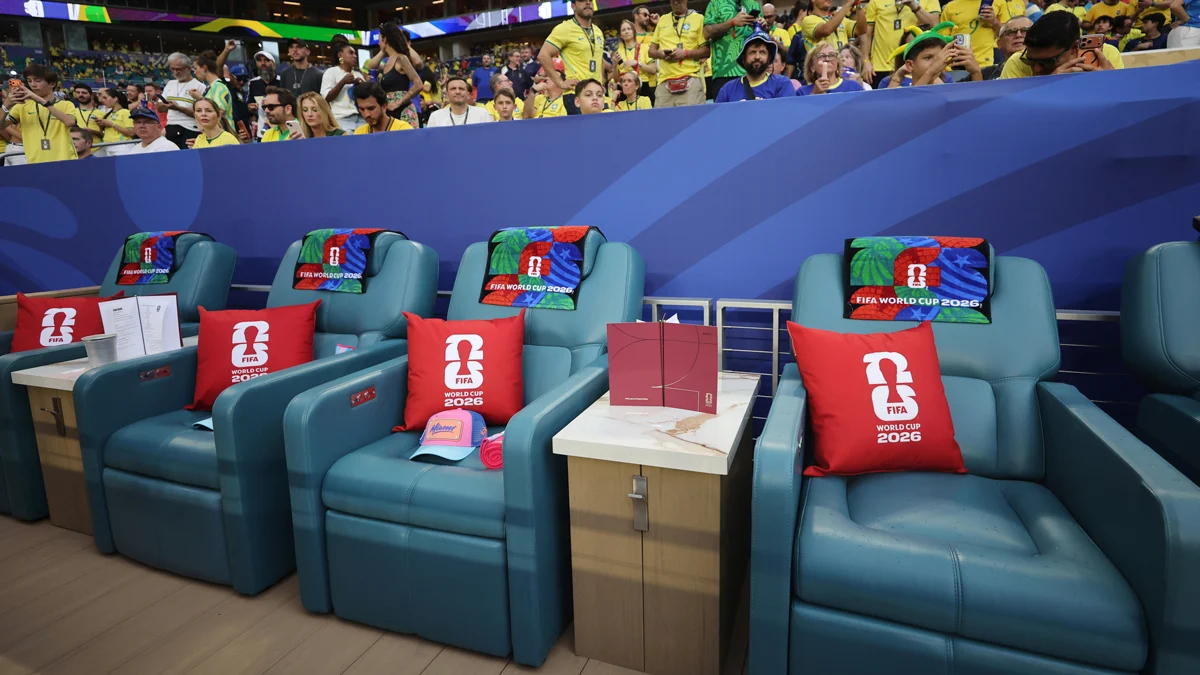
Football has long been celebrated as the "people’s game." In its purest form, it is a sport of radical simplicity: a ball, two goals, and 22 players. It is a game born in the streets and industrial heartlands, accessible to anyone with a patch of grass and a dream. However, as the countdown to the 2026 FIFA World Cup begins, that democratic image is being replaced by a far more exclusive reality.
As the tournament prepares to span three nations—the United States, Mexico, and Canada—it is setting records not just for its scale, but for its cost. With tickets for some matches soaring toward the $10,000 mark and entry-level seats frequently hitting four figures, the 2026 World Cup is cementing a new era of "sports-as-prestige." The beautiful game, it seems, is being repackaged for the one percent.
Main Facts: The Unprecedented Scale of 2026
The 2026 FIFA World Cup will be the largest in history, a sprawling behemoth of an event that reflects the massive commercial ambitions of modern sports. For the first time, three host nations will share the duties, facilitating an expanded roster of 48 national teams. This expansion results in an unprecedented 104 matches played across 16 cities.
While the sheer volume of games—a 25 percent increase over the 2022 tournament in Qatar—theoretically suggests a glut of opportunity for fans to attend, the economic reality is quite different. The 2026 iteration is already being labeled the "most expensive World Cup ever." This is driven by several converging factors:
- Dynamic Ticket Pricing: Similar to the algorithms used by airlines and ride-sharing apps, ticket prices fluctuate based on real-time demand, often pushing costs far beyond the reach of the average supporter.
- Logistical Complexity: The vast distances between host cities in North America have caused transportation and fuel costs to skyrocket, expenses that are invariably passed down to the consumer.
- The Luxury Pivot: A fundamental shift in how sporting events are marketed has turned "being there" into a status symbol. Tickets are no longer just passes to a game; they are "prestige items" in a global social competition.
Chronology: The Five-Year Rise of Sports Tourism
The transformation of the stadium from a communal gathering place to a luxury destination has been accelerating for over half a decade. According to travel industry experts, the global interest in "sports tourism"—the practice of traveling specifically to attend a sporting event—has seen a meteoric rise since 2019.
Following the global stagnation of the pandemic, a "revenge travel" phenomenon collided with a newfound obsession with live experiences. By 2021, the landscape began to shift visibly. Formula 1, bolstered by the success of the Netflix series Drive to Survive, saw an explosion in global interest, particularly among younger, affluent demographics in the Middle East and Asia Pacific. This served as a blueprint for other sports.
By 2024, the trend reached a fever pitch. The Paris Olympics and the upcoming Milano-Cortina Winter Games began offering "ultra-exclusive" packages that moved beyond the traditional "VIP box." The industry realized that High-Net-Worth (HNW) travelers were no longer satisfied with a good view; they wanted "experiential exclusivity"—a seat at the table, or in the case of F1, a seat in the pit lane.
Supporting Data: A Trillion-Dollar Market
The numbers behind this shift are staggering. The sports tourism industry is currently valued at approximately $707.29 billion. However, market analysts at McKinsey and Fortune Business Insights project this figure to nearly double, reaching $1.3 trillion by 2032.

Sports now account for roughly 10 percent of the total global tourism market. This growth is fueled by "Marquee Events" that draw international crowds:
- FIFA World Cup & Premier League Soccer: Remains the dominant force in global sports spending.
- Formula 1: Since 2021, an additional 50 million people have attended at least one F1 event. The 2024 season saw record-breaking attendance across all 24 races.
- The "Big Four" & Tennis: The Super Bowl, NBA Finals, and Grand Slam tennis (specifically the Australian Open and Wimbledon) have become anchors for luxury travel itineraries.
The costs for these "bucket list" experiences are reaching astronomical heights. At the 2026 World Cup, a "Follow My Team" package—which grants access to early group stage matches and lounge entry—starts at $6,000 for the most basic tier. For a high-stakes match, such as the U.S. Men’s National Team playing at SoFi Stadium in Los Angeles, entry-level tickets have been spotted at $1,400, while Tier 1 seating reaches $3,400.
Official Responses: The Industry Perspective
Travel experts and luxury consultants suggest that this pricing is not a deterrent, but rather a feature for their clientele.
"Worldwide sporting events have skyrocketed and the demand is there," says Diedra Pyle, co-founder of Fioraé Luxury Travel. She notes that her clients are increasingly looking to combine high-stakes sports with bespoke travel itineraries.
Julie Danziger, co-founder of Embark Beyond, describes the current climate as a "gold mine." According to Danziger, the modern HNW traveler is looking for "immersion" rather than just observation. "Access is number one," she explains. "High-net-worth travelers don’t want a great seat at a top event—they want to be in the action. It’s a go big or go home situation."
This sentiment is echoed by Erica Jackowitz, co-founder of Rêve Travel Club, who highlights the desire for "frictionless" experiences. For the 2026 World Cup, her firm is seeing starting points of $32,000 per ticket for top-tier hospitality. "It is the difference between attending something and truly experiencing it," Jackowitz says. These packages often include granular details, such as securing the single available helipad at the Meadowlands for the final or organizing pre-match "meet-and-greets" that were once reserved for team owners.
The hospitality sector is responding with equally extravagant offerings. In Miami, the W South Beach launched a "Million-Dollar Soccer Superstar Package." For $1 million, guests receive:
- Multiple nights in an Oceanfront Penthouse.
- A private police escort to matches to bypass traffic.
- VIP match-day access.
- Daily premium cigars and private tours of local rum distilleries.
Similarly, the Liberty Hotel in Boston is offering a $75,000 "Goal-den Legendary Experience," featuring presidential suite accommodations and private helicopter transfers to Gillette Stadium to avoid the notorious Foxborough traffic.

Implications: The Death of the Everyman Fan?
The enrichment of the sports experience for the wealthy has left the traditional fanbase in a state of "pricing out" anxiety. When the minimum price to enter the World Cup final starts at a rumored $7,600 on secondary markets, the "people’s game" begins to look more like an invite-only gala.
There are three major implications for the future of global sports:
1. The Pivot from Sport to Social Currency
As Jason Squatriglia, a luxury travel expert, points out, sporting events are becoming less about the athletic competition and more about the cultural moment. He notes that during the last NFL season, he received multiple requests for suites "closest to Taylor Swift." The game itself has become the backdrop for a social statement. "It has become a conversation piece, fashion statement, and even a status symbol," Danziger adds.
2. The Two-Tier Fan Experience
We are witnessing the end of the "monolithic" fan experience. In the past, while there were always expensive seats, the majority of the stadium was filled by local supporters. The 2026 World Cup threatens to create a "two-tier" reality where the atmosphere—traditionally provided by the working-class "ultras"—is diluted by a "corporate" crowd that may be more interested in the omakase dinner in the lounge than the tactics on the pitch.
3. The Globalization of Exclusion
As sports tourism grows to $1.3 trillion, the pressure on host cities will increase. While these events bring in massive revenue, they also drive up local costs for housing and transport during the tournament, further alienating the local population from the event happening in their own backyard.
In conclusion, the 2026 FIFA World Cup will undoubtedly be a spectacle of unmatched proportions. It will showcase the pinnacle of human athleticism and the incredible logistical reach of three modern nations. However, it will also serve as a stark reminder of the widening wealth gap. As the "people’s game" moves into the garages, helicopters, and penthouses of the elite, the world must ask: what is the true cost of the most expensive game on earth?
 Iffa Jayyana