


By Location Rebel Editorial Desk
Published: October 2023
Main Facts: The Silent Killer of Freelance Careers
In the hyper-competitive landscape of digital content creation, thousands of aspiring freelance writers enter the market every year equipped with polished portfolios, creative flair, and boundless enthusiasm. Yet, a staggering percentage of these professionals fail to secure a sustainable income, not because their writing lacks quality, but because of a fatal flaw at the very beginning of their business pipeline: they stop at the first email.
According to outreach experts and industry veterans, the single most critical differentiator between struggling freelancers and those generating consistent, four-figure monthly incomes is not a secret writing formula or an elite roster of high-profile connections. It is the disciplined, systematic execution of the email follow-up.
Cold emailing remains the bedrock of client acquisition for modern freelance writers. However, sending a single letter of introduction (LOI) and moving on when silence is the initial response is functionally equivalent to planting a seed and walking away before watering it. Industry data overwhelmingly suggests that the vast majority of commercial transactions and client-freelancer partnerships are forged not during the initial point of contact, but through persistent, respectful, and well-timed subsequent touchpoints.
Despite this, countless freelancers abandon promising leads prematurely, paralyzed by the fear of being perceived as a nuisance. This article explores the anatomy of effective cold outreach, the psychological barriers behind follow-up reluctance, optimal scheduling cadences, and modern technological tools that transform chaotic outreach pipelines into streamlined revenue generators.
Chronology: The Anatomy of a Modern Freelance Outreach Campaign
To understand why follow-ups are indispensable, one must examine the typical lifecycle of a cold outreach campaign. For years, the traditional advice given to new writers was simple: find a target company, pitch your services, and if they do not respond within 24 hours, assume the lead is dead.
However, a chronological breakdown of how modern business operations function reveals why this legacy approach is fundamentally flawed:
Phase 1: The Initial Introduction (Day 1)
The journey begins with targeted research. A freelance writer identifies a publication, agency, or corporate blog that aligns with their niche expertise. They spend time crafting a personalized cold email—ideally focusing heavily on a customized opening line that demonstrates genuine familiarity with the prospect’s brand. Upon hitting "send," the clock starts.
Phase 2: The Silence Gap (Days 2 to 5)
In 90% of cases, the initial email is met with radio silence. This is not necessarily a rejection; it is a reflection of modern workplace reality. Decision-makers are inundated with hundreds of messages daily. An email arriving at 9:00 AM may be read during a momentary lull, but if an urgent project interrupts, the message is instantly buried under a mountain of new notifications.

Phase 3: The First Strategic Follow-Up (Days 3 to 6)
This is where the divergence between successful and unsuccessful freelancers occurs. By waiting a respectful window of two to five days, the writer re-engages the prospect. This message is not a carbon copy of the first; it provides a gentle bump, perhaps offering a fresh piece of insight, an additional content idea, or simply bringing the original thread back to the top of a crowded inbox.
Phase 4: The Long-Term Cadence (Weeks to Months)
Beyond the initial follow-up, successful outreach operates on a seasonal or thematic cadence. Rather than nagging a prospect weekly, high-performing freelancers integrate prospects into a quarterly check-in schedule. By aligning messages with natural business inflection points—such as end-of-year budget crunches, Q1 planning, spring campaign launches, or summer updates—the writer pivots from being an annoying salesperson to a reliable, long-term resource.
Supporting Data: What the Sales Statistics Reveal
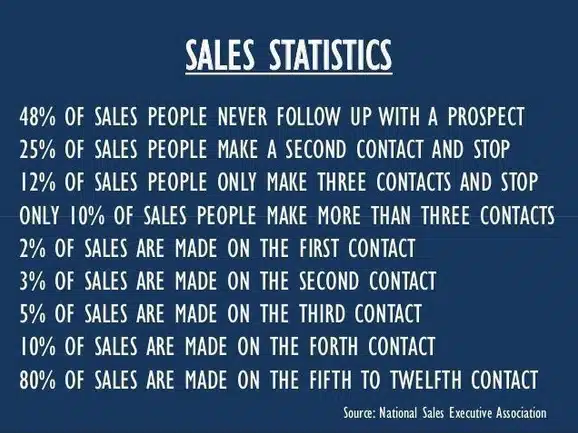
The aversion to follow-ups is largely emotional, driven by the fear of rejection or social awkwardness. However, hard data paints an undeniable picture of sales realities that completely invalidates this fear-based hesitation.
Industry sales metrics compiled across B2B outreach campaigns illustrate a dramatic distribution of where deals actually close:
- The 2% Rule: Roughly 2% of sales are made on the very first contact. For a freelancer sending 100 cold emails, this means accepting a 98% failure rate if they stop after one message.
- The 3% Milestones: Approximately 3% of sales close on the second contact.
- The 5% Threshold: Another 5% of deals are secured on the third contact.
- The 10% Zone: The fourth contact captures another 10% of closed deals.
- The Bulk of Success: An astonishing 80% of all sales are made between the fifth and twelfth contact.
[Sales Conversion Breakdown by Touchpoint]
Contact 1:  [2%]
Contact 2:  [3%]
Contact 3:  [5%]
Contact 4:  [10%]
Contacts 5-12: [80%]
When evaluated against these statistics, the freelancer who sends a single email and moves on is willingly walking away from up to 98% of potential revenue. The data proves that timing is rarely synchronized on the first attempt. A prospect may admire a writer’s portfolio on Monday, but if they do not have an active content budget or a pressing deadline until three months later, the initial email will be archived or ignored.
It is only through repeated, value-driven visibility that a freelancer remains top-of-mind when the precise moment of need finally arises.
Official Perspectives and Industry Insights: The Human Element
According to veteran entrepreneurs and online business educators, the debate over cold emailing usually boils down to quality versus persistence. The market is currently saturated with automated, poorly executed outreach efforts, which has created a widespread prejudice against cold emails.
The Scourge of Generic AI Spam
Industry leaders frequently voice frustration over the influx of generic, low-effort pitches that flood modern inboxes. Many of these messages are generated hastily by automated tools, featuring zero personalization and followed up by aggressive daily reminders that ignore basic professional courtesy.
This lazy approach is precisely why cold emailing has garnered an unfair reputation. When prospects receive automated, impersonal templates day after day, their instinct is to mark them as spam or write off the sender entirely.
The Power of the Micro-Personalized Opening
Conversely, professionals who practice mindful outreach report extraordinary response rates by focusing on a single principle: radical relevance. Personalization does not require spending an hour researching a prospect’s entire life history. According to experienced mentors, dedicating just one sentence at the beginning of an email to reference a specific article the prospect wrote, a recent company milestone, or a unique project instantly separates a human professional from a machine-generated bot.
The "Easy Out" Strategy
Another vital tactic endorsed by top-tier copywriters is the integration of an "easy out" in the closing lines of an outreach email. By removing high-pressure sales language and offering prospects a gracious exit strategy—such as acknowledging that if they aren’t currently looking for writers, they can simply ignore the message—the dynamic shifts. This non-intrusive approach psychological disarms the reader, lowering their guard and keeping the digital door open for future communication without creating friction.
Implications: Building a Sustainable Freelance Machine
The implications of adopting a rigorous, systematic follow-up strategy extend far beyond immediate cash flow. For a new freelance writer trying to hit their first $1,000 month, shifting outreach habits transforms the entire trajectory of their business.
1. Maximizing Return on Effort (ROD)
Researching a client, analyzing their blog, and crafting a tailored pitch takes time and cognitive energy. Stopping at a single email squanders that invested time. By implementing a multi-touch follow-up cadence, a freelancer multiplies the return on every single hour spent prospecting, effectively extracting 5x to 10x more value from the exact same initial workload.
2. Transitioning from Pest to Partner
There is a fine, yet distinct, line between persistence and spamming. Spam is unwanted, irrelevant, and ignores boundaries. Persistence, when paired with genuine value and polite timing, is often welcomed by busy executives. When a decision-maker suddenly finds themselves short-staffed or facing an unexpected content backlog, they rarely have time to scour Google for a new freelancer. They look in their inbox. The writer who has maintained a respectful, quarterly presence is the one who secures the contract.
3. Leveraging Automation and AI for Sanity
Tracking dozens—or hundreds—of ongoing conversations manually can quickly overwhelm even the most organized individual. Fortunately, modern freelancers have access to powerful tracking infrastructure:
- CRM-in-Inbox Tools: Platforms like Streak for Gmail transform standard email inboxes into lightweight CRM systems, allowing users to track open rates, set automated reminders, and schedule follow-up sequences effortlessly.
- AI-Assisted Project Management: Advanced language models like Claude or ChatGPT can serve as virtual marketing assistants. By maintaining a clean log of outreach dates, target names, and responses, writers can prompt AI assistants to generate weekly summaries, track conversion metrics, and draft personalized follow-up templates.
Conclusion: Don’t Let Your Effort Go to Waste
Building a freelance writing business requires grit, talent, and thick skin. You have already done the heavy lifting: honing your craft, curating your portfolio, identifying lucrative niches, and drafting thoughtful initial pitches.
Do not let that labor-intensive foundation go to waste simply because you hesitated to hit "send" a second, third, or fourth time. By committing to a structured, respectful follow-up cadence—and utilizing modern tracking tools to keep your pipeline organized—you position yourself not as an annoying solicitor, but as a persistent, professional partner ready to step in the exact moment your next big client needs you.
 Asep Darmawan
  Asro
Asro  Basiran