

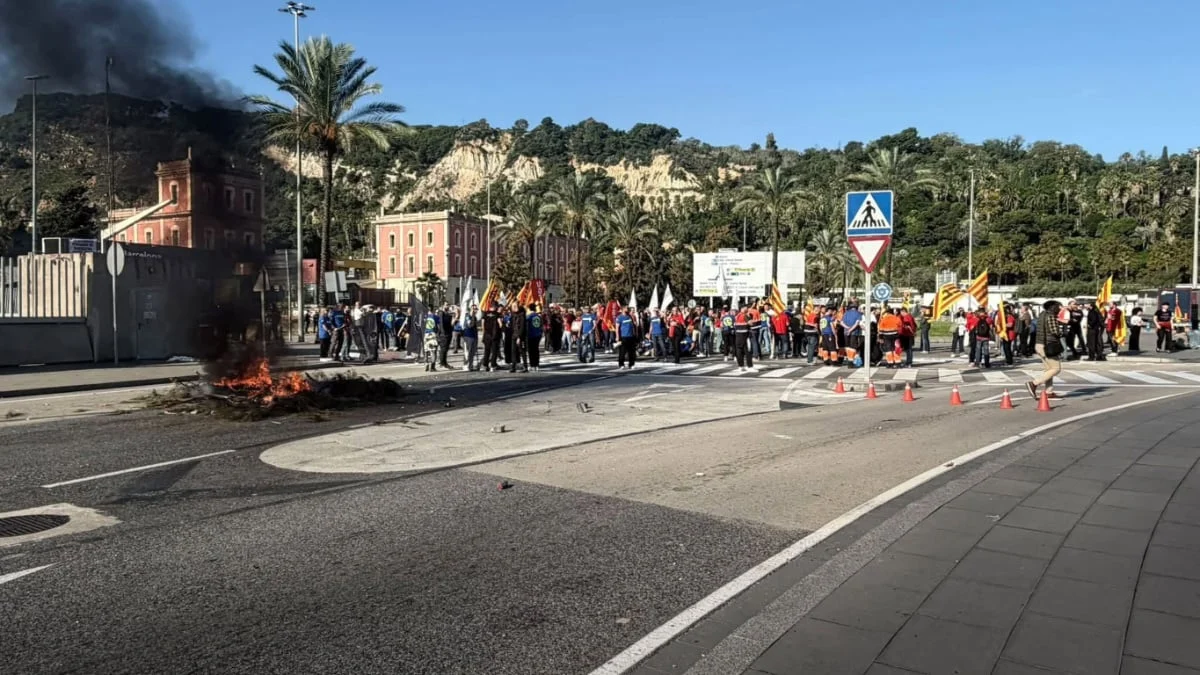
BARCELONA, SPAIN — Thousands of international travellers experienced a harrowing start or interruption to their dream holidays on Wednesday, October 28, 2026, after fierce port worker demonstrations and burning fire barricades completely blocked vehicular access to Barcelona’s bustling Moll Adossat cruise terminal.
The unexpected civil unrest caught thousands of tourists completely off guard, turning what should have been a seamless day of embarkation or sightseeing into a chaotic scramble. With transport links entirely severed by striking labourers, passengers were forced to undertake grueling, multi-mile treks on foot along industrial roadways just to reach their floating hotels or return from city excursions.
While no physical injuries or threats to the vessels were reported, the incident underscores the growing volatility of travel logistics in major European cruise hubs amid a wave of broader domestic labour disputes and political tensions sweeping across Spain.
Main Facts
The disruption unfolded early on the morning of Wednesday, October 28, when local port workers—aggrieved by a bitter financial bonus dispute that they argue violates existing collective bargaining agreements—escalated their grievances. Rather than targeting the tourism industry directly, the demonstrators focused their wrath on port infrastructure, utilizing flaming barricades and human chains to seal off the primary vehicular bridge leading into the Moll Adossat complex.
At the time of the blockade, four massive cruise ships were berthed at the port:
- Royal Caribbean’s Odyssey of the Seas
- TUI Cruises’ Mein Schiff 7
- AIDA Cruises’ AIDAmar
- Norwegian Cruise Line’s Norwegian Escape
Together, these vessels brought upwards of 13,000 guests into the Catalan capital. The blockade temporarily trapped thousands of tourists on both sides of the barrier. Passengers eager to explore the gothic quarters, architectural marvels, and culinary delights of Barcelona found themselves confined to their ships or stranded in the city centre. Conversely, new arrivals attempting to board their vessels faced terrifying moments of uncertainty, fearing they might miss their scheduled departures as traffic ground to a complete standstill.
Chronology of the Disruption
The morning unfolded as a rapidly escalating logistical nightmare for port authorities, cruise operators, and passengers alike.
- Early Morning (6:00 AM – 8:00 AM): Port workers assemble near the Moll Adossat access points. As the shift begins, the demonstration rapidly intensifies. Makeshift barriers are erected, and tires or debris are set ablaze, producing thick plumes of smoke and completely halting all bus, taxi, and private vehicle traffic entering or leaving the terminal.
- Morning Rush (8:30 AM – 11:30 AM): Thousands of cruise passengers attempting to disembark for pre-booked shore excursions are told by port personnel and security that no vehicles can pass. Social media footage soon captures long files of bewildered tourists hauling heavy luggage or wearing shore-excursion gear, choosing to hoof it along the industrial access roads. For those docked at the farthest berths, the trek stretches up to two miles each way under the Mediterranean sun.
- Midday (11:45 AM): Following negotiations and police intervention, the fiery barricades are cleared, and the roadway is slowly reopened to vehicular traffic. Disembarkation for trapped ships like Odyssey of the Seas resumes, and a backlog of taxis and coaches finally begins moving passengers toward the terminals.
- Afternoon: Despite the earlier chaos, traffic normalizes just in time. All four vessels safely manage their operations, clearing the port later in the day without any reported instances of passengers being left behind due to the blockade.
Supporting Data and Vessel Profiles
The simultaneous presence of four major international vessels magnified the impact of the blockade, creating a localized bottleneck involving an estimated 13,000 transient guests. Each ship was operating under distinct itineraries, ranging from standard Mediterranean loops to complex transatlantic repositioning voyages:
- Odyssey of the Seas (Royal Caribbean International): This mega-resort ship was navigating a 14-night transatlantic journey that departed Civitavecchia (Rome) on Sunday, October 25, bound for Cape Liberty, New Jersey. Guests onboard reported being delayed for hours before finally being permitted to step off the ship around noon. Notably, this is not the first time Odyssey of the Seas guests have encountered civil unrest this season; passengers on the ship’s previous sailing were issued stern safety warnings regarding similar protests in Naples, Italy.
- Mein Schiff 7 (TUI Cruises): Homeported out of Palma de Mallorca, this vessel was in the middle of a 7-night western Mediterranean itinerary that commenced on October 22.
- AIDAmar (AIDA Cruises): Like its fleetmate in regional cruising, the AIDAmar was also homeported in Palma de Mallorca, executing a 7-night voyage that kicked off on October 25.
- Norwegian Escape (Norwegian Cruise Line): The situation was arguably most stressful for guests boarding this vessel. The Norwegian Escape was utilizing Barcelona as its primary homeport on Wednesday, embarking on a 16-night transatlantic crossing to Port Canaveral, Florida. Crucially, this voyage marked the ship’s very first sailing following a comprehensive two-week dry dock overhaul in Marseille, France. Consequently, there were no debarking passengers; the terminal was inundated exclusively with anxious embarkation guests trying to get onboard.
Official Responses and Security Warnings
Local law enforcement agencies responded swiftly to clear the fire barricades and restore public order, though tensions remained palpable throughout the district.
Adding to the regional unease, the disruption coincided with heightened security protocols across Spain. Just weeks prior, the U.S. Embassy and Consulates in Spain and Andorra issued an expansive countrywide demonstration alert. The advisory warned American citizens and international expatriates to exercise extreme caution, avoid large gatherings, and anticipate widespread traffic disruptions, road closures, and potential escalations into violence leading up to Spain’s general elections scheduled for late November 2026.
The official guidance proved prescient, as flashpoint labor strikes and political demonstrations continue to materialize unpredictably across major Spanish metropolitan and industrial centers.
Passenger Reactions and Implications
Frustration at the Port Gates
For the thousands of tourists caught in the middle, the emotional toll ranged from mild annoyance to sheer panic.
“A protest by the port crew early this morning has blocked the bridge’s vehicular entrance to the cruise terminal, so no vehicles were allowed to go in or out,” recounted one disgruntled passenger aboard Odyssey of the Seas in a widely shared social media post. “We had to wait until the protest was over just before noon before disembarking the ship to go into town.”
For embarkation guests, the stakes felt significantly higher. “Barcelona, what a stressful situation! Our way to the port is blocked by protesters, and we’re just trying to get to our cruise ship!” wrote a distressed Norwegian Escape passenger on Facebook. “We came here to enjoy our trip, not to be stuck on the road worrying about missing our cruise.” While expressing theoretical sympathy for the workers’ right to strike, the passenger admitted the chaotic welcome made them eager to see Barcelona fade into the horizon.
The Broader Implications for the Cruise Industry
The Barcelona incident highlights a harsh reality of modern cruising: the strict liability of the passenger regarding port arrival times.
Major cruise lines maintain an unwavering policy that guests are entirely responsible for arranging their own timely transportation to the ship. If a passenger is delayed by traffic accidents, public transit failures, or civil unrest outside the cruise line’s direct control, the ship is under no contractual obligation to wait. While the October 28 protests dissolved just in time to prevent any missed boardings, the margin for error was razor-thin.
As European destinations grapple with ongoing economic pressures, inflation-driven wage disputes, and anti-tourism sentiments, cruise ports are increasingly vulnerable to sudden infrastructural blockades. For travelers, the takeaway is clear: navigating European port cities in an era of heightened social activism requires an extra layer of vigilance, flexible itineraries, and a willingness to lace up your walking shoes when unexpected disruptions bring vehicular traffic to a halt.
 Dwi Wanna
 Nana
 Ammar Sabilarrohman
