

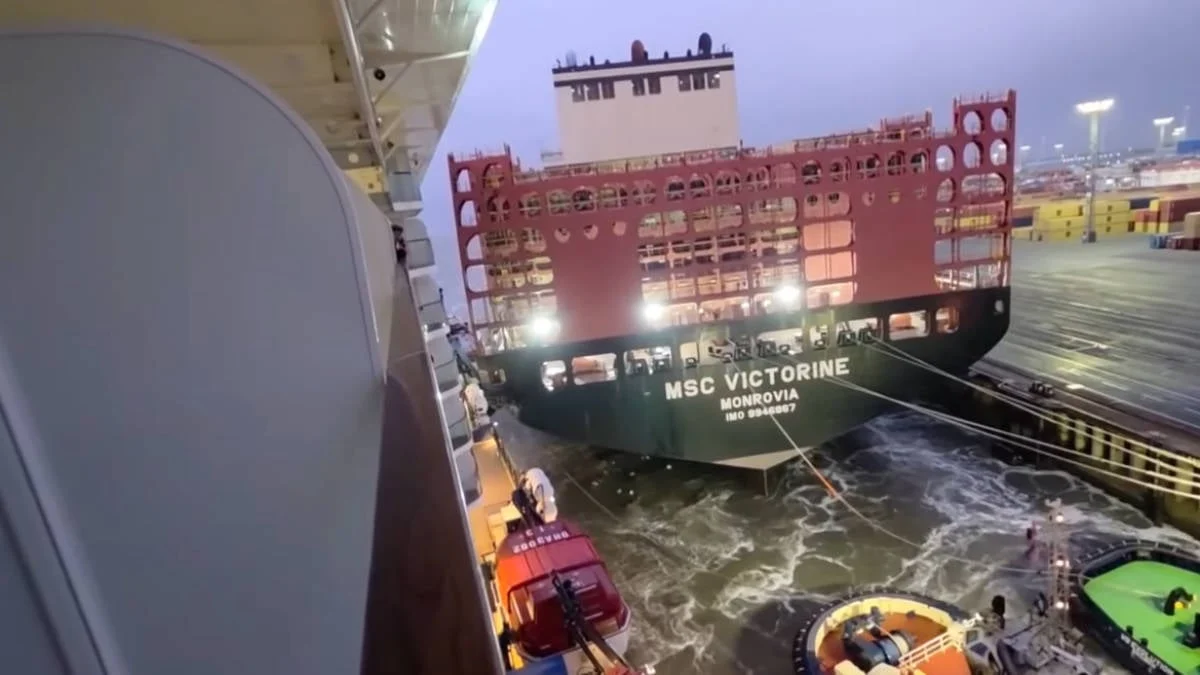
BREMERHAVEN, GERMANY — TUI Cruises has officially confirmed the cancellation of a highly anticipated 20-night Canary Islands itinerary following a dramatic maritime accident on Sunday, October 25, 2026. The cruise ship Mein Schiff 3, carrying thousands of passengers and crew, collided with two moored container ships while departing from the German port city of Bremerhaven.
The incident, which occurred just after 5:00 p.m., has left the nearly 100,000-gross-ton vessel with substantial structural damage—most notably to its lifeboats, davits, and hull—requiring immediate shipyard intervention. While maritime authorities and local police have launched formal investigations, no injuries have been reported among the thousands of people onboard at the time of the collision.
Main Facts: The Incident at a Glance
The collision involving the 99,526-gross-ton Mein Schiff 3 has sent shockwaves through the European cruise community. The sequence of events unfolded rapidly as the vessel attempted to leave its berth on a late October evening.
- Date and Time: Sunday, October 25, 2026, shortly after 5:00 p.m. local time.
- Location: Port of Bremerhaven, Germany.
- Vessels Involved: The cruise ship Mein Schiff 3 (operated by TUI Cruises) and two moored container ships, the MSC Anne F and the larger MSC Victorine.
- Persons Onboard: 2,428 guests and 922 crew members, totaling 3,350 people.
- Casualties: Zero injuries reported among passengers and crew across all involved vessels.
- Primary Damage: Mein Schiff 3 sustained significant damage to its port-side lifeboats, lifeboat cranes, and hull structure. The moored container ship MSC Victorine suffered severe structural tearing along its port side and damaged container guides, while the smaller MSC Anne F sustained minor superficial impacts.
- Operational Impact: Immediate cancellation of the current 20-night Canary Islands voyage. A formal sailing ban has been issued by maritime safety authorities for all three ships involved as investigations continue.
Chronology of Events: How the Accident Unfolded
Understanding how a modern mega-cruise ship came into contact with two stationary cargo vessels requires examining the weather conditions and the precise timeline of the departure procedure from Bremerhaven.
Departure and Sudden Weather Shifts
Late Sunday afternoon, Mein Schiff 3 completed its pre-departure safety checks, bringing hundreds of eager vacationers to the outer decks as the ship prepared to cast off lines. The vessel was scheduled to embark on an extensive 20-night voyage designed to take travelers through Portugal, multiple destinations across the Canary Islands, as well as port calls in Morocco and Spain before returning to Germany on Saturday, November 14.
As the ship maneuvered away from the dock, local weather conditions deteriorated rapidly. Unusually powerful, unannounced wind gusts swept across the Bremerhaven port basin. According to updates provided by the Wasserschutzpolizei (Water Police) of the Bremen Police Department, these severe gusts exerted immense lateral pressure against the massive superstructure of the cruise ship, turning the vessel into a massive sail.
The Double Collision
Overpowered by the wind forces, the bridge team faced critical drifting as the ship was underway. Despite the use of thrusters and tug assistance—details of which remain under review by investigators—Mein Schiff 3 drifted uncontrollably toward a section of the port where container vessels were securely moored.
Initially, early reports suggested the cruise ship had grazed a single cargo vessel. However, subsequent official assessments confirmed a more complex sequence: Mein Schiff 3 first made heavy contact with the smaller container ship, MSC Anne F, before sliding or being pushed into the larger container ship, MSC Victorine.
The impact point on the cruise ship’s port side struck the cargo vessels directly, tearing through external fixtures, safety equipment, and structural plating. Lifeboats on the port side of Mein Schiff 3 were crushed and torn apart during the impact, along with the mechanical cranes (davits) used to lower them in emergency scenarios.
Immediate Aftermath and Assessment
Port authorities, emergency responders, and maritime pilots rushed to stabilize the situation. Tugs maneuvered Mein Schiff 3 away from the cargo ships and guided the vessel back to a secure berth within the port.
Technical teams boarded the cruise ship immediately to conduct preliminary safety assessments. It quickly became evident that the damage sustained was far too severe to be patched up during temporary port stops or while at sea. The vessel was ordered to remain indefinitely in Bremerhaven pending full regulatory inspections.
Supporting Data and Technical Assessments
The physical toll of the collision has been meticulously detailed by port authorities, maritime safety boards, and police reports released in the days following the accident.
Structural Damage Breakdown
According to the Bremen Police Department’s Water Police division, the distribution of damage varied significantly across the three ships:
-
Mein Schiff 3 (TUI Cruises):
- Hull: Sustained scrapes and structural indentations along the port side where it struck the cargo ships.
- Life-Saving Appliances: Multiple port-side lifeboats were severely mangled, crushed, or entirely torn apart.
- Handling Equipment: The specialized cranes and davits required for lifeboat deployment were heavily damaged, rendering them entirely non-operational. Without a full complement of certified, functional lifeboats, the ship legally cannot carry paying passengers under international maritime law (SOLAS conventions).
-
MSC Victorine (Larger Container Ship):
- Hull and Structure: Suffered "considerable damage." The collision tore open several meters of the vessel’s port-side plating above the waterline.
- Cargo Equipment: Container guides on the ship were severely deformed, which will require extensive shipyard engineering work to realign before the vessel can resume cargo operations.
-
MSC Anne F (Smaller Container Ship):
- Structure: Sustained only minor, cosmetic damage from the initial brush with the cruise ship.
Regulatory Interventions and Stability Checks
Despite the frightening visuals of mangled lifeboats and torn steel, technical surveyors confirmed a vital piece of good news: all damage occurred strictly above the waterline. Consequently, there was no immediate risk of flooding, compromised watertight integrity, or environmental fuel spills on any of the three vessels.
Nevertheless, the Dienststelle Schiffssicherheit (the German maritime safety authority) stepped in immediately, issuing a strict administrative sailing ban on Mein Schiff 3, MSC Victorine, and MSC Anne F. This ban ensures that none of the ships can move from their current berths until certified safe by independent naval architects and marine surveyors.
Official Responses and Guest Communications
Managing the expectations and logistical nightmare for over 2,400 displaced passengers became TUI Cruises’ immediate priority in the hours following the collision.
TUI Cruises’ Official Statement
In a formal statement released to maritime media and directly to booked guests, TUI Cruises expressed profound regret while emphasizing that safety protocols remain absolute:
"We can confirm that, as the Mein Schiff 3 was leaving Bremerhaven in the late afternoon of 25 October, a collision occurred with two container ships. The safety of our guests and crew is our top priority. We are therefore very relieved that, according to current information, no one has been injured."
Addressing the cancellation of the voyage, the cruise line elaborated:
"In light of this, we have decided to cancel the planned cruise to the Canary Islands. This decision has been extremely difficult for us to make. We know how much our guests were looking forward to this cruise and deeply regret the inconvenience this causes. At the same time, we are convinced that this is the only responsible decision to ensure our high safety standards are maintained."
Impact on Future Itineraries
Because Mein Schiff 3 remains docked in Bremerhaven under a regulatory sailing ban, TUI Cruises has had to adopt a cautious stance regarding subsequent voyages scheduled for late November and December.
In a customer advisory posted to the company’s official website, management stated:
"Based on this, we will determine whether—and to what extent—subsequent voyages may be affected. As soon as we can reliably assess any potential impact on future sailings, we will proactively inform all booked guests."
Affected passengers have been offered standard industry compensation packages, including full refunds for the canceled cruise fare, reimbursement or rebooking assistance for travel arrangements, and future cruise credits to mitigate the disruption to their holiday plans.
Implications: Legal, Financial, and Operational Fallout
A collision of this magnitude involving a major cruise vessel and commercial cargo ships triggers a complex web of legal, financial, and regulatory consequences that will take months—if not years—to untangle.
The Investigation into the Ship’s Master
According to reports from German news outlet t-online, the Bremen Police Department has officially opened an investigative procedure involving the captain of Mein Schiff 3. German legal authorities routinely initiate such investigations following maritime accidents to determine whether the vessel’s master fulfilled their strict legal duty of care (Sorgfaltspflicht) while navigating out of the port.
Legal experts note that this is standard procedure under German maritime law rather than an immediate assumption of guilt. The inquiry will scrutinize bridge voice recordings, voyage data recorder (VDR) logs, radar tracking, pilot communications, and local weather station reports to ascertain whether human error, mechanical failure, or extraordinary environmental factors were the primary root causes. If negligence is formally proven, the captain could face administrative fines or legal penalties, though many maritime analysts point out that sudden, localized wind shear events in constricted port basins can sometimes overpower even the most experienced navigation teams.
Financial Liabilities and Insurance Claims
The financial ramifications for TUI Cruises and Mediterranean Shipping Company (MSC), the operators of the container ships, will be substantial.
- Dry-Dock Costs: Mein Schiff 3 must be transferred to a specialized shipyard for heavy structural repairs, resulting in weeks of lost operational revenue while the ship sits idle.
- Cargo Vessel Repairs: The heavy structural tearing on the MSC Victorine requires certified marine engineering repairs, likely involving dock time and offloading of containers.
- Passenger Compensation: TUI Cruises faces significant financial payouts in refunds, administrative overhead, and goodwill compensation for the 2,428 guests whose vacations were abruptly cut short.
Insurance underwriters from all involved parties will spend the coming months parsing liability based on the findings of the Dienststelle Schiffssicherheit and police reports. Questions surrounding harbor pilot actions, tugboat deployment, and weather forecasting will heavily influence how financial responsibility is apportioned.
Broader Safety and Operational Takeaways
For the wider cruise industry, the Bremerhaven incident serves as a stark reminder of the vulnerabilities large vessels face when encountering sudden micro-weather phenomena in narrow channels. As cruise ships continue to grow in physical volume and windage area, port maneuvering operations demand increasingly sophisticated predictive weather modeling and rigorous tugboat protocols.
For now, the focus in Bremerhaven remains on forensic investigations, safety certifications, and the meticulous restoration of Mein Schiff 3. Passengers who dreamed of sun-drenched beaches in the Canary Islands must settle for refunds and memories of a voyage that ended before it truly began, while the maritime world watches closely to see what lessons emerge from this unusual autumn collision in northern Germany.
 Evan Lee Salim
 Suro Senen
