

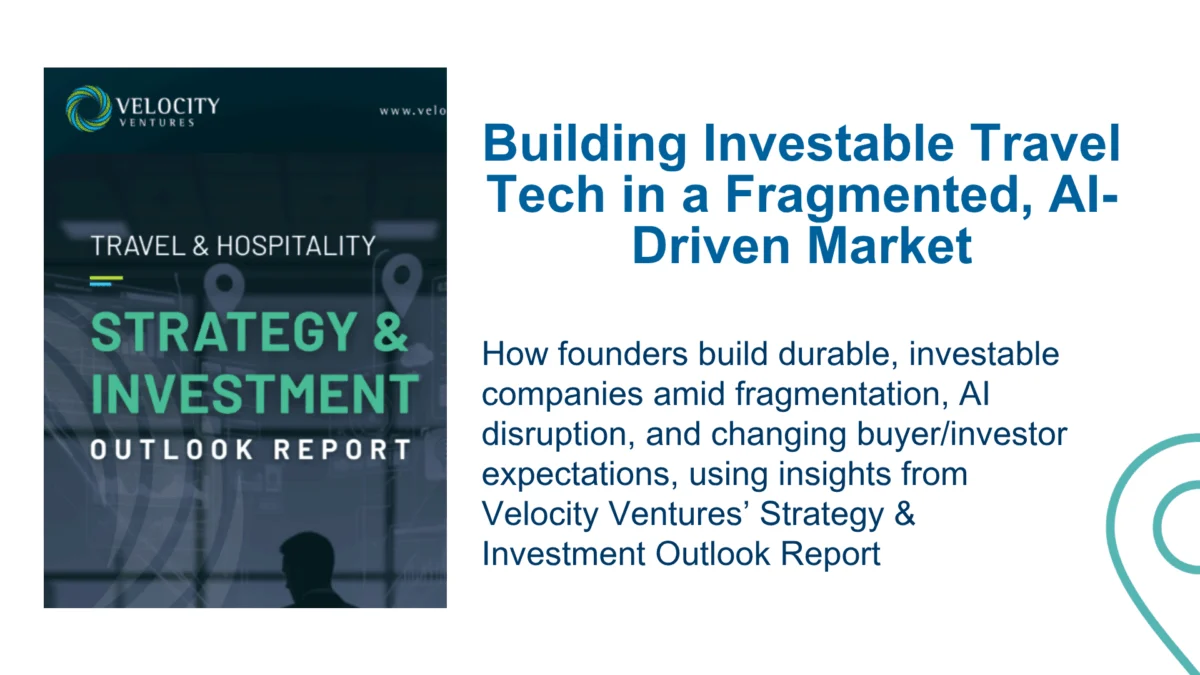
Washington, D.C. — August 25, 2026 — In an era defined by rapid technological acceleration and shifting geopolitical landscapes, the travel industry stands at a pivotal crossroads. This week, the Travel Tech Association (Travel Tech), the primary advocacy voice for the global travel technology ecosystem, convened its August Start-Up Member Monthly Meet-Up to address these challenges head-on. The session featured Nicholas Cocks, Partner at Velocity Ventures, who provided a masterclass on building durable, investable companies in a market defined by fragmentation and the pervasive influence of artificial intelligence.
The event, titled “Building Investable Travel Tech in a Fragmented, AI-Driven Market,” served as a critical touchpoint for early-stage founders looking to bridge the gap between innovation and commercial viability. Drawing directly from the insights published in Velocity Ventures’ 2H 2026 Strategy & Investment Outlook Report, the discussion moved beyond theory to offer a granular look at how capital allocators are currently vetting the next generation of travel platforms.
The Core Challenge: Resilience in a Volatile Ecosystem
For the modern travel entrepreneur, the environment is increasingly complex. Founders are no longer just competing on product-market fit; they are navigating a world where AI is disrupting traditional distribution channels, geopolitical tensions are complicating cross-border logistics, and traveler expectations are evolving at a breakneck pace.
During the session, Nicholas Cocks emphasized that the "growth-at-all-costs" era has definitively ended. In its place, investors are prioritizing "durability"—a term that encompasses not just a startup’s burn rate, but its ability to maintain a competitive moat in an age where AI can replicate basic features overnight.
“Building a travel tech company today requires a dual focus,” Cocks noted during the fireside chat. “You must solve a genuine, high-friction pain point for the traveler or the enterprise, while simultaneously building a data architecture that is defensible against the commoditization brought on by generative AI.”
Chronology of the August 2026 Strategy Session
The August meet-up was designed to provide actionable intelligence rather than high-level platitudes. The structure of the event unfolded as follows:
- 10:00 AM – The State of the Market: Cocks provided an overview of the 2H 2026 Strategy & Investment Outlook Report. He highlighted the cooling of speculative venture capital and the resurgence of "smart money"—investors who prioritize technical depth and operational efficiency.
- 10:30 AM – The AI Paradox: The discussion turned to artificial intelligence. While AI lowers the barrier to entry, it also raises the bar for success. Cocks argued that AI should be used to automate complex decision-making, not just to wrap a user-friendly interface around legacy databases.
- 11:00 AM – Founder Q&A: A curated selection of pre-submitted questions from Travel Tech members addressed specific concerns, such as how to secure Series A funding when the "travel tech" label is crowded with AI-enabled wrappers.
- 11:45 AM – Networking and Community Building: The event concluded with breakout sessions, facilitating connections between emerging founders and seasoned industry mentors—a hallmark of Travel Tech’s commitment to fostering a collaborative, rather than purely competitive, environment.
Supporting Data: The 2H 2026 Outlook
The 2H 2026 Strategy & Investment Outlook Report provided the analytical backbone for the session. Several key metrics and trends identified in the report are currently dictating the flow of capital into the travel sector:
1. The Fragmentation Index
The report identifies that the travel industry has become increasingly "siloed." While this fragmentation creates inefficiency, it also presents a massive opportunity for startups that can act as the "connective tissue" between legacy systems, fragmented booking APIs, and localized regulatory requirements. Investors are currently seeking companies that act as middleware to solve these interoperability gaps.
2. AI-Driven Efficiency
According to the report, 68% of new venture deals in travel tech for the second half of 2026 involve a core AI component. However, the report cautions that the "AI-wrapper" phase is over. Companies that simply utilize Large Language Models (LLMs) without proprietary datasets or unique workflow integration are seeing significantly lower valuation multiples than those that are building vertical-specific AI agents.
3. Geopolitical Risk Premiums
With travel patterns shifting due to regional instability, the report highlights a growing demand for travel tech solutions that offer robust risk management and real-time re-routing capabilities. Start-ups that offer "resilience-as-a-service" are currently attracting 25% more interest from institutional investors compared to consumer-facing booking platforms.
Official Responses and Industry Sentiment
The feedback from the event highlighted the hunger for institutional-grade advice within the startup community. Bethany Reitsma, Senior Manager of Industry Relations at Travel Tech, emphasized the vital role of these sessions in the broader ecosystem.
“Nicholas gave our start-up members a practical investor perspective on building durable companies in today’s travel technology market,” said Reitsma. “Discussions like this strengthen our start-up community by giving founders direct access to insights and relationships that can help them grow. When you bring together the brightest minds in tech with the capital allocators who understand the nuances of the travel sector, you create a ripple effect that benefits the entire industry.”
The sentiment among the attendees was one of cautious optimism. Many founders reported that the session helped them pivot their pitch decks to emphasize "operational durability" over "user acquisition numbers," a shift that many noted was necessary given the current cost of capital.
Implications for the Future of Travel
The implications of this discussion are far-reaching. As the industry moves toward 2027, the barrier to entry for travel tech will likely remain low, but the barrier to scaling will reach record highs.
The Death of the "Generalist" Platform
The era of the "everything app" in travel is facing immense pressure from specialized AI agents. Investors are increasingly betting on startups that own a specific niche—whether it is corporate travel expense management, sustainable aviation fuel tracking, or hyper-personalized hyper-local itinerary planning.
The Rise of Data Moats
As LLMs become commoditized, the real value in travel tech will shift toward the "proprietary data moat." Startups that are successfully capturing high-intent, real-time data from users will find themselves in a strong position for acquisition by larger enterprise players who lack the agility to innovate in-house.
A New Era of Collaboration
Finally, the event underscored the importance of the Travel Tech Association’s advocacy efforts. By connecting founders with policy experts and industry leaders, the association is ensuring that as the industry adopts AI and new digital tools, it does so within a framework that encourages competition and protects the consumer.
Building What’s Next: A Call to Action
The journey of a travel tech startup is rarely a straight line. From navigating the complexities of GDS integration to meeting the ethical standards of AI deployment, the challenges are significant. However, for those who can navigate the "fragmented market" described by Velocity Ventures, the opportunities for disruption are unparalleled.
Through its Start-Up Membership Program, the Travel Tech Association continues to provide the scaffolding upon which the future of travel is being built. Whether it is through monthly meet-ups, quarterly investor connects, or high-level summits, the organization acts as a critical force-multiplier for founders.
Are you building the future of travel? The path to success is often difficult to navigate alone. By joining the Travel Tech ecosystem, founders gain access to the industry’s most vital network of peers, regulators, and investors.
For more information on how to join the Travel Tech Start-Up Membership Program, visit traveltech.org/start-up.
About the Travel Tech Association
The Travel Tech Association (Travel Tech) is the unified voice for the travel technology ecosystem. We bring together enterprise leaders, growth-stage companies, and emerging innovators to advance public policies that support competition, innovation, and a strong technology-enabled travel marketplace. Through advocacy, regulatory intelligence, and cross-sector collaboration, Travel Tech helps shape the future of modern travel.
To schedule an interview with a Travel Tech spokesperson, please contact Jessica Matthias at [email protected].
 Nana Muazin
  Asro
Asro  Reynand Wu